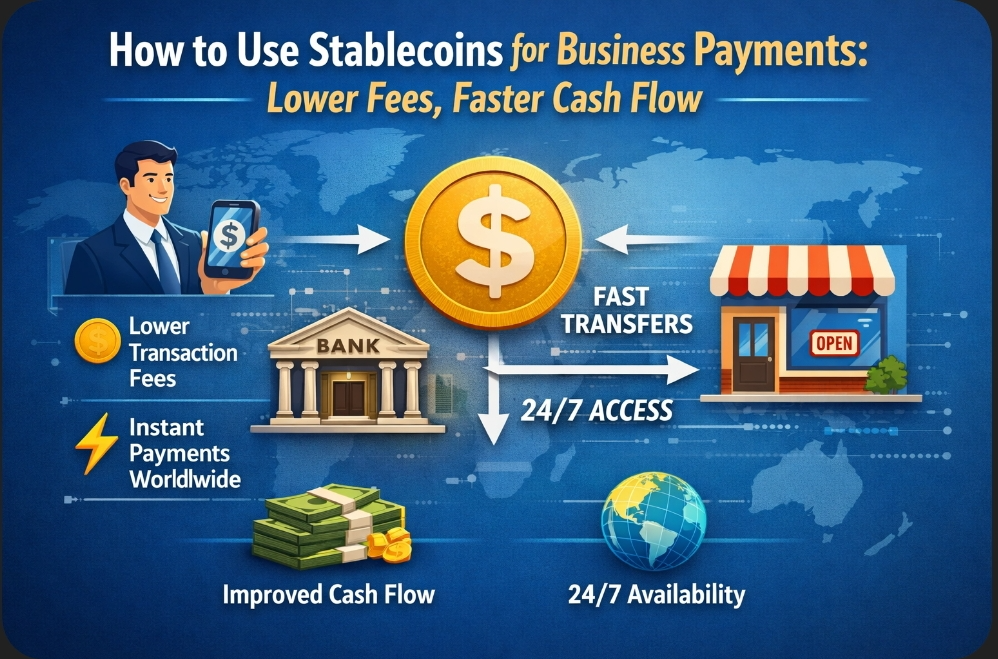
If you've been watching stablecoins from the sidelines, waiting for them to "mature," the moment has arrived. Businesses and freelancers around the world are using USDC, USDT, and other dollar-pegged tokens to pay suppliers, receive client payments, and hold working capital, without touching a bank account or waiting three business days for a wire to clear. This isn't a crypto experiment anymore. It's a practical financial infrastructure that works currently, and this guide walks you through exactly how to put it to work.
What Are Stablecoins And Why They're Different From Bitcoin
Stablecoins are cryptocurrencies designed to hold a fixed value, typically pegged 1:1 to the US dollar. Unlike Bitcoin or Ethereum, their price doesn't move with the market. One USDC is worth one dollar today. One USDC next Tuesday is also worth one dollar.
The most widely used stablecoins right now are:
They live on blockchains, which means transactions are fast, borderless, and don't require a correspondent bank to approve them.
The Real Cost of Traditional Payment Rails
Before getting deeper, it's worth understanding what you're currently paying for. A standard international wire transfer costs between $25 and $50 per transaction on your end, plus a receiving fee on the other side, plus a spread on the exchange rate if currencies are involved. ACH transfers are cheaper domestically but take 1 to 3 days to settle and aren't available internationally. Payment processors like Stripe or PayPal charge 2.9% plus a fixed fee per transaction, which can add up fast when you're running high volume.
Stablecoin transfers on a network like Solana or Polygon cost fractions of a cent and settle in seconds. On Ethereum's base layer, fees are higher but still often cheaper than a wire once you factor in exchange rates and delays.
How to Use Stablecoins for Cash Flow Management
Here's where it gets practical. There are a few distinct use cases worth separating.
If you have team members or suppliers in other countries, stablecoins solve a real problem. Instead of sending a wire that takes days and costs $40 each way, you send USDC directly to their wallet. They receive it in under a minute. They can convert it to local currency through a local exchange or hold it as a dollar-denominated asset.
Many freelancers in countries with volatile local currencies prefer to be paid in USDC because it lets them maintain stable value without a US bank account.
If your business operates in multiple currencies but you want dollar exposure, holding USDC is cleaner than converting to USD and back—no forex spread, no minimum balance requirements, no bank bureaucracy. You're just holding a tokenized dollar.
Some clients, especially in crypto-adjacent industries, are already set up to pay in stablecoins. Even in traditional industries, offering a stablecoin payment option signals that you understand modern finance and can eliminate intermediary fees on both sides. For invoices, tools like Request Finance and Coinbase Commerce let you generate professional invoices payable in USDC or USDT, with automatic conversion to fiat if you want it.
Keeping Your Stablecoins Secure
This is the part most guides skip over, and it's where people make costly mistakes. If you're holding any meaningful amount of stablecoins for cash flow purposes, keeping them on an exchange is not a treasury strategy. Exchanges get hacked, freeze withdrawals, and go bankrupt. Ask anyone who had funds on FTX.
The right move is to keep operational balances in a self-custodied wallet. For serious amounts, a hardware wallet is the standard. Tangem is one of the cleanest options on the market right now. It's a card-shaped hardware wallet with no seed phrase to write down or lose, uses chip-based security, and connects to your phone via NFC. It's simple enough that you don't need to be technical to use it safely, which matters when your whole team might need access to a business wallet. Keep what you need for immediate payments in a hot wallet, and hold reserves in your Tangem or similar hardware device.
What About Taxes and Accounting?
It is a legitimate concern. In most jurisdictions, including the US and the EU, converting stablecoins to fiat is a taxable event (though the gain is usually minimal given the 1:1 peg). Sending stablecoins as payment to a contractor generally counts as spending crypto, which may also trigger reporting requirements.
The practical solution is to use accounting software that integrates with crypto. Tools like Koinly, Cryptio, or Request Finance can track your on-chain transactions and export reports that your accountant can actually use. The accounting overhead is real, but manageable, and for most businesses it's far less painful than the cost of slow, expensive wire transfers.
Getting Started Without Overcomplicating It
You don't need to overhaul your entire payment process on day one. Here's a simple way to start:
That's it. Most businesses that start with a single test payment expand their workflow within a month because the speed and cost differences are immediately obvious.
Frequently Asked Questions
Is it legal to pay employees or contractors in stablecoins?
In most countries, yes, with conditions. In the US, you can pay contractors in stablecoins, but W-2 employees generally must be paid in USD for the minimum wage component. Always check local labor laws, but for international contractors, there are very few restrictions.
What happens if USDC or USDT loses its peg?
Both have briefly depegged in the past (USDC dropped to $0.87 during the Silicon Valley Bank collapse in March 2023, then recovered within days). For short-term cash flow use, this risk is relatively low. If you're holding significant reserves long-term, diversifying across USDC and USDT reduces single-issuer risk.
Do I need a crypto exchange account to receive stablecoins?
No. You just need a wallet address. A free software wallet like MetaMask or Coinbase Wallet gives you an address immediately. You only need an exchange if you want to convert stablecoins back to fiat currency.
Can I use stablecoins for B2B payments if my counterparty doesn't know crypto?
Yes, and this is more common than you'd think. Tools like Request Finance handle the crypto layer in the background and let your counterparty receive fiat while you send stablecoins. The friction is lower than it used to be.