The world of digital manufacturing is moving toward a stage where physical and digital boundaries are becoming less visible. What once required complex manual processes is now being simplified through intelligent scanning and printing systems. At the center of this transformation is the evolving relationship between 3d printer scanner technology and modern handheld 3d scanner tools.
This connection is not just about improving speed or convenience. It is about creating a seamless bridge between real-world objects and their digital replicas. As industries demand higher accuracy and faster workflows, the integration between scanning and printing technologies is becoming more important than ever.
Another major shift is the way users now expect flexibility in their workflow. Instead of relying on large, stationary systems, professionals are moving toward portable solutions that allow them to capture and process data anywhere. This is where handheld scanning devices are playing a critical role in reshaping the entire ecosystem.
The concept of a 3d printer scanner has evolved significantly over time. Earlier systems were limited, often requiring manual input and complex modeling before any physical printing could take place. These traditional workflows were time-consuming and required a high level of technical expertise.
Modern systems, however, are becoming more integrated and intelligent. Instead of treating scanning and printing as separate processes, they are now part of a unified workflow. This integration allows users to move smoothly from physical object capture to digital modeling and finally to 3D printing without unnecessary interruptions.
This evolution has opened new possibilities for industries such as engineering, healthcare, product design, and manufacturing.
The rise of the handheld 3d scanner has been one of the most important advancements in this field. Unlike traditional stationary scanners, handheld devices offer mobility, flexibility, and real-time control.
Users can move freely around an object while capturing detailed geometry from multiple angles. This makes the scanning process more natural and adaptable to real-world environments. It also reduces the need for controlled studio setups, making scanning more accessible.
These devices are especially useful in fieldwork, where objects cannot be moved easily. By bringing the scanner to the object instead of the other way around, workflows become more efficient and practical.
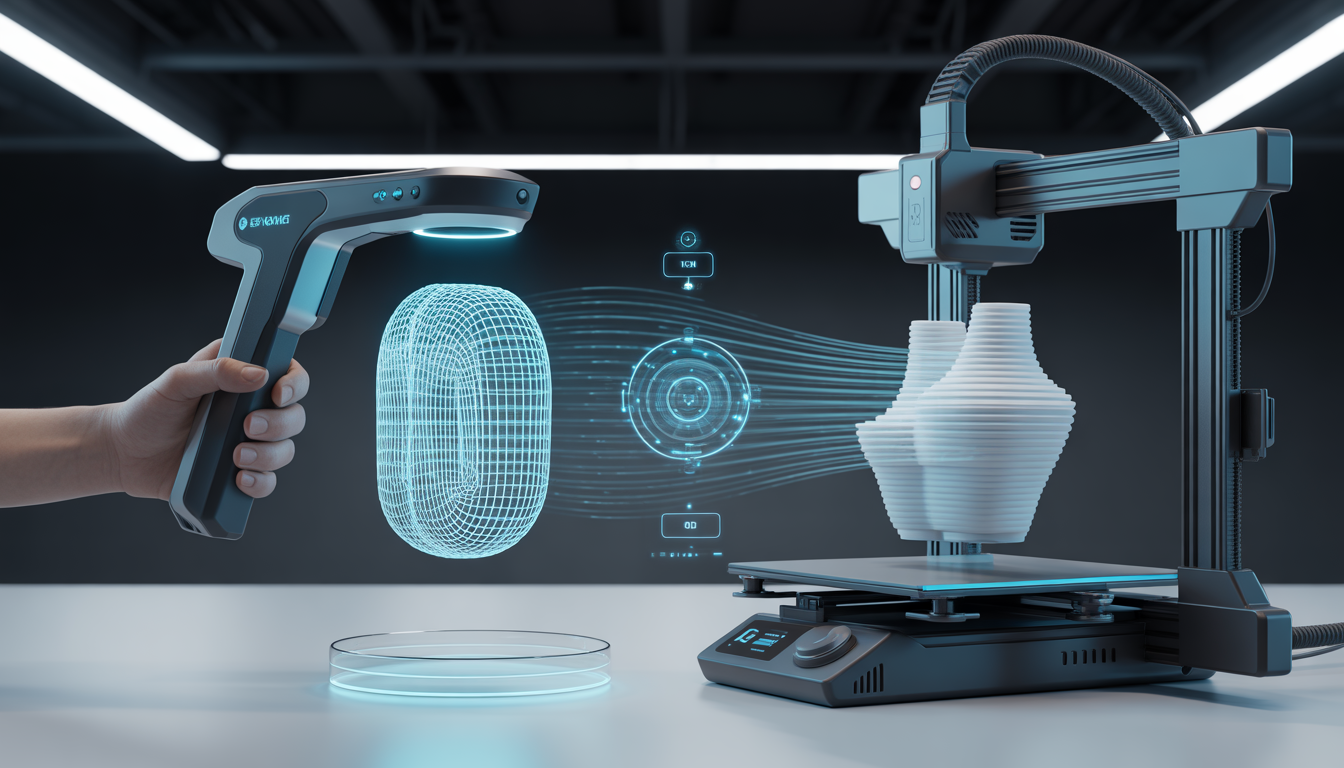
One of the most powerful developments in modern 3D technology is the creation of a seamless workflow between scanning and printing. The combination of 3d printer scanner systems and handheld 3d scanner tools allows users to move from physical reality to digital models with minimal effort.
This workflow typically involves capturing an object using a handheld scanner, processing the data into a digital model, refining it if needed, and then sending it directly to a 3D printer. The entire process is now faster, more accurate, and more user-friendly than ever before.
This seamless connection reduces manual steps and helps eliminate errors that often occur in traditional modeling processes.
Accuracy plays a central role in the success of any scanning and printing system. Without precise data capture, the final printed object may not match the original design or structure.
The handheld 3d scanner contributes significantly to this accuracy by capturing fine details and complex geometries with high precision. This ensures that the digital model remains as close to the real object as possible.
When combined with advanced 3d printer scanner systems, this level of accuracy becomes even more powerful, resulting in high-quality printed outputs that meet professional standards.
In the past, scanning and printing were treated as separate stages of a workflow. Today, integration has become essential. Users expect systems that can communicate seamlessly and reduce unnecessary steps.
The connection between 3d printer scanner innovation and handheld 3d scanner technology is a perfect example of this integration. It allows data to move smoothly from capture to output without losing quality or detail.
This integration is not just a technical improvement; it is a fundamental shift in how digital manufacturing is approached.
The combined use of scanning and printing technologies is being adopted across multiple industries. In engineering, it supports reverse engineering and prototyping. In healthcare, it helps create custom prosthetics and anatomical models. In education, it provides interactive learning tools.
The flexibility of the handheld 3d scanner makes it especially valuable in these fields, while the 3d printer scanner completes the process by turning digital models into physical objects.
This combination is expanding the possibilities of what can be created and reproduced in both professional and creative environments.
One of the most noticeable trends in this industry is the move toward portability. Users no longer want to rely on large, fixed systems. Instead, they prefer compact and mobile tools that can be used in different environments.
The handheld 3d scanner is a direct response to this demand. It allows professionals to work in real-world conditions without sacrificing accuracy or detail.
When paired with modern 3d printer scanner systems, this portability creates a highly flexible workflow that can adapt to different project requirements.
The future of digital manufacturing is likely to be defined by even deeper integration between scanning and printing technologies. Artificial intelligence, automation, and real-time processing will play a major role in this evolution.
We can expect handheld 3d scanner devices to become even more intelligent, with improved accuracy and faster processing capabilities. At the same time, 3d printer scanner systems will continue to evolve toward fully automated workflows.
This will lead to a future where physical objects can be captured, modified, and reproduced with minimal human intervention.
The relationship between 3d printer scanner innovation and handheld 3d scanner technology is transforming the way digital and physical worlds interact. What was once a complex and fragmented process is now becoming a seamless, integrated workflow.
This transformation is not just improving efficiency; it is redefining how objects are designed, analyzed, and reproduced. As technology continues to advance, this bridge between scanning and printing will become even stronger, opening new possibilities for industries and creators alike.
In the long run, this integration represents a major step toward a more connected, precise, and accessible future in digital manufacturing.