As a business starts to expand, the figures start to pop up in all directions. There’s sales reports, invoices, bank statements, expense receipts. In the beginning, everything appears to be under control. The cash is received, the bills are paid, and the processes continue. However, at some point, most business owners reach a crossroad where earnings are good but cash is constrained. Costs are higher than anticipated, and profitability is eroding.
This is a very widespread state of affairs. The cause of making wrong decisions in most instances lies in a lack of understanding of the distinction between bookkeeping and accounting. These two functions are interdependent, but they are used differently in a business. One is concerned with structuring financial information, and the other with transforming it into valuable knowledge.
To see how they interact, consider the example of Vertex Solutions, a small digital services company specializing in marketing and technology-related support for businesses.
At the time Vertex Solutions began, its activities were not very complicated. Its client base was small. These included issuing invoices, paying freelancers, and covering routine business expenses such as software subscriptions and utilities.
Record-keeping at this stage ensures that all transactions are accurately recorded, so the business knows what is actually happening to its money.
This is where bookkeeping comes in.
The bookkeeping process involves recording, organizing, and classifying financial transactions. It ensures that all payments and expenses are properly recorded. In the case of Vertex Solutions, it would entail tracking client revenues by invoice, payments to contractors, recording operating costs, and regularly reconciling bank accounts.
Financial records easily get out of order without adequate bookkeeping. Invoices could be lost, costs could go unaccounted for, and bank accounts could be hard to balance. In the long term, the result of such a lack of structure is confusion, tax hassles, and poor quality financial reporting.
Proper bookkeeping brings about sanity in financial information. It also ensures that the business does not have any loose paperwork, adheres to legal requirements, and maintains credible financial records where necessary. It also enables owners to understand how they are spending their money and whether their operations are safe.
The most basic financial question answered at this phase of the company’s development is bookkeeping.
Where did the money go?
The company maintains a sound financial history by keeping records of its transactions. This data is later used to provide further financial penetration.
It is not sufficient to record transactions. The management should make sense out of the numbers. And this is where accounting comes in.
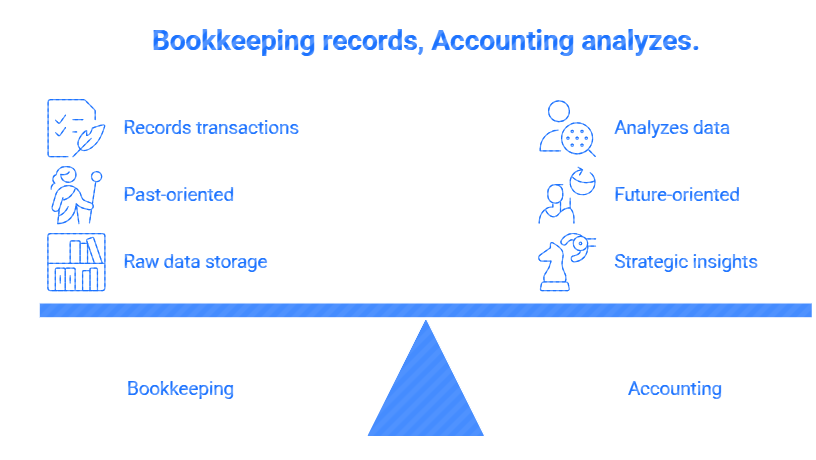
Accounting is the process of using financial information captured in bookkeeping to analyze, interpret, and summarize it to aid strategic decision-making. Accounting considers the larger picture rather than individual transactions.
An accountant at Vertex Solutions will begin preparing the structured financial reports, i.e., the income statements, balance sheets, and cash flow statements. These reports show the company’s financial performance.
As an illustration, an accounting analysis can show that despite increasing revenue, profit margins are declining because operational costs are rising. Alternatively, it may indicate that some service packages generate much greater profit than others.
The information enables business owners to make decisions on pricing, staffing, and expansion.
Accounting thus answers deeper questions like:
Whereas bookkeeping provides an accurate record of what has already transpired, accounting uses those records to measure performance and make future decisions.
For instance, the sales rate Vertex Solutions identifies during one of the quarterly reviews indicates that revenue has grown by almost 30% compared to last year. On the surface, this is great news. Nevertheless, the analysis of accounting is something surprising.
The rate of growth in the cost of operations has been nearly the same as that of revenue. Software expenses, fees paid to contractors, and even marketing expenses have increased sharply. Consequently, it has had minimal effect on the company’s profit margin despite high sales.
In the absence of accounting analysis, this problem may be masked by spectacular revenue numbers.
The leadership team can make informed decisions and determine the optimal way to adjust its pricing model, reduce operational expenses, and improve resource allocation with clear financial insights. These will go a long way in enhancing profitability over the subsequent months.
This case shows that accounting turns financial records into known action.
Financial planning is increasingly significant as companies grow. Budgeting and forecasting help the company analyze opportunities. Using historical financial data, accountants can project future revenue and expense trends and determine whether the business will be in a position to cover additional costs.
To illustrate, the professional accounting services may analyze, for a CPG company, product-level margins and identify that one product line generates significantly lower profitability due to rising fulfillment and shipping costs. With this insight, management can decide whether to adjust pricing, renegotiate supplier terms, or discontinue the product to protect overall margins.
Such proactive analysis helps business owners make informed decisions using financial evidence rather than guessing.
Compliance with regulations and financial transparency are other spheres of accounting that are of great importance. The financial statements are maintained in accordance with professional accounting standards, and tax calculations are performed in accordance with the required standards. This reduces the risk of legal claims related to compliance and helps the company avoid hefty fines.
The company will also be more credible by having proper financial reporting. Stakeholders rely on prepared financial statements to assess the organization’s stability and expansion when it requires financing, cooperation, and investment.
It is impossible to make such reports as reliable as they would need to be in the eyes of external decision-makers without accounting oversight.
The roles of bookkeeping and accounting are different in a business, though they are closely related.
The bookkeeping aspect involves maintaining accurate financial records. It is used to ensure that all transactions are captured, categorized, and structured in a system.
Accounting is a discipline that deals with the analysis and interpretation of financial information. It applies recorded information to measuring performance, managing risk, and making strategic decisions.
To explain it simply, bookkeeping is the record-keeping of numbers, and accounting is the interpretation of their meaning.
These are both critical functions. Financial information would be incomplete or unreliable without bookkeeping. In the absence of accounting, such data would be unanalyzed, hindering smart business decisions.
Accounting provides the strategic insight that long-term planning relies on, whereas bookkeeping provides financial accuracy.
Accounting and bookkeeping are the same at first glance, since both deal with financial data. They, however, carry varying responsibilities in business success.
Bookkeeping is the foundation of financial accuracy, as it documents all transactions and maintains systematic records.To save time and reduce errors, many businesses rely on outsource bookkeeping services for consistent and professional record management.
Accounting is based on that and analyzes financial performance and makes strategic decisions. It processes raw data into valuable insights that help companies control risk, enhance profitability, and strategize for future development.
When a business has proper records, it gets a clear picture of its finances. When a business analyzes such records, it finds direction.
When bookkeeping and accounting cooperate, companies can act with precision and strategy, which are key factors for long-term success.