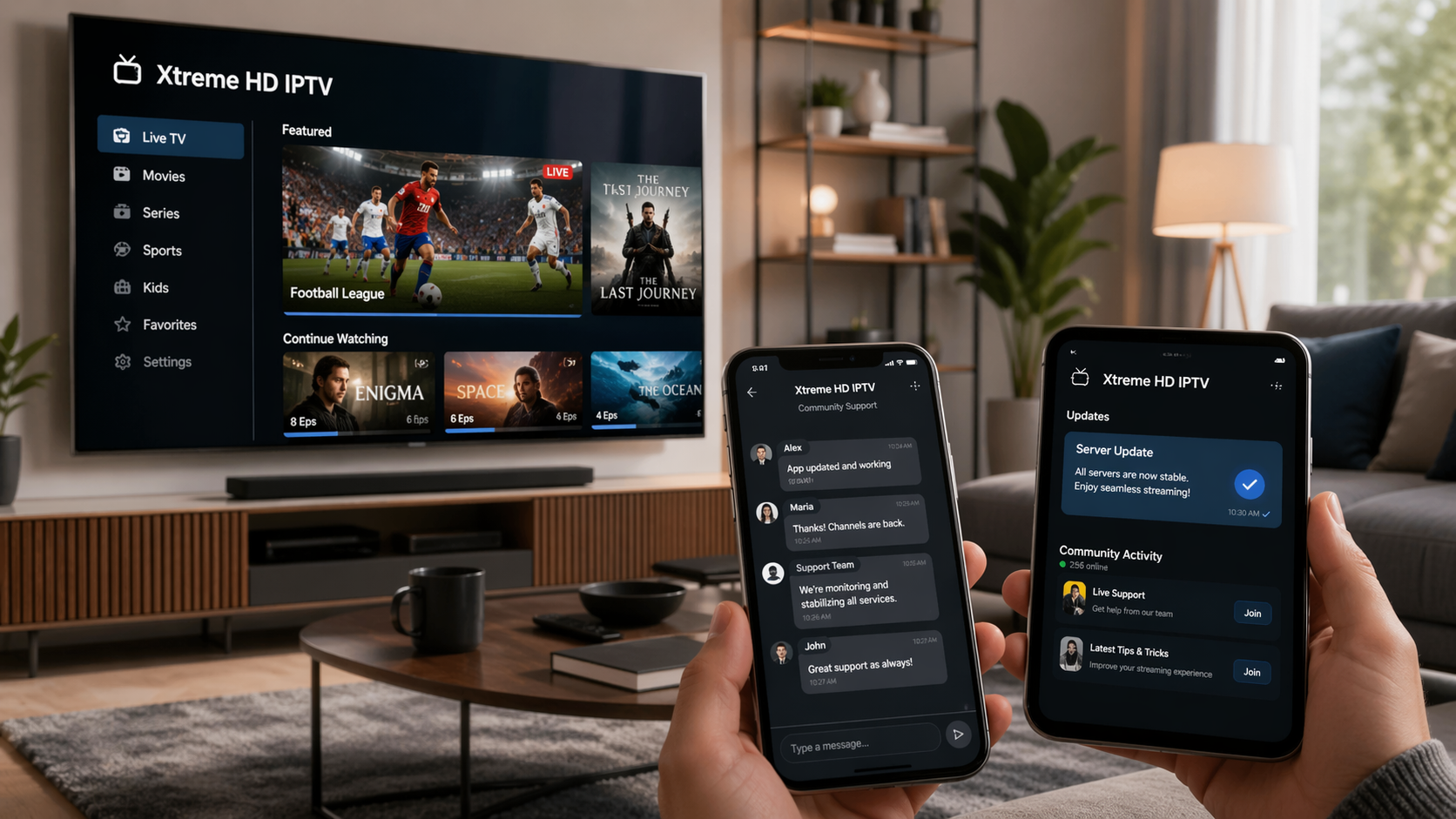
As streaming services compete for attention in an increasingly crowded digital market, support is becoming a bigger part of the customer experience. For many viewers, the question is no longer only what a service offers, but how quickly it communicates when users need help.
That shift is putting community-based support in the spotlight.
Recent coverage of IPTV Xtreme has pointed to a growing trend among streaming users: the demand for faster updates, clearer communication, and more accessible support channels.
The trend reflects a broader change in consumer expectations. Viewers now use a wide mix of devices, including smart TVs, Firesticks, Android boxes, tablets, phones, laptops, and IPTV players.
When a streaming issue happens, the cause is not always clear. It may be the app, the device, the internet provider, Wi-Fi strength, account settings, or the service itself.
That complexity has made real-time communication more valuable.
Streaming support has traditionally happened behind closed doors through email tickets, private chats, or help desks. Those systems still matter, especially for account-specific problems. But they can feel slow when users need immediate answers.
For live streaming, timing matters. A delayed response can mean missing a match, a live program, or an important event. In those moments, users often want to know one thing first: is the issue only happening to me, or is it affecting others too?
Community-based support helps answer that question faster.
Through public channels such as Telegram groups, Discord servers, or online communities, users can check updates, compare experiences, and see whether others are reporting similar problems. That shared visibility can reduce confusion and prevent unnecessary troubleshooting.
The change comes as streaming customers become more selective about where they spend their money.
Deloitte reported that the average subscribing household spends around $69 per month on streaming video services. The same report noted that many consumers would consider canceling their favorite service if the monthly price rose by only a few dollars.
That puts more pressure on streaming providers to deliver value beyond content. Reliability, communication, and support quality are now part of the overall customer experience.
In a crowded market, unclear communication can quickly damage trust. A short public update may not solve every issue, but it can show users that a service is aware, active, and responding.
Community-based support works because streaming problems often affect groups of users in similar ways.
If several people report the same issue at the same time, support teams can identify a wider pattern. If only one person is affected, the problem may be connected to a device, app, internet connection, or setup error.
That distinction matters.
Instead of forcing every user into a separate support conversation, a public community allows common questions and updates to be handled in one place. It also allows experienced users to help newer users with device setup, app configuration, and basic troubleshooting.
For IPTV-related services, this can be especially useful because users often rely on different apps and devices. One customer may watch through a Firestick. Another may use a smart TV app. Others may use Android boxes, phones, tablets, or desktop players.
The more varied the setup, the more important clear communication becomes.
The streaming industry has become highly competitive, and trust is increasingly difficult to earn. Customers are more cautious, more informed, and more willing to switch services when expectations are not met.
This makes transparency a competitive signal.
A service that provides visible updates can reduce uncertainty. Users may still face technical issues, but they are less likely to feel ignored when communication is public and consistent.
This is especially relevant to Internet Protocol television, where delivery depends on IP-based networks and can be affected by multiple factors outside the service provider’s direct control, including local internet performance, device compatibility, and app behavior.
For users, clear updates can help separate service-wide problems from local setup issues. For providers, public communication can reduce repeated support requests and create a faster feedback loop.
The discussion around Xtreme HD IPTV fits into this larger industry movement.
As users expect faster answers and more visible communication, streaming services are under pressure to make support easier to access. Community channels provide one way to meet that expectation.
They do not replace private customer support. Billing issues, login questions, and account-specific problems still require direct assistance. But for general updates, device guidance, and shared troubleshooting, community support can move faster than traditional one-to-one systems.
That is why the model is gaining attention. It gives users a place to find information quickly and gives support teams a way to respond to broader concerns more efficiently.
The rise of community-based support shows that streaming providers are being judged on more than content libraries and pricing.
Customers want services that communicate clearly, especially when problems happen. In a market where users can cancel and switch easily, that communication can influence retention.
Parks Associates has reported that cutting household expenses remains one of the leading reasons consumers cancel streaming services. That means providers must work harder to prove value at every stage of the customer relationship.
Support is now part of that value.
A service that answers quickly, posts public updates, and helps users understand technical issues may have an advantage over one that stays silent until a private ticket is answered.
Community-based support is becoming a larger part of the streaming experience because it addresses one of the industry’s biggest frustrations: uncertainty.
When viewers know where to check updates, how to compare experiences, and where to ask questions, the service feels more responsive. That does not eliminate every technical issue, but it can make those issues easier to understand and resolve.
Xtreme HD IPTV’s connection to this trend shows how support expectations are changing across the streaming market. Viewers want more than access. They want communication, visibility, and confidence that help is available when it matters.