 What is Pin Design Software?
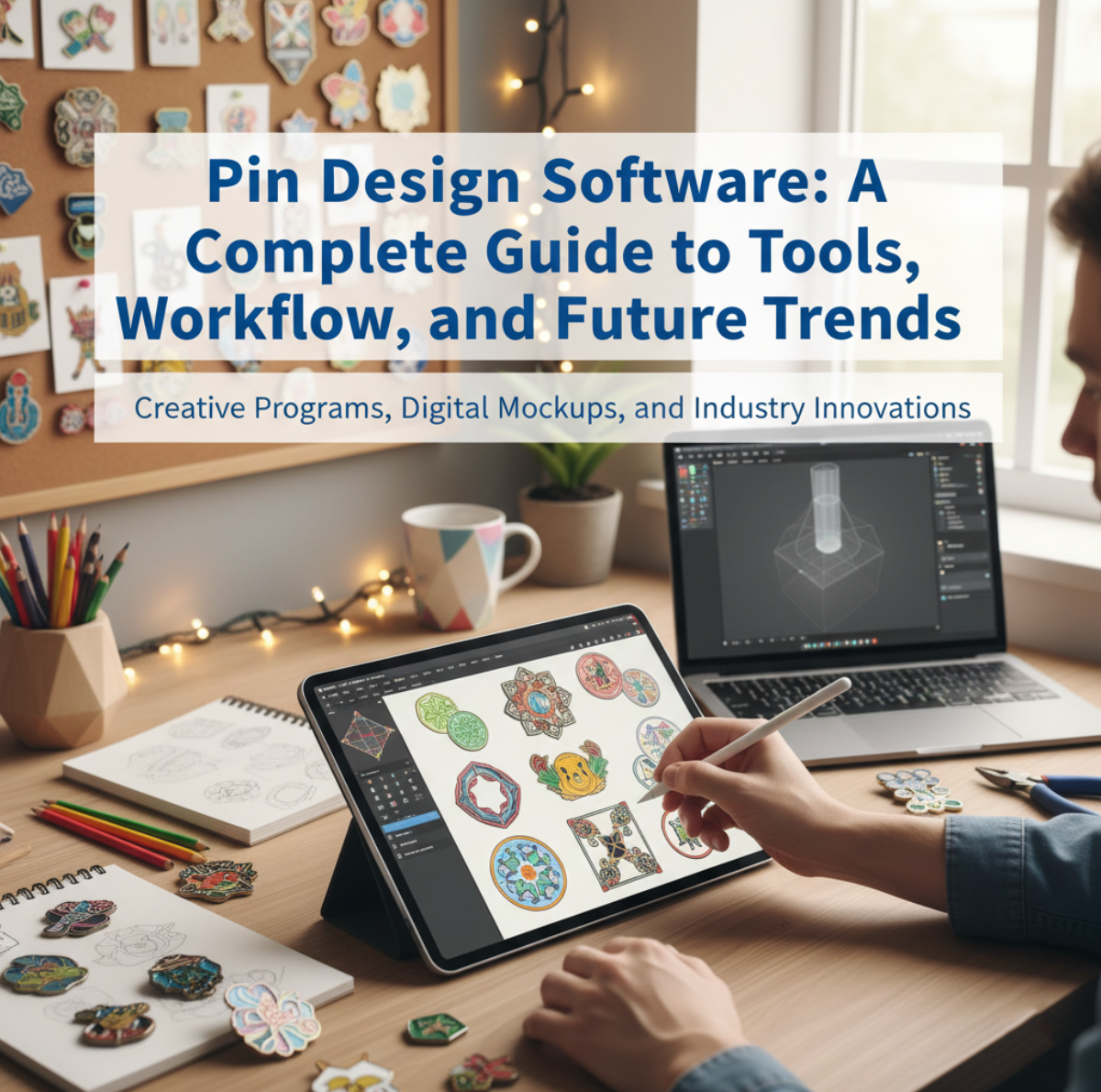
Pin design software allows users to create custom pins, including enamel designs, with various shapes, colors, and patterns. It helps artists, designers, and businesses produce print-ready designs efficiently.
These tools support formats like SVG, PNG, and JPG, making it easy to import or export designs. SVG is especially useful because it can be resized without losing quality.
Several software have options for pattern designing and it is very handy for people who work on intricate or repetitive style elements quite often. Designing pins incurs some production limitations. For example, fine, delicate lines may not translate well in production, especially on small pins, typically 1-2 inches in size.
To combat this, pin design software usually features options to simplify your artwork or emphasize bold lines and harsh colors so that they come through on the final piece. Users should take into account the materials and production methods employed by the pin factories, as these may be too costly or impractical for certain types of designs. A metallic finish, for instance, may lend better to super simple designs whereas soft enamel pins can support more loud colors.
Pin design software is available for any skill level. Other applications are targeted at the professional crowd, with complex user interfaces, advanced tools and options, and customization settings. High-end software provides comprehensive capabilities, including layering, vector modifications, and color calibration, which may be useful for professional designers or those working on expansive projects.
Free solutions, like Inkscape, offer fundamental features for amateurs, whereas paid options such as Adobe Illustrator present advanced tools for more sophisticated designs.
Designing pins requires more than creativity—it needs a structured, problem-solving mindset. Designers must think beyond appearance, considering branding, usability, and how the pin will be perceived by users.
It’s because in shifting the problem to new perspectives, designers discover new potential solution spaces — like trying non-traditional layouts or adding subtle motion to draw more attention. This guarantees that the solution is not just attractive, but practical and appropriate as well.
Non-linear and iterative thinking is another hallmark of this mindset. Designers, after all, don’t often take a direct route in pinning software. They may begin with the ideas, leap ahead to prototyping, gather input and then return back to high-level concepts.
As a practical example, a designer might mock up a simple pin, use social media to test it, and iterate based on results. This iterative process enables continual refinement, guaranteeing that the end product connects with its intended users.
Working through uncertainty is necessary for designers. Sometimes the needs for a pin are nebulous or the brand standards open to interpretation. In these cases, designers instead lean on their talent for deciphering uncertainty.
They play with type and color and visual order to generate clarity and flow. Consider, for example, a designer tasked with creating a holiday-themed pin — one that begins as rough sketches and evolves through feedback and testing to be just right for the user while still being on brand.
Empathy is core to the designer’s mindset. Designers seek to know the audience, and what users need, not just what they like. For instance, aware that users favor visually scannable information, a designer might focus on neat layouts and emphatic, minimal text in their pins.
Likewise, the system-oriented approach enables designers to design things that naturally slot into larger campaigns, all the elements working harmoniously together.
Choosing the right pin design software affects your workflow, productivity, and final output. One key factor is your skill level and familiarity with design tools. Others are for seasoned designers and offer advanced features that require expertise with design software. Some are more novice friendly with intuitive interfaces and guided workflows.
For example, Canva works great for design beginners, whereas Adobe Illustrator might be better for professionals looking for more control and flexibility. Get a sense of your comfort with the design tools before you settle on software.
The learning curve is still another important consideration. Some software you can learn in 30 minutes, others take days or weeks of practice. If you’re on a tight schedule, or just prefer faster adaptability, choose tools with simple navigation and tutorials.
Easier software such as CorelDRAW’s beginner mode will likely be a time-saver, while a power-packed program like Affinity Designer might take a while to learn.
Being software agnostic helps. Don’t stick to one tool for everything, use multiple programs that do different things. For example, you might use Procreate, then jump into Inkscape for vector editing.
This freedom guarantees you the optimal results for each step of your design workflow.
Price is another pragmatic concern. Certain software, like GIMP, is totally free and open-source, whereas others might be subscription-based, like Adobe Creative Cloud. Consider how manageable your budget is for a single purchase versus a recurring fee.
File compatibility and output formats are just as critical. For example, if you must export your designs in SVG, PNG or PDF, verify the software can do this. See if they have any file size limitations, which can impact more complicated designs.
Programs like Gravit Designer provide strong export options, making them attractive for a variety of use cases.
Finally, ponder whether offline compatibility is a deal breaker for you. Certain apps, including Figma, are internet-centric, which may not be appropriate for users in regions with unreliable connections.
Offline-capable software such as Sketch guarantees you’ll always have access to your work.
Pin design requires attention to detail and a clear message. Every design element should work together to ensure readability and visual appeal. Regardless if the pin is for self expression, branding or promotion, this workflow has to strike a balance between creative and functional.
For strong visual hierarchy, designers use things such as font type, size and weight. For example, bold fonts highlight a key message, lighter fonts are nice for small details. Contrast is huge here—contrasting colors or text sizes make important information pop. Complementing graphics, like icons or shapes, can direct the eye. Easy is good!
I believe you should never use more than two fonts on a single design. For instance, combining a strong sans serif with a delicate script can feel professional and chic without being overkill.
Choosing colors is another crucial part of the workflow. Using complementary colors that fit with the brand’s main palette can make the pin more attractive. Or for example, if a brand uses blue as its main color, accent them with orange or yellow etc.
Having appropriate spacing and margins, usually between 1/4″ and 1/2″, makes the pin feel balanced and polished, not cramped or cluttered. As for size, the typical design for a pin is to conform to a 1-1.5 inch diameter. Not to mention, this size is inexpensive and convenient for daily use – such as lapels or jackets.
Although larger pins are eye-catching, they cause your unit price to go up and reduce their versatility. Who wants those big giant pins, anyhow, RIGHT WRONGLY SAYS THE TARGET AUDIENCE!
Finally, readability is a must. Any text overlay must be crisp and readable, even at a reduced size. This guarantees that your pin is both stylish and functional – whether that’s generating traffic to your website or promoting brand awareness. A good pin design integrates all of these things together for the biggest effect.
To make these designs both beautiful and useful, designers need to keep a few key things in mind, from sizing and style to manufacturing needs and cataloging approaches.
The pin’s size is fundamental to its design. A diameter of 1-1.5 inches is usually suggested for straightforward designs, giving sufficient room for intricacies while remaining subtle on the wearer. Smaller pins tend to accentuate simplicity, while larger sizes can embrace more detailed designs or typography.
Designers for different pins need to adapt their style appropriately and choose the size that fits best with the desired aesthetics.
Pin styles affect design, too. Soft enamel pins, for example, are a popular option because they can hold more colors. These pins are enamel painted, which is paddled to fall just below the metal borders, resulting in a tactile surface.
Designs can be completely colourless, rely on a minimalist palette of up to 5 enamel colours, or dive deep with 6-21+ colours. Both work for different pins. For instance, a minimalist design could depend on black and white tones, whereas colorful designs work well with fun or daring ideas.
Metal finishes provide yet another level of personalization. With as many as 14 metal finish options—from timeless gold and silver to antique copper or classy matte black—designers can match a pin’s look to its theme.
A shiny gold finish could pair with a refined design, and a matte black finish is perfect for contemporary, bold ideas. These finishes not only influence the aesthetic but the perceived quality of the pin.
So are the tools with which you design pins. Most pin design software has icon-based menus and intuitive tool choices, so even a novice designer can get started. They’ll often offer layering, color, and resizing tools that designers need to design for production.
To keep things tidy, designers have folders to organize multiple projects — especially helpful when you’re designing a collection or variations of a single design.
Last, but not least, designers need to format their work for pinning. This step includes your factory needs like exact measurements, colors, and file formats. Making sure your design translates during manufacturing is key to the outcome.
Future trends in pin design software will focus on combining innovation with human-centered design, blending digital and physical experiences.
One big change is that the pendulum is swinging back towards handmade, human-centered design. It’s a response to the fast, at times dehumanizing, pace of technological progress. By injecting artisan touches into online utilities, pin design software can assist users in generating designs that are more human and more resonate.
Think hand-drawn or organic look and feel features, allowing users to craft pins that connect with an audience on an emotional level. It’s those kinds of designs that pop in a world saturated with slick, mass-made images.
One more important trend is multimodal interface integration. By 2025, pin design software might have to support voice commands, gestures and touches, automating workflows and making designing more natural. Say, for instance, a designer sketches a layout using gestures and uses voice input to change colors or insert elements.
This fluid interaction may transform the way designers interface with creation tools, rendering them more intuitive and effective.
Design trends are changing as well. There’s an increasing appetite for understated sophistication as opposed to the loud, flamboyant looks of the past few years. We’re seeing minimalist designs with diagonal layouts, layered elements and progress indicators start to take hold.
These patterns generate beautiful compositions and direct user focus, improving engagement. For example, a pin that combines diagonal text with understated layered graphics directs the viewer’s attention organically to the focus.
This balance between virtual and physical experiences is reshaping design priorities. As e-commerce continues to expand, solutions are emerging around bringing in-real-life (irl) interactions into digital designs. For instance, pins advertising products could include QR codes or AR components that connect the digital interaction to the physical world.
It forges real relationships, resonating with readers hungry for reality in a cybernetic universe.
Finally, typography is back. Writing, combined with honest, sleek portrayal is returning. Future pin designs could instead emphasize bold, expressive typography or handwritten text to inject character and uniqueness.
For example, a pin featuring a powerful handwritten quote might feel personal and accessible, cutting through the noise of saturated online environments.