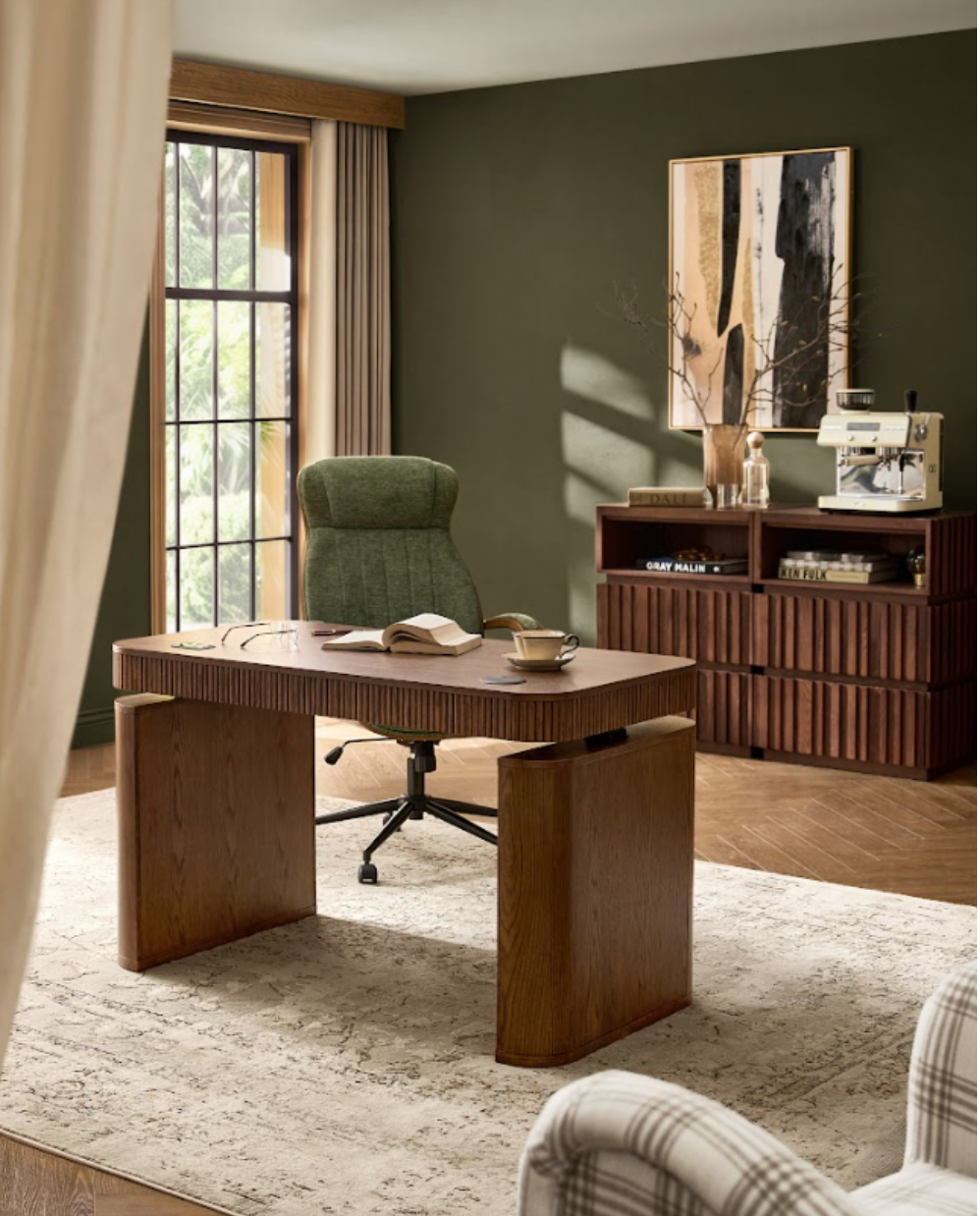
As WFH becomes routine, the standing desk is shifting from a productivity instrument to a domestic essential
In 2013, the headline that would define a product category for the next decade appeared on the front page of a national newspaper. 'Sitting is the new smoking.' The phrase was arresting in the way that only a slightly imprecise analogy can be — it compressed a set of epidemiological findings about sedentary behaviour into a single memorable claim, and it sold a great many standing desks.
The first generation of products that rode that headline were designed accordingly. They were ergonomic instruments: height-adjustable frames in brushed aluminium, digital keypads with blue LED displays, cable management systems that prioritised function over appearance with the conviction of objects that had nothing to apologise for. They arrived in offices already accustomed to the visual grammar of productivity equipment — grey partitions, task chairs on castors, monitor arms in powder-coated black — and they fitted in entirely. They solved the problem they were designed to solve: they got people off their chairs.
They also, in the process, created a second problem that nobody was yet paying attention to. The office aesthetic they embodied was not the only aesthetic those desks would ever have to navigate. When, beginning in 2020, those same ergonomic instruments began appearing in spare bedrooms and living room corners and kitchen alcoves across Britain, they brought the office with them. The room had not asked for it.
For the first two years after the pandemic-driven shift to home working, most commentary treated it as a transitional state. Hybrid working was an adjustment. Home offices were temporary. The standing desk wedged into the spare room would, eventually, be moved back to the office it had come from, or retired to the garage, or sold on to someone who had more space.
That transitional reading has not aged well. Forty-four per cent of UK workers are now hybrid, a figure that has stabilised rather than continued to fall. The WFH desk UK workers require is no longer a stopgap solution — it is a permanent piece of domestic furniture, as permanent as the dining table or the bed, and deserving of the same consideration. The rooms in which people work from home have become, quietly and without much ceremony, a new category of domestic space. They need to be designed as such.
This shift changes what a standing desk is for. In the office, a standing desk was an ergonomic instrument with a single function — to get the worker off their chair. In the home, it is still that, but it is also something else: it is an object that has to coexist with everything else in the room at 7pm on a Friday, when the laptop is closed and the working day is over and the room has to be somewhere you want to be.
The British home has a visual grammar that is specific, quietly demanding, and difficult to articulate in a product brief. It is the grammar of accumulated rather than installed — of rooms that have arrived at their current state through decades of iteration rather than a single design decision. Warm timber. Worn stone. The particular quality of light in a room with a north-facing sash window and walls that have been repainted four times. Objects with provenance: a chair that came from somewhere, a lamp that has been in the room long enough to have become the room.
The standing desk, for most of its commercial history, has not spoken this language. It has spoken the language of the contemporary workplace: precision-machined, materialistically neutral, optimised for function and agnostic about context. This is not a criticism of the category's designers — they were designing for offices, and offices do not have cornicing.
But the consequence of that design tradition, in the context of the British domestic home office, has been a persistent visual friction. The standing desk and the room around it have existed in a state of uneasy negotiation: the room conceding space and visual coherence to the desk, the desk indifferent to the concession. For a product category that now occupies a significant number of the most intimate rooms in the most lived-in homes in the country, that indifference has become harder to justify.
Design objects carry arguments in their material choices. A solid wood surface argues for permanence, for warmth, for the domestic rather than the institutional. A clean square edge, crafted with precision, argues for belonging — for an object that has been considered from the perspective of the room it will live in rather than only from the perspective of the body it will serve. A warm-toned base, where the category default is silver or black, argues for the visual register of furniture rather than equipment.
These are the arguments carried by the Julia standing desk from Hulala Home. It is a motorised, height-adjustable workstation with the functional specification the category requires — quality motor, programmable presets, stable frame, adequate weight capacity — and it carries, in addition, a set of material arguments that its predecessors did not. It does not try to disappear into the room. It tries, more ambitiously, to belong to it. To read as a piece of domestic furniture that happens to be motorised, rather than as a piece of office equipment that happens to have been moved into a home.
The distinction matters more than it might appear. An object that tries to disappear will always draw attention to its absence of character. An object that belongs draws no attention at all — it simply exists, as the right things in a room simply exist, as part of the visual logic of a space that has been put together with care.
Julia is not the only product in the category moving in this direction. But it is, currently, the most coherent expression of a design philosophy that the standing desk has been working its way toward for the better part of a decade: that the domestic standing desk is not an office instrument in a domestic setting. It is a domestic instrument, full stop.
Product categories have design eras. The first era of the standing desk was defined by the ergonomic problem: how do we get office workers off their chairs? That era produced a generation of functional, aesthetically indifferent instruments that solved the problem with considerable effectiveness and little charm.
The second era — the one we are now entering, fitfully and unevenly — is defined by a different problem: how do we make a height-adjustable workstation that belongs in a domestic room? That is a harder design problem, because it requires understanding rooms as well as bodies. It requires knowing what British cornicing looks like at standing eye level, and what the warm grain of oak does in north-facing morning light, and why clean square edges crafted from quality timber signal domestic belonging in a way that cheap machined corners cannot.
The products that will define the standing desk category in the next decade are those that have learned to answer that question. Not by abandoning ergonomic function — the first problem is still worth solving — but by treating the room as a design constraint as serious as the body. By understanding that the object that stays in the home for ten years is not the one that performs most impressively on a spec sheet. It is the one you are glad to look at on a Sunday morning, when the laptop is closed and the room is quiet and everything in it has to earn its place by simply being right.