
Developer adds retail, affordable units to proposed Lansdale townhouses
Project near Pennbrook SEPTA station being vetted by committee
A property near the Pennbrook SEPTA station in Lansdale has given borough officials several options to consider.
Developer W.B. Homes could add more residential units, commercial space, or a mix of both.
“I came back to the planning commission and presented some different options, and we’re here to talk about them,” said developer Chris Canavan.
In early February council’s code committee first saw a draft of plans by developer W.B. Homes to redevelop a 6-acre parking lot at 1180 Church Road into a proposed complex of 74 single-family attached homes. Council had asked the developer to revise the plans to add more units and/or commercial space on the site.
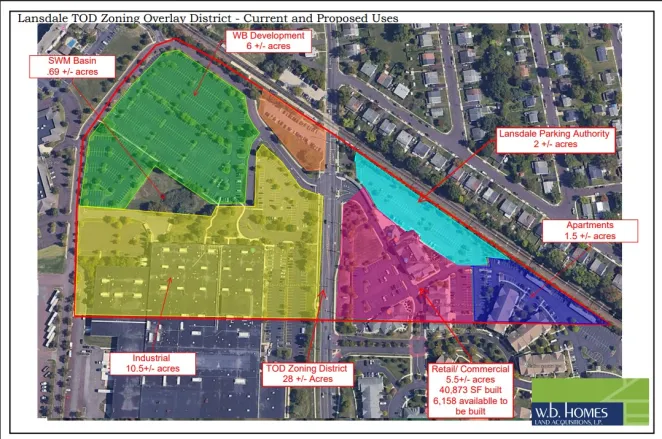
As he spoke to council’s code committee on May 6, Canavan showed the group a series of maps, starting with the entire Transit Oriented Development area, the existing Pennbrook apartments, the pad sites on the site, the two-acre parking lot owned by the borough parking authority, and the area WB is proposing to develop.
“The current ordinance requires a minimum of 20 acres to utilize a TOD overlay, which is why we proposed a small-parcel version of that. Otherwise, it’s zoned underlying industrial, and that’s not what we want to see in this area,” he said.

The first version of WB’s plan presented earlier this year showed a total of 74 townhouses, spaced in clusters of four to six along a series of private roads running through the property, with driveway connections to the SEPTA lot and the driveway running around the site. A first option for redeveloping the site would replace a cluster of six townhouses with a 6,000-square-foot commercial pad site, while a second would replace that same cluster with six more townhouses priced using attainable housing criteria, and the third option would be a split of five new attainably-priced units and 3,000 square feet of retail.
“We moved some setbacks around, and created an area for a 6,000-square foot commercial pad, that could be used for a variety of retail or commercial uses, as neighborhood services and retail within that community adjacent to the Pennbrook train station,” Canavan said.
“This is a way it could lay out and fit within the site. This would require a few modifications,” including waivers to allow smaller side yard setbacks to fit the mix of uses on the site, he said.

The attainable housing units would be priced lower than the rest of the development, “targeting somewhere in the high-threes to around four, versus what the rest of the development would be” in the high-$400,000 to $500,000 price range, the developer said.
How affordable?
Based on input from council and the public in earlier talks, Canavan added, his proposal is to start developing an ordinance that would require a percentage of attainable units or commercial space, or a combination of the two, on a small parcel project.
“We can draft that into the ordinance, so that anybody who would utilize this, would have to come in with both, or one or the other. That would allow us to draft something into ordinance format, that would come back to the planning commission for review, before we go to council,” he said.
“It’s easy to show a picture, now we have to write it into words of how you make an appropriate formula, based on the number of units, how many square feet per how many acres, or something along those lines,” Canavan said.
If authorized by council, the developer could begin work on a draft plan showing the affordable units that would be roughly 1,400 square feet, three bedrooms, with no garage, and slightly narrower than the others in the development. Councilman Mike Yetter asked if those units would be owner-occupied or rented, and Canavan said that depends in part on how the code is written.
“The goal here would be to make sure, if you’re going to create them once, they should stay as attainable in the future — that would be the intention, and that’s something we can write into the ordinance,” he said.
“You don’t want someone buying it at a lower than market rate, and then either flipping it or renting it for higher than market. You lose the ‘attainable,’ and there would have to be some protections written into the ordinance for that. And we’re happy to do that,” Canavan said.

Code committee chair Rafia Razzak asked if the affordable units would be located together, and Canavan said the early plan has three of those units together and two others alongside other units elsewhere in the development, and borough Code director Rick Lesniak said that was based on input from the town’s planning commission.
“We’ve been listening,” Canavan said, and Razzak replied: “We can only get better by listening.”
Public share thoughts
Several residents added input into the latest version of the plans, starting with Dominic Frascella, who asked if the town’s recent talks about removing minimum requirements for parking with new projects could be applied to this project, or others of similar size.
“We have other developers who had big plans, who kind of had to take a step back for various reasons. Maybe this is something that can entice them back, if this sort of zoning is on the book for infill developments,” he said.
Alex Sickler asked if the roughly 1,400 square foot townhouses were comparable in size to houses elsewhere in town, and Canavan said he and his firm could build closer in size to the early-20th-century rowhouses elsewhere in town, but those may not sell.
“Homes have just gotten bigger, the way we build is different. I’ll take any feedback, but you do have to leave it a little bit to the private sector,” Canavan said.
One comparison already in town: the Cannon Square townhouses built by WB in the early 2010s were designed and built to be only 18 feet wide, less than the 24 feet wide required under current codes near Pennbrook.
“You can narrow them, but the developer/investor has to be able to have some feedback,” the developer said.
Meghan Kochersperger said she thought that site, just steps away from the SEPTA station, was ideal for density.
“We’re talking about transit oriented development, which should be designed for density, and less car-centric-ness,” she said.
“The fact that our standard residential zoning, allows narrower (house) widths and smaller setbacks than even what you’re proposing, is just wild to me, and should absolutely be changed. I would go even further,” Kochersperger said. “We would like to open up opportunities for developers to do more with these spaces. We need more housing in Lansdale, not less, and density can help you get there.”
Canavan answered that the draft small parcel code he’s looking to write could include provisions to use smaller dimensions and/or reduced parking requirements in such projects, and said he’s seen similar codes in other towns that allow those reductions if a parking study is presented by the developer.
“That’s a good model to work off of, so you’re basing it off of something,” he said.
Dominic Visturia then asked if the committee agreed with the residents that the third option, with some retail and more affordable units, was their ideal outcome.
“Option three is awesome to see, that we can get both. I think most of us want that,” he said.
Razzak then asked for a direction to give the developer, and the three agreed to ask WB to pursue the option with both commercial space and affordable units, and Canavan said he’d bring an updated plan and draft code back to the town’s planning commission for future talks.
“We need to come up with formulas for how you calculate each of them, so that it’s replicate-able on other projects,” he said.
Lansdale’s borough council next meets at 7 p.m. on May 20, and the code committee next meets at 7:30 p.m. on June 3, both at the borough municipal building, 1 Vine Street. For more information, visit www.Lansdale.org.
This article appears courtesy of a content share agreement between Fideri News Network and The Reporter. To read more stories like this, visit https://www.thereporteronline.com