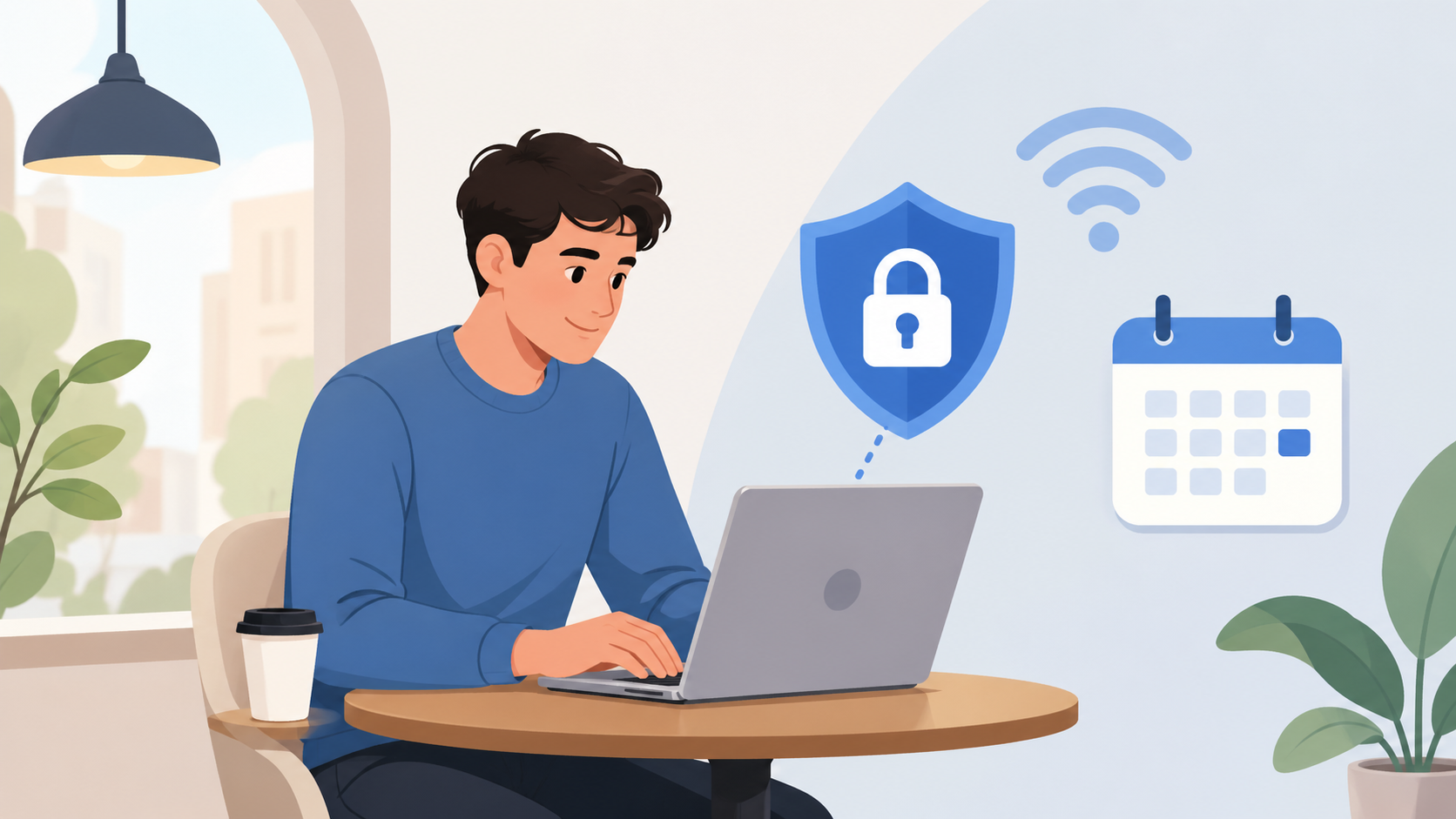
Paying for a VPN does not have to mean locking yourself into a long-term plan.
A monthly VPN gives you online privacy protection one month at a time, which can be useful if you are traveling, working remotely, using public Wi-Fi, or simply testing a service before committing. For many people, the appeal is simple: more flexibility, less pressure, and no big upfront payment. Public Wi-Fi in places like cafés, hotels, airports, and libraries can create real privacy risks, especially when you are checking email, logging into accounts, or handling work files. Cybersecurity agencies have also warned that public wireless networks can expose users to threats if devices and connections are not properly protected.
In this guide, we will explain what a monthly VPN is, who should consider one, how it compares with annual plans, and what features to check before paying month to month.
A monthly VPN is a VPN subscription that renews every month instead of once a year or once every two or three years. You get access to the VPN service for a shorter billing period, and in most cases, you can cancel before the next renewal if you no longer need it.
The basic function is the same as other paid VPN plans. A VPN, or virtual private network, creates an encrypted connection between your device and the internet. This helps protect your online activity from being easily viewed on unsecured networks, especially when you are using public Wi-Fi. The FCC advises people who regularly use public Wi-Fi to consider a VPN because it encrypts transmissions between the device and the internet.
The difference is not the technology. The difference is the commitment.
With a monthly VPN plan, you are paying for flexibility. You may pay more per month than someone on a long-term plan, but you are not stuck with a bigger upfront payment. That makes a month-to-month VPN useful for people who only need short-term protection or want to test a provider before choosing a longer subscription.
The biggest reason is simple: not everyone needs a VPN all year.
Maybe you are taking a two-week trip. Maybe you are working remotely for the summer. Maybe your college student is moving into a dorm and you want to test online privacy tools before buying an annual plan. Maybe you run a small local business and need secure browsing while working from cafés, hotels, or client locations.
In those cases, a monthly VPN can make more sense than buying a long-term subscription immediately. You can use it when the need is clear, test the speed and apps, then decide whether it is worth keeping.
This is especially relevant for readers who rely on public Wi-Fi. North Penn Now has already covered public Wi-Fi privacy and VPN use in travel and digital nomad contexts, which makes this topic a natural fit for local readers who want practical online safety advice without getting buried in technical jargon.
A monthly VPN is also useful because it lowers the pressure of choosing “the perfect VPN” right away. Instead of committing for a year based on reviews, you can test the service in your actual daily life. Does it work well on your laptop and phone? Does it slow down video calls? Is the app easy enough for your family to use? Can you cancel without frustration? These are questions you can only answer properly by using the service yourself.
A monthly VPN is better when flexibility matters more than price. An annual VPN is usually better when you already know you will use it regularly.
That is the trade-off.
Month-to-month VPN plans usually cost more on a per-month basis. Recent VPN pricing research shows that monthly, no-commitment plans commonly cost around $10 to $16 per month, while longer subscriptions often advertise much lower average monthly prices.
But that does not automatically mean monthly plans are a bad deal. They are simply built for a different type of user.
If you only need a VPN for one month of travel, paying for one month may be smarter than buying a two-year plan just because the advertised monthly average looks lower. If you need a VPN every week for remote work, streaming privacy, public Wi-Fi, or general browsing protection, then a yearly plan may make more sense.
Think of it this way: a monthly VPN is like renting a tool for a specific project. A long-term VPN plan is like buying the tool because you know you will use it often.
A monthly VPN is not for everyone, but it fits several common situations.
Travelers are one of the clearest examples. If you are staying in hotels, passing through airports, working from cafés, or connecting to unfamiliar Wi-Fi networks, a short-term VPN can add a layer of protection while you are away from your trusted home network. The NSA specifically notes that users who must connect to public Wi-Fi should take precautions, including using a personal or corporate VPN to encrypt traffic.
Remote workers and freelancers are another strong fit. If you handle client emails, invoices, shared documents, cloud dashboards, or business accounts outside your home office, a VPN can be part of a smarter security routine. It does not replace strong passwords or two-factor authentication, but it can help protect your connection when the network itself is not fully under your control.
Students and families may also consider a monthly VPN, especially when testing whether it is useful across multiple devices. A student using library Wi-Fi, dorm Wi-Fi, or public hotspots may benefit from extra privacy. Parents may want to understand how a VPN works before adding it to family devices. This should be handled responsibly: a VPN is a privacy tool, not a replacement for parental guidance, device settings, or honest conversations about online behavior.
Small business owners can also use a monthly VPN as a trial before wider adoption. A local consultant, realtor, contractor, designer, or service provider may not need a full business security stack on day one. But if they often work outside the office, a month-to-month VPN can be a low-commitment way to test secure browsing, device compatibility, and workflow impact.
A free VPN can look tempting, especially if you only need protection for a short time. But free does not always mean better value.
Some free VPNs are legitimate, but many come with trade-offs. They may limit data, speed, server access, device support, or customer service. Some may also rely on business models that do not align with strong privacy expectations. That does not mean every free VPN is unsafe, but it does mean you should read the privacy policy carefully and understand what you are getting.
A paid monthly VPN is often the middle ground. You avoid a long-term contract, but you still get access to a full-featured service for a short period. For travelers, remote workers, students, and small business owners, that can be a better balance than using a limited free option or committing to a multi-year plan too soon.
The first mistake is choosing only by price. A cheap monthly VPN is not automatically a good monthly VPN. If the app is confusing, the speeds are poor, the support is weak, or the privacy policy is unclear, the lower price may not be worth it.
The second mistake is ignoring renewal details. Monthly plans usually renew automatically unless canceled. If you only need a VPN for one trip, set a reminder before the renewal date. This sounds basic, but it is one of the easiest ways to avoid paying for months you did not plan to use.
The fourth mistake is skipping the refund policy. Many VPN providers advertise money-back guarantees, but the details can vary. Before you subscribe, check how long the refund window lasts, whether monthly plans are included, and how to request the refund if needed.
The fifth mistake is failing to test the VPN early. Do not wait until the last day of your subscription to see whether it works well. Test it during normal use: video calls, streaming, email, banking, file uploads, gaming, and any apps you rely on. If something does not work, you want time to fix it or cancel.
There is no single perfect price, but you should understand the pattern. Monthly VPN plans usually cost more per month than long-term plans because you are paying for flexibility. Long-term plans often advertise lower average monthly prices, but they require a bigger upfront commitment.
For long-term users, monthly billing can become expensive quickly. If you use a VPN every day or every week, and you already trust the provider, an annual plan may be more cost-effective. Just remember to check the renewal price, because promotional rates can change after the first billing period.
Before choosing a monthly VPN, ask yourself a few direct questions.
Will you use it for one trip, one semester, one work project, or ongoing privacy? Does it support your phone, laptop, tablet, and browser? Does it include a kill switch? Is the privacy policy clear? Are there enough server locations for your needs? Can it handle video calls, streaming, and file uploads without major slowdown? Is the monthly price clearly shown? Can you cancel online? Is there a refund window?
If you cannot answer these questions from the provider’s website, that is a sign to slow down. A good VPN should make the basics easy to understand.
A monthly VPN is worth it when you need privacy protection for a short period, want to avoid a long-term commitment, or need to test a service before paying for a year. It is especially useful for travelers, remote workers, students, families, freelancers, and small business owners who use public Wi-Fi or shared networks.
It may not be the best choice if you know you will use a VPN all year. In that case, a long-term plan may offer better value.
The smartest approach is simple: use a monthly VPN when flexibility matters, switch to a longer plan only after you trust the service, and always check privacy, speed, device support, cancellation terms, and renewal pricing before you pay.
Yes. Many VPN providers offer monthly VPN subscriptions that renew month to month. This is useful if you need a VPN for travel, temporary remote work, school, or short-term testing.
A monthly VPN is better for flexibility. A yearly VPN is usually better for long-term savings. If you only need a VPN for a short time, monthly billing may make more sense. If you use a VPN regularly, an annual plan may be more cost-effective.
A VPN can help protect your connection by encrypting traffic between your device and the VPN server. This is especially useful on public Wi-Fi networks in places like hotels, airports, cafés, and libraries. Public Wi-Fi still requires caution, so users should also keep devices updated, avoid suspicious links, and use strong passwords.
It can. Because a VPN encrypts and routes your traffic, some speed loss is normal. A quality VPN should still be fast enough for everyday browsing, video calls, streaming, and work tasks.