There is a version of fleet management that involves a dispatcher calling a driver to ask where they are, getting an approximate answer, and updating a whiteboard accordingly.
Plenty of Australian businesses still run this way, particularly smaller operations that have grown without ever formalising their visibility infrastructure.
The problem is not that it feels outdated. The problem is that it costs money continuously in ways that never appear on a single line of a budget.
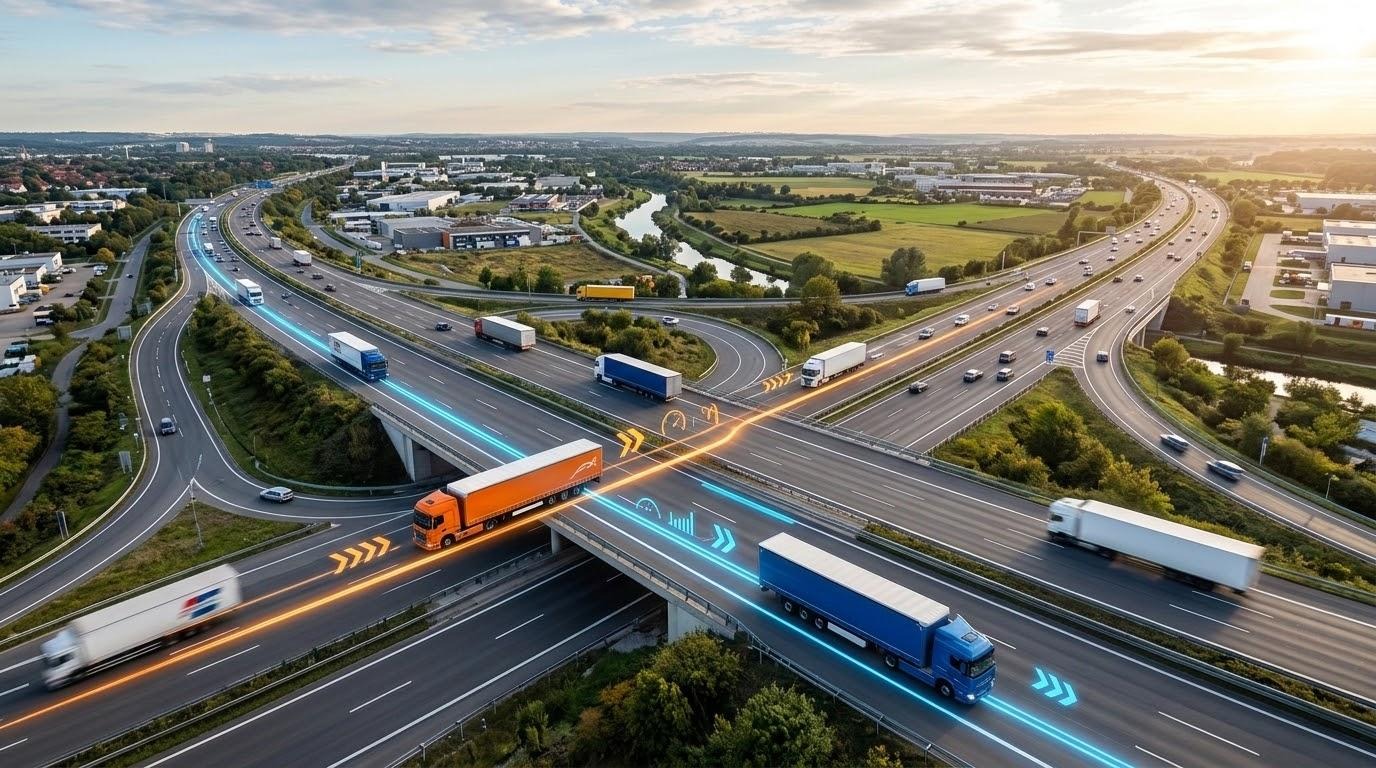
Real-time truck tracking, integrated with route optimization, changes the fundamental relationship between a logistics business and its fleet.
The vehicle is no longer an asset that disappears when it leaves the yard and reappears when a job is done. It becomes a data source that informs decisions throughout the working day.
GPS tracking in fleet management has been around long enough that the basic concept is well understood.
A device on the vehicle transmits location data at regular intervals, and a platform displays that data on a map.
What has changed considerably in recent years is the density and usefulness of the data being transmitted, and the degree to which it integrates with other operational systems.
Modern telematics platforms do not just show where a vehicle is. They show its speed, heading, idle status, engine condition and driving behaviour in real time.
When that data feeds into a route optimization system, the picture becomes operational rather than merely informational. A dispatcher is not just observing. They are managing.
Every fleet operates with a plan at the start of the day and a reality that diverges from it almost immediately.
Traffic incidents, customer delays, mechanical issues, new bookings and cancellations all alter what a driver's day actually looks like.
Without real-time visibility, the dispatcher finds out about these divergences when a driver calls in, a customer complains, or a vehicle fails to return at the expected time.
With live tracking, divergences are visible as they happen. A vehicle sitting idle for longer than expected at a stop triggers an alert.
A truck that has fallen significantly behind its scheduled route positions shows up on a dashboard before it becomes a service failure. The information arrives in time to act on it rather than after the fact.
Tracking and route optimization are most powerful as a combined system rather than separate tools.
Tracking provides the live data — where vehicles are, how they are performing, where delays are developing.
Route optimization uses that data to continuously assess whether the planned sequence of stops still makes sense and, where it does not, to generate an alternative.
A driver stuck in unexpected traffic on one route, with three stops remaining, may be better deployed to a single nearby stop while another vehicle absorbs the remaining two.
Without live positional data for both vehicles and an optimization engine assessing the alternatives, a dispatcher making that call manually is working with incomplete information and limited time.
The same decision made by software drawing on real-time inputs across the whole fleet is faster and more reliable.
Dynamic rerouting — the ability to update a driver's route mid-run based on changing conditions — depends on two things working together.
The first is accurate, current data about where the vehicle is and what conditions it is encountering.
The second is an optimization engine that can recalculate efficiently rather than generating a new plan from scratch each time something changes.
This combination is what separates a genuine real-time capability from a system that is technically live but operationally static.
A platform that shows vehicle positions but requires manual intervention to adjust routes is a monitoring tool.
One of the less discussed benefits of real-time truck tracking is what it makes possible in customer communication.
An accurate estimated arrival time, updated continuously as the vehicle moves through its route, is something customers increasingly expect and that many logistics businesses still cannot reliably provide.
The reason they cannot provide it is usually the same reason dispatchers are calling drivers to ask where they are. The information does not exist in a form that can be shared.
When live tracking data feeds into a customer-facing notification system, estimated arrivals become a data output of the tracking platform rather than a manual calculation that someone has to maintain and communicate individually.
For businesses where on-time delivery performance is part of their value proposition, this closes a gap that affects both customer experience and competitive positioning.
Real-time tracking generates a secondary data set that is often underutilised: information about how individual drivers are operating their vehicles and managing their time.
Excessive idling, frequent harsh braking, prolonged stops and consistent deviations from planned routes all show up in telematics data and all have a direct relationship to fuel costs, vehicle wear and route performance.
This data is not primarily useful as a surveillance tool. Its value lies in identifying patterns that training or process improvements can address.
A driver who consistently runs late on a particular type of run may be dealing with a route that was never accurately planned for the actual stop time required.
A vehicle that is regularly idle at certain times of day may indicate a scheduling issue rather than a driver performance issue. The data raises the questions; the operational response provides the answers.
Real-time tracking tends to generate the most obvious returns at scale — larger fleets, more complex route networks, higher volumes of daily stops.
The per-vehicle cost of telematics infrastructure is easier to justify when the efficiency gains are multiplied across many vehicles.
For smaller operations, the calculus is different but the underlying logic is the same.
A five-vehicle fleet where the dispatcher has live positional data for all five vehicles and can see at a glance where each job stands is operating with information that a business of the same size without tracking simply does not have.
The decisions that information enables — which job to take on, which driver to send, when to call a customer proactively about a delay — have value regardless of fleet size.
The question is not whether tracking and route optimization are useful at a given scale. It is whether the operational decisions being made without that information are good enough to justify not having it.