No two chemical spills are identical. The substance involved, the volume released, the location, the proximity to drainage and the people nearby all shape what an appropriate response looks like.
What does not change between incidents is the underlying logic of the cleanup process — a sequence of actions that, when followed in the right order, limits harm to personnel and the environment and sets the site up for a complete recovery.
For incidents that exceed on-site capacity, professional emergency spill response should be contacted immediately and in parallel with any on-site actions.
For smaller incidents managed internally, the following process reflects best practice across Australian industrial and commercial settings.
Rushing into a spill without understanding the substance is one of the most consistently dangerous mistakes made during chemical incidents.
The Safety Data Sheet for the spilled material is the starting point for any assessment.
Key questions to answer before anyone approaches the spill are: what is the substance, what class of hazard does it present, how much has been released, where is it moving, and is there any risk of fire, explosion or toxic vapour.
Flammable liquids require all ignition sources in the area to be controlled before any person gets close. Volatile substances may require evacuation of nearby personnel before assessment can even begin safely.
If the substance is genuinely unknown, it should be treated as hazardous until confirmed otherwise.
Approaching an unknown liquid without this assumption has caused preventable injuries on Australian worksites more times than can be attributed to bad luck.
Once the substance is identified and its hazards understood, the correct PPE for that specific chemical needs to be donned before anyone enters the spill zone.
Gloves, eye protection, respiratory protection and protective clothing requirements vary depending on the substance.
General-purpose gloves are not appropriate for all chemicals. Respiratory protection adequate for one type of vapour may offer no protection against another.
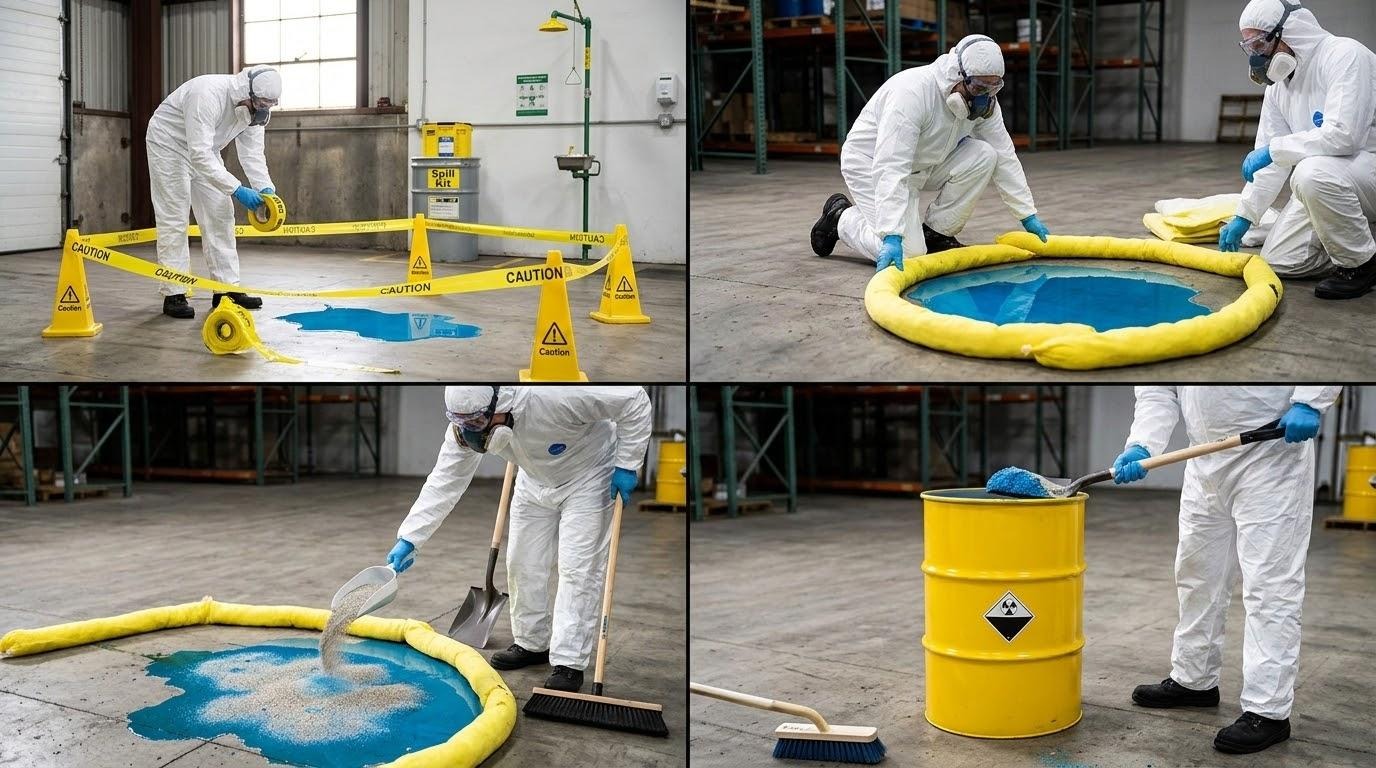
The spill zone should be cordoned off and access restricted to trained response personnel only.
Foot traffic through or near a spill spreads contamination across a wider area, creates slip hazards and exposes additional people unnecessarily.
Signage and physical barriers deployed quickly at this stage reduce the total footprint of the incident.
Where it is safe to do so, stopping further release of the substance should happen simultaneously with or immediately after securing the area.
Closing a valve, uprighting a tipped container, applying a temporary seal to a breached fitting or shutting off a pump all reduce the total volume that needs to be managed in the cleanup.
In some situations stopping the source is not immediately achievable — pressurised lines, structural failures or large storage tank breaches may require specialist equipment.
In those cases, the volume continues to grow while containment is being established, which is precisely why the next step needs to happen as fast as possible.
Drain protection and containment need to happen before cleanup begins, not after.
Absorbent socks or booms placed around drain openings, combined with a physical containment barrier around the perimeter of the spill, stop the spread and protect the stormwater system from receiving contaminated material.
The containment approach depends on the substance. Hydrocarbon spill kits use oleophilic absorbents that preferentially absorb oil while repelling water.
Chemical spill kits use different absorbent materials suited to a broader range of substances. Using the wrong absorbent can reduce effectiveness and in some cases produce unintended reactions — oxidising chemicals, for instance, should not be absorbed with sawdust or other organic materials because of fire risk.
Once contained, the boundary should be held while the removal process begins. Adding more absorbent within the boundary progressively reduces the volume of free liquid.
With the spill contained, the process of physically removing the material begins. Absorbent pads and granules placed within the containment boundary draw up remaining liquid.
For larger volumes, vacuum recovery equipment operated by trained personnel removes liquid directly into sealed containers.
The direction of removal matters. Working from the outer edges of the spill toward the source prevents spreading contained material outward. Scooping, sweeping or vacuum collection should all follow this logic.
Any containers used to collect spilled material need to be chemically compatible with the substance involved, clearly labelled and kept separate from incompatible wastes.
Mixing collected chemical waste into a single container without confirming compatibility risks secondary reactions that create new hazards from a situation that was being brought under control.
Removing the bulk of the spilled material does not complete the cleanup. Residues remaining on surfaces continue to pose exposure and environmental risks, particularly if the site is subject to rainfall or foot traffic.
Surface decontamination using the neutralising agents or cleaning compounds recommended in the SDS addresses residual contamination that absorption alone will not remove.
For acid spills, a sodium bicarbonate solution is a commonly used neutralising agent. For alkali spills, a dilute acid solution may be appropriate.
The SDS for the specific substance provides the correct recommendation — improvised approaches risk creating secondary chemical reactions rather than neutralising the hazard.
After decontamination, the area should be washed and the resulting washwater recovered rather than allowed to drain. Washwater from a chemical spill cleanup is itself contaminated waste.
Everything used in the cleanup process that has come into contact with the spilled substance is contaminated waste.
Absorbents, PPE, cleaning equipment, used containers and collected washwater all need to be treated according to the hazard classification of the original substance.
Contaminated materials from a hazardous chemical spill cannot go into general waste bins. They require licensed collection and transport to an approved waste treatment facility.
Placing hazardous cleanup waste into general waste streams is an environmental breach that creates consequences extending well beyond the original spill incident.
Waste should be stored in sealed, labelled containers on site until collection. Labels should clearly identify the spilled substance, the date of the incident and the nature of the contents.
Personnel involved in the cleanup need to decontaminate their PPE according to the substance-specific procedures in the SDS before removing it.
Some PPE can be laundered and returned to service. Other items, particularly where contact with the substance has been significant, may need to be disposed of as contaminated waste.
The incident should be documented in full once the immediate response is complete — what was spilled, when, in what volume, where, what actions were taken, by whom and how waste was managed.
This documentation supports incident investigation, informs future risk management and provides a record of responsible management if the incident attracts external scrutiny.
Spill kits used during the response need to be restocked before they are returned to service. A partially depleted kit available at the next incident is a significantly less reliable resource than a fully stocked one.