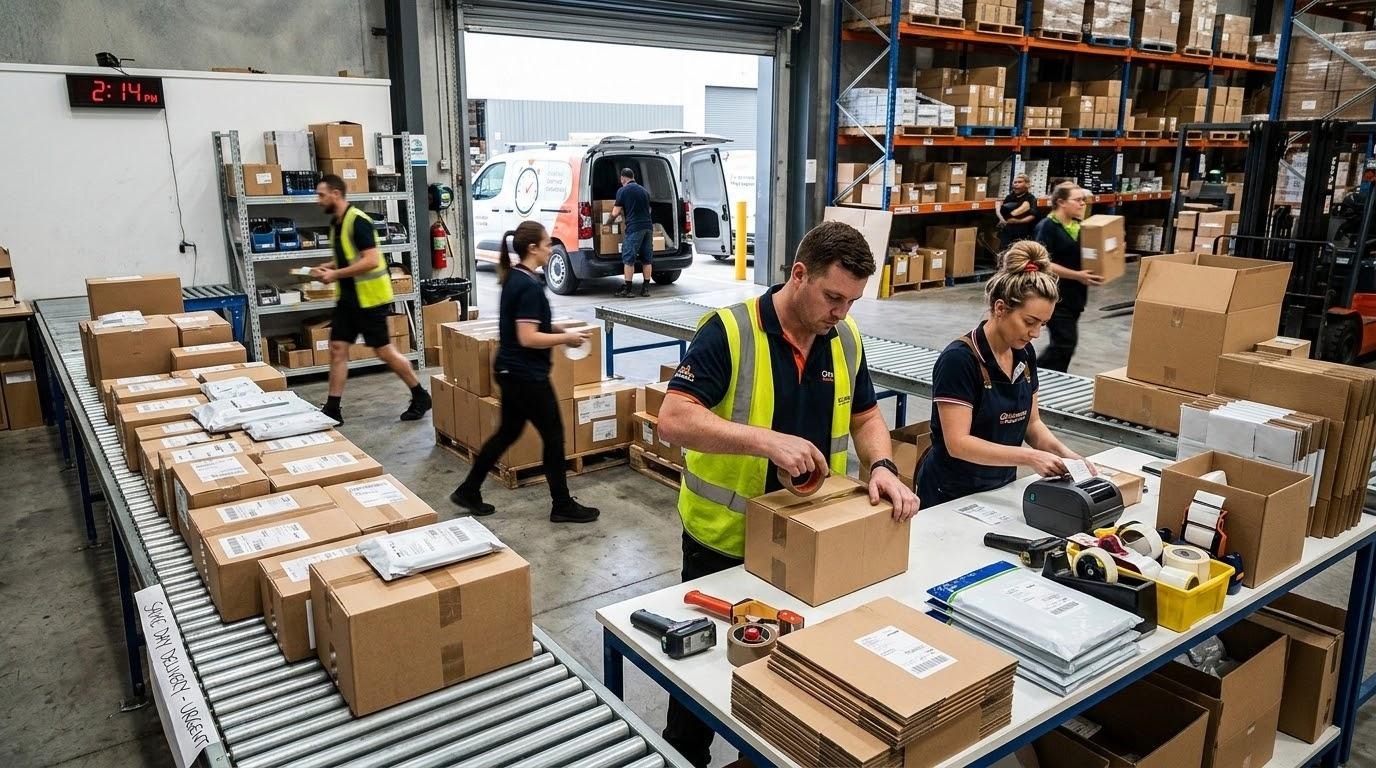
Same day delivery and last-minute orders are not the same problem, even though they often arrive together.
A business with a well-run same day operation handles most orders smoothly because systems are designed for speed from the start.
The challenge is the order that arrives outside those systems — after the morning run is planned, after a driver has departed, or with a destination that was not on anyone's radar when the day began.
How a business handles that scenario reveals whether its same day capability is genuine or whether it works only when conditions are favourable.
For businesses where same day interstate delivery is part of the service offering, the stakes are higher again because the margin for error narrows considerably the moment distance is involved.
A last-minute order does not just add a stop to an existing plan. It introduces a constraint that was not accounted for when the day's capacity was allocated.
Drivers may already be mid-run. Vehicles may be at or near capacity. Cut-off times for certain delivery windows may have passed.
The order itself may require handling, packaging or documentation that takes time the day does not have.
Businesses that treat last-minute orders as a version of normal orders consistently struggle with them.
The workflows that work for orders placed with adequate lead time — batch processing, scheduled dispatch, optimised route building — do not adapt well to an order that needs to move within the hour.
Managing last-minute demand well requires separate processes rather than modified versions of standard ones.
Cut-off times often get discussed purely as a customer-facing promise — order by two in the afternoon to receive delivery today. Their operational function is equally important.
A clearly defined cut-off creates a boundary that allows same day capacity to be managed rather than improvised.
Without a cut-off, every order that arrives during the day is a potential last-minute order. With one, the business has a defined window of planned volume and a defined category of exceptions.
Orders that arrive before the cut-off are processed through standard same day workflows.
Orders that arrive after it are either declined for same day, escalated to an express process, or assessed against remaining capacity before being accepted.
That assessment is only possible when the business has live visibility of what is already committed.
A dispatcher who does not know where drivers are, what they are carrying and when they are expected to return cannot make a reliable call about whether a late order can be accommodated.
Real-time tracking and dispatch visibility are not optional infrastructure for a business managing same day volume seriously.
The businesses that handle last-minute orders most reliably do not rely on squeezing them into plans that were already full.
They build slack into their daily capacity deliberately — holding back a portion of driver availability or vehicle capacity that is not committed to scheduled runs until later in the morning.
This looks inefficient from the outside because it means early in the day some capacity is idle.
In practice, it functions as a buffer that absorbs the volume of last-minute demand that any business running same day delivery will encounter.
The alternative — filling all capacity with scheduled runs and then having no room for unplanned orders — produces either declined late orders or degraded service on existing commitments when drivers are asked to absorb more than their routes can handle.
How much flex capacity to hold depends on the predictability of last-minute demand. Businesses with consistent late order patterns can calibrate this over time.
Those with more variable demand need to be more conservative in how much of their capacity they commit early.
Last-minute orders become a genuinely different challenge when the destination is in another city.
For same day interstate delivery, the available window between booking and departure is not defined by how far a driver needs to travel. It is defined by flight schedules.
An order that needs to reach Melbourne from Sydney same day has a fixed number of flight options, each with a check-in cut-off that determines whether that flight is still achievable.
A booking made at ten in the morning has multiple flight options and a strong chance of same day delivery.
The same booking made at two in the afternoon has fewer options and depends heavily on what is departing in the next few hours and whether airport handling time can be met.
Managing last-minute interstate same day orders requires knowing those flight schedules before the order is confirmed, not after.
A business that accepts a late interstate same day order without checking flight availability is making a commitment it may not be able to honour.
One with the flight schedules and cut-off times mapped for its most common interstate routes can make that assessment quickly and accurately.
The speed at which a last-minute order can be processed and assigned depends on how much manual work the dispatch process requires.
A business where assigning a new order means calling a driver, waiting for an answer, manually calculating where the new stop fits in an existing run and then relaying revised instructions to the driver will always be slower to respond than one where the same task is handled through a dispatch platform that pushes the new stop to the driver's app and updates the route automatically.
Automated dispatch and real-time route adjustment are not exclusively large-fleet capabilities.
The same platforms used by larger operations are accessible to smaller businesses and produce the same operational benefit at any scale — reduced lag between order receipt and dispatch, and fewer manual steps that introduce delay or error under time pressure.
Last-minute orders carry heightened customer expectations precisely because the customer already knows timing is tight when they place the order.
Managing those expectations actively reduces complaints and builds trust even when things do not go exactly as planned.
A customer who receives a tracking link and an accurate estimated arrival time immediately after booking has information they can act on.
A customer who receives nothing and calls to ask where their order is an hour later is generating a support interaction that consumes time the operation cannot spare during a busy period.
Automated notifications triggered at booking, at pickup and at delivery are standard in modern courier platforms and require no manual effort once configured.
For businesses offering same day service, they are a baseline customer experience requirement rather than a premium feature.