A spill response that goes wrong rarely fails in one dramatic way.
More often, it unravels through a sequence of small, avoidable errors that compound each other until a manageable incident has become something considerably more serious.
The mistakes that cause the most damage are not exotic. They are familiar, predictable, and worth understanding before an incident occurs rather than after.
For businesses that handle chemicals, fuels or liquid waste, having access to professional emergency spill response is one layer of protection.
Understanding where on-site responses most commonly go wrong is another.
The single most consequential mistake in any spill response is treating an unknown substance as if it is known. Absorbents that work safely on a hydrocarbon spill may react with an acid.
Protective equipment appropriate for one chemical class may offer no protection against another.
Attempting containment without understanding what you are containing puts response personnel at direct risk and can make the situation significantly worse.
Safety Data Sheets exist precisely for this reason. Every hazardous chemical on a site should have an SDS that is accessible to staff and response teams, not filed somewhere difficult to reach.
When a spill occurs and the substance is genuinely unknown, the correct initial action is to treat it as hazardous and wait for it to be identified before anyone makes physical contact or attempts cleanup.
Hosing down a spill is an instinctive response to a mess. It is also one of the most damaging things a person can do in a spill situation.
Water disperses liquid substances across a wider area, accelerates their movement toward drains and stormwater infrastructure, and in some cases produces chemical reactions that generate heat, fumes or toxic by-products.
Containment means stopping the spread, not redirecting it.
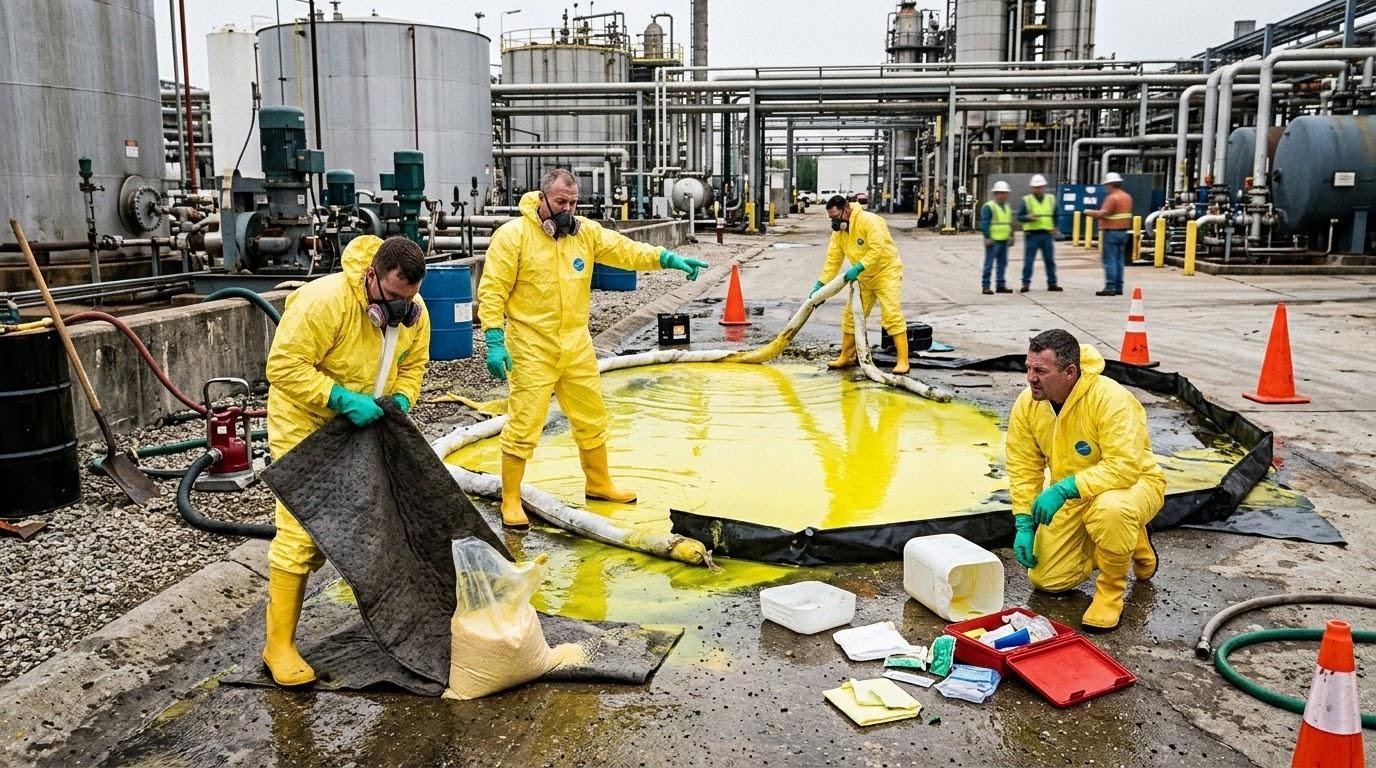
Booms, absorbent socks and drain covers should be deployed to create a physical boundary around the affected area before any removal takes place.
Getting water involved before containment is established consistently transforms a localised incident into a broader one.
Liquid finds the path of least resistance immediately and continuously. On a sloped concrete surface near a drain, a spill that looks contained in the first sixty seconds may have already reached the drainage system.
In an urban setting, stormwater infrastructure connects directly to waterways, and the transition from a workplace incident to an environmental event can happen faster than most people expect.
The tendency to pause and assess while a spill is still moving is one of the most common patterns observed in poorly managed incidents.
Containment is not something to begin once the situation is understood. It needs to begin while that understanding is still being formed, using whatever materials are immediately available while better-equipped personnel are mobilised.
Spill kits are not interchangeable. A general-purpose kit designed for hydrocarbons will not effectively contain an acid or an alkali.
A kit sized for minor incidental drips is not suited to a large-volume release. Kits that have been partially used and not restocked leave response personnel working with inadequate materials at the worst possible moment.
Businesses that store multiple chemical types need kits that match their specific risk profile, positioned at the locations where spills are most likely to occur.
Checking that kits are correctly stocked and that expiry dates on absorbent materials have not been reached should be part of routine site management, not something that gets discovered mid-incident.
The difference between a minor spill and a major one is not always obvious at first glance. Volume matters, but so does toxicity, location and proximity to drainage.
A small quantity of a highly reactive or toxic substance near a stormwater drain can constitute a major incident by any reasonable measure, while a large volume of a low-risk material in a bunded area may be entirely manageable on-site.
Classifying a spill too conservatively leads to under-resourcing the response. More personnel and equipment arrive than were needed, and the cost is some wasted preparation.
Classifying it too aggressively in the other direction — deciding it is minor when it is not — leads to an inadequate response, delayed escalation and outcomes that are far harder to manage than they needed to be.
When there is genuine uncertainty, treating the incident as serious until proven otherwise is the more defensible position.
Cleanup generates waste, and that waste inherits the hazard classification of whatever was spilled. Absorbents used to contain a chemical spill are hazardous materials.
Contaminated soil, PPE, equipment and drainage water all require appropriate handling and cannot be disposed of through general waste streams.
This is an area where corners get cut under pressure, particularly on sites where the cleanup itself has gone well and the incident feels resolved.
The collected waste being directed to an unlicensed facility or placed in general bins is where a well-managed response can still generate serious downstream consequences.
Licensed waste transport and disposal is not an optional final step. It is part of the response.
A spill response plan that exists only as a document has a known limitation: nobody on site has ever used it.
The first time it gets tested under real conditions, gaps in training, unclear responsibilities and missing equipment all become apparent simultaneously, exactly when there is the least capacity to deal with them.
Realistic drills, even simple ones, reveal practical problems that theoretical planning does not.
Where are the spill kits actually located relative to where spills are most likely to happen? Who contacts the external response provider, and does that person know the number? What happens if the first person to respond is not the person the plan assumed would be there?
Testing a plan before it is needed is the difference between a response that functions under pressure and one that improvises.
The businesses that manage spill incidents most reliably are almost always the ones that have practised.