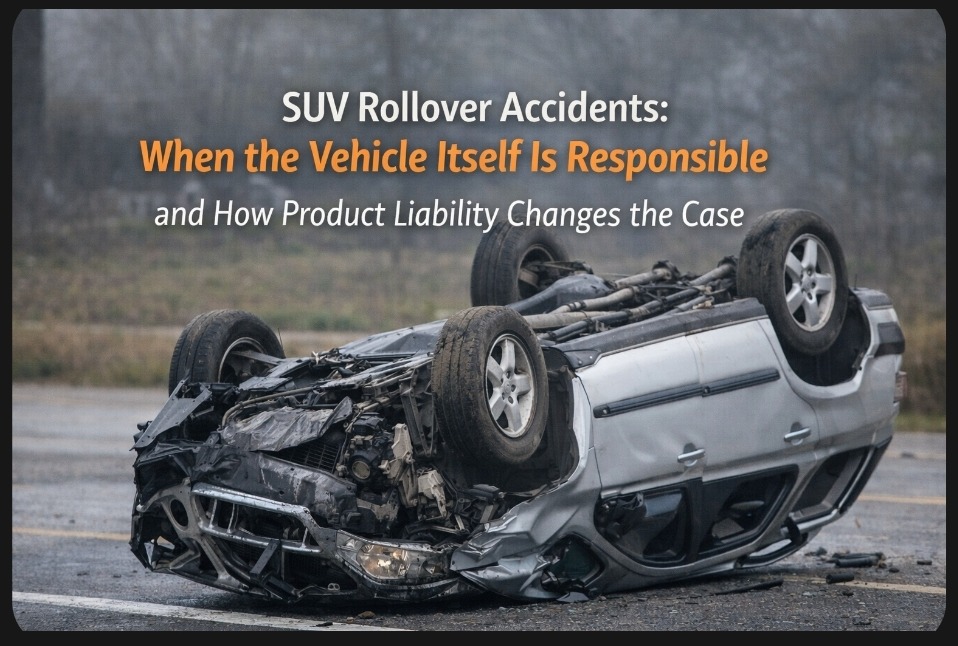
SUV rollover crashes are among the most lethal motor vehicle accidents, producing fatality rates that significantly exceed those of frontal and side impacts at comparable speeds. The elevated fatality rate reflects several physical realities specific to rollover crashes: the multiple impact sequences as the vehicle rotates, the risk of occupant ejection when windows and doors open under rollover forces, and the roof crush that occurs when the vehicle's roof structure, which was not engineered to the same standard as the floor and side structures, contacts the ground and deforms into the occupant space. For seriously injured SUV rollover victims and their families, the liability analysis must begin with a question that standard vehicle accident cases do not ask: was the rollover caused by driver error, or did a defect in the vehicle's design, its electronic systems, or its structural integrity make the rollover more likely, more severe, or more injurious than it should have been?
SUVs have a higher center of gravity than passenger cars by design, a consequence of the raised ground clearance and elevated seating position that define the category. A higher center of gravity increases the vehicle's susceptibility to rollover in evasive maneuvers, in sudden lane changes, and in tire blowout scenarios where the vehicle's response to steering inputs is amplified by the elevation of the mass it must control. When an SUV manufacturer designs a vehicle with a center of gravity height that increases rollover risk above what the vehicle's intended use requires, or when the stability control system is insufficient to counteract the rollover tendency the design creates, the manufacturer has produced a vehicle with a design defect that is present in every unit.
The specific analysis that establishes whether a given SUV's rollover tendency constitutes a design defect requires an engineering expert who can calculate the vehicle's tilt angle and rollover resistance index, compare those metrics to alternative designs in the same vehicle class, and establish whether a reasonable alternative design would have reduced the rollover risk without sacrificing the utility that justified the vehicle's configuration. The National Highway Traffic Safety Administration's rollover resistance ratings for specific vehicle models provide the publicly available baseline data that places the specific SUV's rollover susceptibility in its documented peer-group context.
Electronic stability control systems are designed to detect the pre-rollover instability that precedes most SUV rollovers and to intervene through selective braking and throttle reduction to correct the vehicle's trajectory before rollover occurs. ESC has been mandatory on all new U.S. passenger vehicles since the 2012 model year, and its introduction produced a documented reduction in rollover fatalities. When an ESC system fails to intervene as designed, when intervention occurs too late to prevent rollover, or when a system defect causes the ESC to apply corrections that worsen the instability rather than correcting it, the manufacturer's product liability for the resulting rollover is independent of any driver error that contributed to the pre-rollover instability.
When a rollover occurs, the adequacy of the roof structure's resistance to crush determines whether the occupant space is maintained through the rollover sequence or whether the roof deforms into the occupant compartment and contacts occupants. Federal Motor Vehicle Safety Standard 216 establishes minimum roof strength requirements, but research has consistently documented that vehicles meeting the minimum standard still produce roof crush that contributes to occupant injury in real-world rollovers. A vehicle whose roof crushes significantly beyond the FMVSS 216 minimum in a rollover that the standard was designed to address has a roof design that, while technically compliant, may still be the subject of a design defect claim when the analysis establishes that a stronger, equally feasible roof design would have prevented the specific occupant injuries.
The NHTSA's SUV rollover safety data and ratings provide the vehicle-specific rollover resistance and roof strength data that frames the product liability analysis. An experienced SUV rollover accident lawyer evaluates both the driver negligence and product liability theories from the first day of representation and retains the engineering experts needed to develop whichever theory the specific vehicle's design and the specific crash sequence supports.