Buena Park, California, May 2026 - For millions of families around the world, financial support from relatives living abroad carries significant economic weight and serves as a primary source of stability for households globally.
Ria Money Transfer, one of the world's leading money transfer companies, has published a new study analyzing the profound impact of remittances in key recipient countries, including Mexico, India, and Colombia. The report explores how these funds are integrated into the daily budgets of households and the critical role they play in both local economies and times of urgent need.
The data reveals that remittances represent a meaningful share of the national economy in these regions. According to 2024 data from the World Bank, remittances account for approximately 3.7% of the national GDP in Mexico, 3.5% in India, and 2.8% in Colombia.
These percentages represent billions of dollars that directly sustain communities and drive economic activity. Pennsylvania has a large and established immigrant population with deep roots in Latin America, South Asia, and other parts of the world. For many of those residents, these figures land close to home. Sending money abroad is a routine part of the month, built into budgets alongside rent, groceries, and utility bills.
Reports from institutions such as the World Bank, the Federal Reserve Bank of Dallas, and CSIS indicate a clear pattern: when families receive remittances, the money is primarily used to cover basic household needs. These funds are consistently directed toward:
These regular transfers provide immediate stability to daily life and strengthen long-term financial security for receiving families.
While remittances are primarily used for everyday essentials, the Ria Money Transfer study also highlights how this support intensifies when families face serious disruptions. By analyzing search behavior, the report shows clear spikes in the urgency of sending money linked to climate-related emergencies.
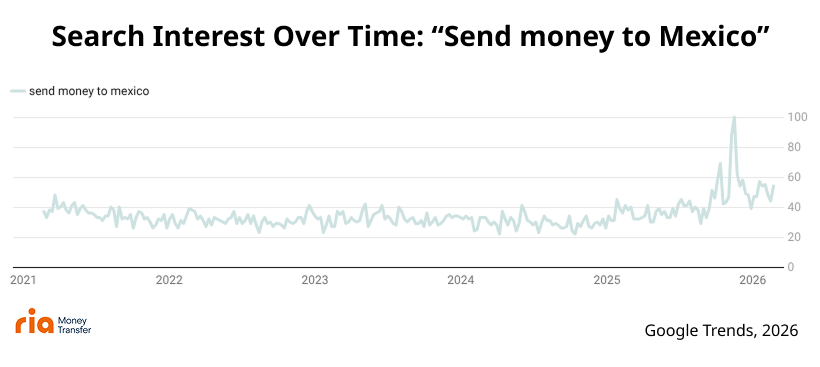
In November 2025, for example, searches for "send money to Mexico" reached their highest level of the year during severe flooding in the country.
A similar pattern appears in other destinations such as India, where interest in sending money increased sharply during the most intense periods of last year's monsoon season.
In Colombia, increases were also recorded during episodes of flooding and climate-related emergencies throughout 2025.
The data clearly reflects that while family support is ongoing, it becomes a rapid response mechanism when crises directly impact households. That response tends to be fast and personal. When a flood or a health scare hits, people here don't wait to see what aid organizations will do. They get on the phone, check what they can spare, and send it the same day; for many immigrant families in this region, that kind of immediate action is simply part of how they look after the people they love.
The study underscores that remittances are a steady source of support woven into the lives of millions of households. Behind every transfer is a decision rooted in care and responsibility, helping families stay close and support one another from thousands of miles apart.
What this report captures, in numbers, is that building a life here while keeping a family afloat somewhere else takes financial discipline, careful planning, and a lot of trust in the tools that make those transfers possible. The data is global in scale. But in communities like North Penn, it has a face.
Read the full report to discover what the data reveals about the economic weight of money transfers, and understand how these "back-home budget" transfers influence the daily finances and resilience of many international households.