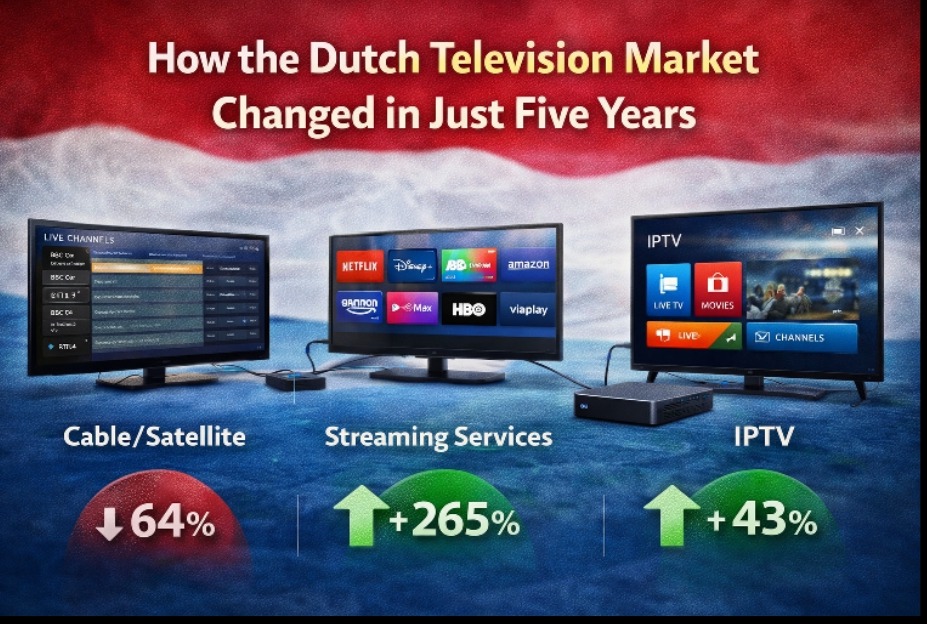
In 2021, traditional cable and satellite providers dominated the Dutch living room. The set-top box was a fixture in nearly every household, monthly cable bills were accepted as a fact of life, and the idea of watching live television through the internet was still associated with unreliable streams and poor picture quality.
By 2026, the landscape looks entirely different. Cable subscriptions are declining, satellite dishes are disappearing from rooftops, and a significant portion of Dutch households now watch television through IPTV. The transformation happened faster than most in the industry expected, driven by changes in infrastructure, consumer expectations, and economics that converged at the same time.
The foundation of this shift was broadband infrastructure. Five years ago, fibre-to-the-home connections were available in most Dutch cities but were still being rolled out across suburbs and rural areas. Many households relied on older connection types that could handle basic streaming but struggled with the demands of live television in high definition.
The aggressive fibre rollout by multiple competing providers changed this. By 2026, fibre coverage in the Netherlands has reached near-total saturation. Competition between providers has driven speeds up and prices down, giving the average Dutch household access to gigabit-level connections that far exceed what IPTV requires.
This created the technical conditions for IPTV to work reliably at scale. When the connection is fast and stable enough to stream 4K video without interruption, the argument for maintaining a separate cable infrastructure weakens considerably. The Netherlands reached this tipping point earlier than most European countries because of the pace and competitiveness of its fibre rollout.
Dutch consumers in 2026 expect something fundamentally different from their television service than they did five years ago. The expectations have been shaped by how they interact with every other digital service in their lives.
They expect to watch content on any device, not just on a television connected to a specific box. They expect to start and stop subscriptions without contracts or penalties. They expect transparent pricing without promotional rates that double after the first year. They expect to control what they watch, when they watch it, and where they watch it.
Traditional cable and satellite providers were not built to deliver on these expectations. Their business model is based on bundled packages, long-term contracts, proprietary hardware, and pricing structures designed to retain subscribers through obligation rather than satisfaction. The gap between what these providers offer and what modern Dutch consumers expect has widened every year.
IPTV Nederland services have filled that gap by aligning with how consumers already interact with digital services. No contracts. No proprietary hardware. Content on every device. Simple pricing. Cancel anytime. For a generation of Dutch viewers raised on digital flexibility, this model feels natural — and the old model feels increasingly outdated.
The shift in consumer expectations might have happened more gradually if not for the economic pressures that Dutch households have faced over the past few years. Rising costs across housing, energy, food, and insurance have forced families to scrutinise recurring monthly expenses more carefully than before.
Television and entertainment subscriptions became an obvious target. When a household is paying €60 to €90 per month across cable and multiple streaming services, the annual cost exceeds €700 to €1,000. For many families, this prompted a simple question: is there a way to get the same content for less?
IPTV provided the answer. A comprehensive subscription that includes live channels, sports, on-demand content, and catch-up functionality — for €5 to €15 per month — replaces what previously required a cable subscription and multiple streaming services. The saving is not marginal; it is substantial enough to influence household budgets.
For Dutch viewers who made the switch, the day-to-day experience of watching television changed less than they expected. The channels are the same. The content is familiar. The electronic programme guide works similarly to what cable provided. Live sport looks the same on a fibre-delivered IPTV stream as it does through a cable connection.
What did change is the practical experience around the television. The set-top box was replaced by a streaming device or a smart television app. The monthly bill dropped significantly. The ability to watch on a tablet in the kitchen, a phone on the train, or a laptop while travelling became standard. The contract that once locked the household in for 18 months was replaced by a subscription that can be cancelled at any time.
For most viewers, the switch felt less like a dramatic change and more like an overdue simplification. The content they wanted was still there — it was just delivered more efficiently, more flexibly, and at a lower cost.
The Dutch television market in 2026 is not what anyone predicted five years ago. The speed of the transition caught traditional providers off guard and left them competing for a shrinking pool of subscribers willing to pay premium prices for a rigid service.
IPTV is no longer an alternative — for a growing number of Dutch households, it is the default. The infrastructure supports it, the economics favour it, and the viewing experience matches what cable delivers. The set-top box era is not over entirely, but in the Netherlands, it is clearly in decline.
The households that have not yet switched are increasingly those who simply have not evaluated the option rather than those who have considered and rejected it. As awareness grows and more neighbours, friends, and family members make the transition, the remaining cable subscribers face a decision that most of them will eventually make — because the numbers and the experience both point in the same direction.