Learn how you can care for a pup during its first year of life as it trains for its future as a guide dog.
Ringo Starr sang on The Beatles 1967 “Sgt. Pepper’s Lonely Hearts Club Band” album, “I get by with a little help from my friends.” And sometimes, those friends are four-legged and furry.
The Seeing Eye knows all about that. Since 1929, the nonprofit organization has been matching seeing eye dogs with blind handlers to create “teams” with success. And now, the New Jersey-based 501(3)(c) is seeking help from you. Could you be the newest member of its puppy raising squad?
Lauren Christie, Director of K9 Development with The Seeing Eye, said that the nonprofit is in need of more puppy raisers in the area. As the network serves all 50 states, Canada, and Puerto Rico, they have a huge and constant need for new dogs. But these dogs aren’t just born with these skills, they have to be learned.
Before they can go to the school, the puppies have to be around a year old. Until then, they require special care, and that’s where the puppy raisers come into service.
The Seeing Eye utilizes four main breeds for its work. The German Shepherd, Labrador Retriever, Golden Retriever, and Lab Golden (a cross of both a Labrador and Golden retriever) typically serve the need best.
“They are very common for most guide dog schools,” said Christie. The school teaches its students (yes, the dogs) through their “graduation,” and its staff has found not only do the breeds make the best learners, but they have a wonderful skillset, too.
“They are known for their intelligence,” said Christie. “They have the training ability, the temperament for the job, and have excellent health and longevity.”
Christie said that the dogs must not only be able to learn, but also to make decisions on the fly. She said a crucial skill to teach the students is called "intelligent disobedience.”
“These dogs are unique in the service dog world,” she said. “Unlike most trained dogs who task on command, like forward, left, right … [seeing eye dogs] have to make real-time decisions when they are guiding.”
Christie said that tasks like navigating through a crowd, around an obstacle, or through potentially dangerous spaces requires this unique skill.
“Intelligent disobedience is disobeying a command if it is unsafe for the team,” she explained. A “team” is the trained seeing eye dog and its handler, the blind owner.
Christie provided a scenario to explain.
“If you are a guide dog handler, imagine getting off of a subway at the platform,” said Christie. “Someone bumps into you, you get turned around, and you think you are facing the stairs to exit the subway, but you are facing the rails below you. The dog disobeys the command to move forward and directs you instead left or right toward the stairs.”
A similar scenario can happen when at a crosswalk facing traffic.
“They do the same with cars,” said Christie of the trained dogs. “Blind handlers use hearing most when crossing a street. They’re listening for parallel traffic, but today’s cars are quieter. You don’t always hear a car idling, and you think the crossing is clear. You tell the dog to walk forward, but the car may be turning red or you don’t hear it in front of you.”
In this case, a trained guide dog will “disobey” the forward command, and instead make the safe decision for the team.
“The dog will stop and avoid the car on your behalf,” she said. “It is very interesting and a very challenging skill, especially for dogs that want to please you and follow your commands.”
As these dogs don’t just come out of the womb, ready to train, they must first be raised with such future endeavors in mind.
“There is a process of preparing a guide dog,” explained Christie. “They say, ‘it takes a village,” and that’s true. Many people are involved in creating a seeing eye dog.”
Dogs with The Seeing Eye are bred and born at a Chester-based campus.
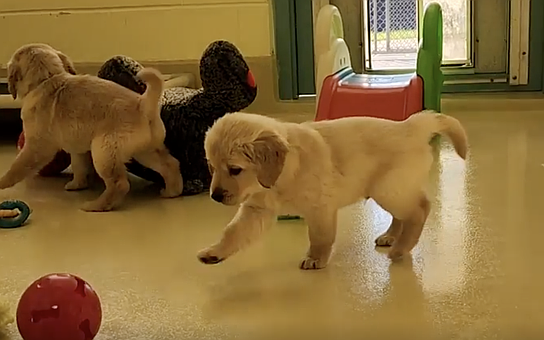
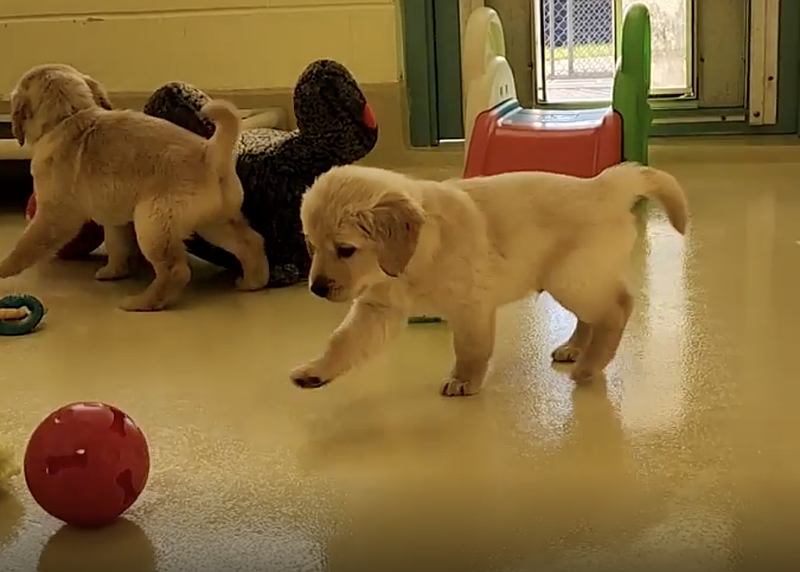
“They spend the first two months of life being cared for by our vet team and technicians who do early socializing,” said Christie. “But once they are seven or eight weeks old, they are ready to take the next steps. They are reading to live in the home of a volunteer puppy raiser.”
The future students will then live with a puppy raiser for about a year.
“They provide the foundation for when the dogs are ready to come back and learn the formal guide works,” said Christie. She explained that a puppy raiser will foster the dog, caring for them, feeding, and getting them to vet appointments or social gatherings.
“We cover the vet expenses and the food, as well,” said Christie. But a puppy raiser provides the TLC, transportation, and baseline skills as the puppy explores the world for its first year.
“With permission from local businesses and the community, they experience the world they’ll eventually be working in,” said Christie. From busy traffic areas, to local schools, museums, libraries, and shops, the puppy raisers are encouraged to visit a variety of spots with the dog in training. However, puppy raisers don’t have to go it alone.
The Seeing Eye organizes outings and educational opportunities for the dog.
“Every year we do a big trip to Newark Airport,” said Christie, as just one example. “We go through TSA and practice getting on a plane.”
She said such outings are crucial to the early learning for the pup.
“These are important experiences for the dogs to have throughout their life,” said Christie. “When they are matched with a blind handler, we want them to be comfortable, calm, and relaxed in scenarios, so they can focus on the job, keeping their handler safe and paying attention.”
In addition to outings and suggestions, puppy raisers offer The Seeing Eye’s dogs life experience.
“Our puppy raisers know a lot about dogs,” said Christie. “They provide them with early experiences. We have a diverse group of puppy raisers, and really anyone willing and interested in doing this and has time to commit to it, we want to talk to you.”
Christie said that being a puppy raiser does not require any experience.
“It’s OK to have kids, other pets … it’s all a great experience for our puppies,” said the development leader. “Our dog may be matched with someone with kids, or another pet. It is a diverse range of people that come to get guide dogs from us.”
The Seeing Eye provides all training the puppy raiser will need.
“Our puppy raisers are organized into county clubs,” said Christie. The clubs then meet once or twice a month, providing a club leader, a staff liaison (called an “area coordinator”) and other club members, many with years of experience.
“When people puppy raise for us, they stay for decades and even generations,” said Christie, who noted the organization even provides a manual for raising puppies. “It is a great community with resources to raise a puppy.”
After the “puppy year,” the dog will become an age to begin school. Outreach programs connect The Seeing Eye with blind owners in need of a guide dog.
“The handlers are totally blind,” said “They have orientation ability skills, and can travel independently. They have a use for a dog, as they will be out work a dog every single day.”
After an extensive process of interviews, applications, and in-person meetings, a dog is matched to its handler with the help of a professional instructor. They will review what it is like to have a guide dog, review expectations on exercise, training, and answer any questions the new handler may have.
The team will then be matched based on what the schools calls a “Juno walk.”
“The instructor kind of mimics what it will be like to work with a guide dog,” said Christie, noting the team assesses speed of walking, gait, and style. “How much pull they like on a harness, that’s an individual preference on how much pull someone needs to guide them comfortably.”
Christie said that personalities, energy levels, and home locations are then considered in the matching process.
“A person in rural Oklahoma does not have the same needs as someone in New York City,” said Christie. She said the matching process is very individualized to seek success.
“It is like two pieces of a puzzle,” she said. “You want to make sure they fit.” She noted sometimes there is also just a “feel” to it. “That’s why we have such a range of individuals getting a dog, that it is good to have a range of dogs as well to meet everyone’s unique needs.”
With puppy raisers typically in the New Jersey, eastern Pennsylvania, Delaware, or Rockland or Orange counties in New York, there is a wide network of puppy raisers in the region.
Christie said that one of the biggest worries new puppy raisers have is the inevitable departure. After all, puppy raisers are just that: raising puppies. Once the dog is of a school-appropriate age, they will move on to their future training.
“The biggest barrier in participating in puppy raising is the fact that the dog returns to us,” said Christie. “It is hard for people to say, ‘goodbye.’”
She said the final step is not easy, but is often done with a happy outlook.
“All puppy raisers will tell you, it is very sad to say, ‘goodbye.’ Your heart breaks each time,” said Christie. “But there is a gratification that our raisers have reported, knowing the dog is going off to do bigger and better things. Many equate it to the feeling of sending a kid off to college. You’re proud of their success, you are excited they are going to make a difference in the world.”
In addition to the love, fun, and memories, Christie added that puppy raisers find great joy, camaraderie, and community in the role.
“We’ve become, since COVID, a very isolated society, working from home and more loneliness,” she said. “But as a puppy raiser, you become part of the community. There are organized group outings, and it is all pulled together with a love of dogs and wanting to do good in the world. It is nice to be a part of something.”
Christie added that working from home can make for a great environment for puppy raising. Who wouldn’t want to have a pup on their lap all day long?
To learn more about becoming a puppy raiser with The Seeing Eye, visit the site at https://seeingeye.org/puppy-raising/. Volunteer hopefuls can submit an application online and learn more about the role on the website. Christie said that, from there, a volunteer with the organization will reach out to speak with you more on the role.
To financially donate to The Seeing Eye, click here. The nonprofit is a 501(3)(c), registered with the IRS.