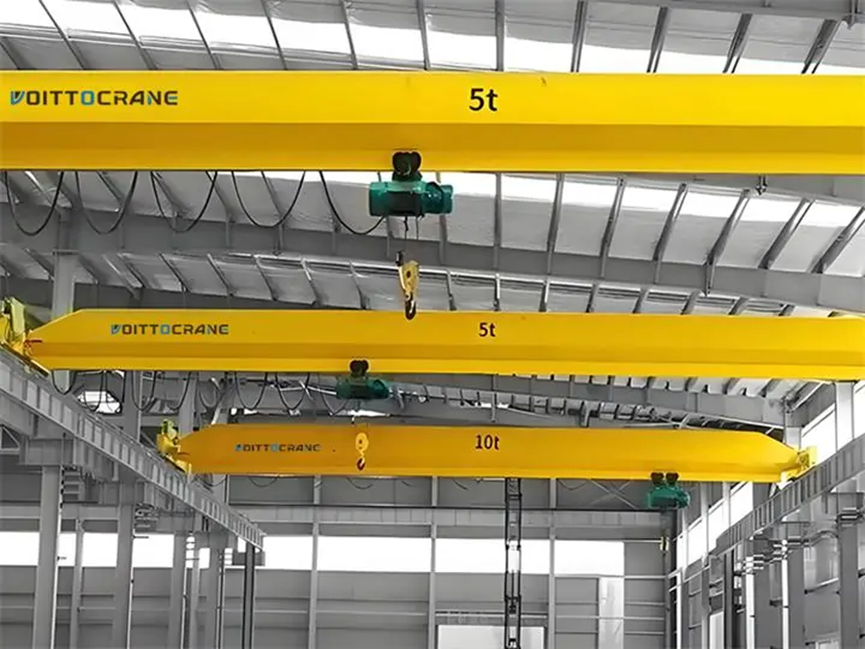
A single girder overhead crane is the most widely used lifting solution in light to medium industrial environments. It handles loads from 1 to 32 tons, fits workshops with limited headroom, and costs significantly less to install and maintain than a double girder alternative.
But "single girder" is not one product. It is a category covering four distinct configurations — each suited to different environments, load cycles, and building structures. Choosing the wrong type means either over-specifying and wasting capital, or under-specifying and facing reliability problems within the first two years of operation.
This guide is written for both procurement managers making the commercial decision and facility engineers verifying technical fit. By the end, you will know which crane type matches your application, which specifications to confirm before ordering, and what to watch for in supplier evaluation.
A single girder overhead crane uses one main bridge beam running between two end beams. The electric hoist travels along the lower flange of that main beam, giving it horizontal movement across the bay. The crane itself travels longitudinally along runway rails mounted to the building structure or a freestanding frame.
This configuration is lighter than a double girder design. That matters for two reasons. First, it places less structural load on the building. Second, it reduces the crane's own weight — which directly affects running costs and the required runway beam size.
The trade-off is hook height. Because the hoist hangs below the main beam rather than running on a rail between two beams, the available lifting height is lower for the same building clearance. In facilities where maximum hook height is critical, this becomes a deciding factor.
The LD type is the most common configuration in general manufacturing. It top-runs on rails mounted above the runway beams, which maximises the span capability and load rating.
Typical specifications:
Best suited for: Factory workshops, textile facilities, food and beverage production, general material handling where moderate duty cycles apply.
The underslung crane hangs from ceiling-mounted rails rather than sitting on top of them. This frees up floor-level and ground-level space that top-running runway structures would otherwise occupy.
Typical specifications:
Best suited for: Compact workshops, sewage treatment facilities, maintenance bays, and any environment where structural columns cannot support a conventional runway system. The lower load rating reflects the suspension design's structural limits.
Identical in structural concept to the LD type, but fitted with explosion-proof electrical components throughout — motor, hoist, control panels, and pendant.
Typical specifications:
Best suited for: Petroleum processing, chemical plants, gas storage, and any environment where flammable gas or vapour may be present. The A3 duty rating reflects the typically lower cycle frequency in these environments.
The HD type uses a European-standard electric hoist rather than a conventional Chinese-standard unit. European hoists are more compact, which reduces the crane's dead weight and — importantly — increases the available hook height for the same building clearance.
Typical specifications:
Best suited for: Facilities where maximising headroom matters, or where higher lifting efficiency is required from a lighter crane structure. The HD type is also the appropriate choice when CE marking under FEM European standards is required.
Span is the horizontal distance between the centrelines of the runway rails. It is not the same as bay width. Measure accurately — errors here affect both crane cost and installation.
Lifting height is the vertical distance from the floor to the hook at maximum elevation. Confirm your required hook path against actual building clearance — subtract the crane beam depth, hoist housing height, and any obstruction clearance margins.
Work duty is the most frequently misunderstood specification in single girder crane procurement. It defines how intensively the crane is designed to operate, based on:
Under FEM 1.001 and ISO standards, duty classes run from A1 (very light, occasional use) to A8 (continuous heavy duty). Most of the single girder configurations above are rated A3 to A5.
Why this matters: A crane specified at A4 used in an A6 duty application will experience accelerated wear on the hoist, brakes, and structural welds. Components that should last 10 years may require replacement within 3. This is one of the most common — and most avoidable — procurement errors in the category.
If you are unsure of your required duty class, your crane supplier should calculate this from your production cycle data before finalising the specification.
Single girder cranes are typically offered with three control options:
For most light manufacturing applications, pendant or radio remote control is sufficient. Cabin control is more common in double girder configurations above 20 tons.
For international buyers, confirm the following before placing an order:
Request actual documentation. Certificate claims without supporting paperwork are not verifiable.
A credible manufacturer conducts 100% load testing on every unit before dispatch. Ask whether pre-delivery test reports are provided as a standard deliverable. This is a basic quality assurance step — not a premium add-on.
The electric hoist is the highest-wear component on a single girder crane. Wire rope, brake linings, and hoist motors will need replacement over the crane's service life. Confirm that the manufacturer holds inventory for these items and can provide realistic lead times for your region.
Before finalising your specification, confirm:
Voitto Crane is a crane manufacturer based in Henan Province, China, with over 26 years of design, manufacturing, and export experience. The company produces single girder overhead cranes across all four main configurations — LD, LX, LB, and HD European — with capacity from 1 to 32 tons and spans to 34 metres. Equipment holds ISO 9001 and CE certifications and has been delivered to customers in more than 80 countries across Southeast Asia, the Middle East, Africa, and South America.
Q: What is the maximum capacity of a single girder overhead crane?
Standard single girder configurations handle loads from 0.5 tons (underslung type) up to 32 tons (HD European type). The LD and LB types are rated to 20 tons. Capacity above 32 tons typically requires a double girder design, which distributes the load across two bridge beams and allows a higher-capacity hoist to be mounted between them.
Q: What is the difference between a top-running and underslung single girder crane?
A top-running crane sits on rails mounted above the runway beams, using the full span of the building. An underslung crane hangs from ceiling-mounted rails below the structure. Underslung designs save floor-level space and avoid the need for ground-supported runway columns, but are limited to lower capacities — typically up to 10 tons — due to the structural limits of ceiling suspension.
Q: How do I calculate the correct span for my single girder crane?
Span is measured between the centrelines of the two runway rails, not between building columns or walls. Deduct clearances on each side for safe hook travel. Your crane supplier should confirm span against your building drawings before finalising the design — errors in span specification are difficult and costly to correct after manufacture.
Q: When should I choose an HD European type over a standard LD crane?
The HD European type is worth specifying in three situations: when maximum hook height matters and you need the most compact hoist to maximise headroom; when CE marking under FEM European standards is required by your market or client; or when you need to lift loads above 20 tons within a single girder configuration. The European hoist's lighter, more compact design also reduces structural load on the runway system compared to a conventional hoist of equivalent capacity.
Q: What maintenance does a single girder overhead crane require?
Key maintenance items include wire rope inspection and replacement (based on ISO 4309 discard criteria), brake lining wear checks, lubrication of hoist gearbox and travel wheels, and inspection of end beam connections and runway rail alignment. The electric hoist is the highest-wear component and typically drives the maintenance schedule. Most manufacturers recommend formal inspection intervals at 3 months, 6 months, and annually, with daily pre-shift visual checks by the operator.