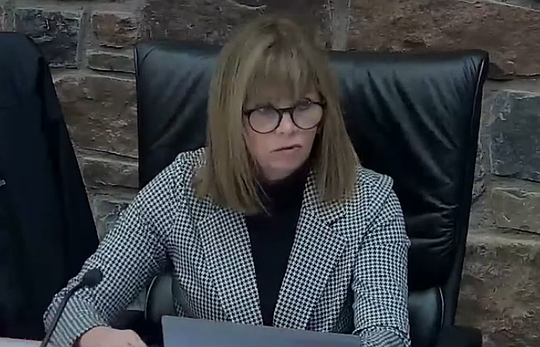
Board discussion centers on consent, meeting procedure, and where written comments should be introduced after recent tensions over emails read aloud at meetings
A discussion Monday night over whether Montgomery Township should amend its public meeting guidelines ended without a formal policy change, but not without a pointed and at times personal debate over how supervisors should handle emails and letters from residents who want their comments read aloud at meetings.
The issue came up under old business as supervisors revisited a public comment resolution, which formalized the township’s long-standing public meeting rules in 2022 after staff and the solicitor recommended consolidating earlier guidance dating back to 1999, 2009, and 2013.
Those rules govern public participation, speaker time limits, decorum, and how comments are reflected in meeting minutes, but Township Manager Carolyn McCreary said the immediate question grew out of a more recent concern raised at the board’s March 9 meeting: residents sending written comments to supervisors and asking that they be read into the record at public meetings.
“At the March 9 public meeting, Supervisor Pelletier brought up the recent emails and letters being sent to the board with the sender requesting that they be read at public meetings,” McCreary told the board. “Board consensus at that meeting was to review the resolution identified above and discuss any proposed modifications at your next public meeting.” She said a copy of Resolution 2022-03 had been included in the board’s packet for review and possible direction to staff.
Township Solicitor Sean Kilkenny quickly drew a line between the existing resolution and the controversy that sparked the discussion.
“This resolution is mainly set up to regulate public comment, meaning people who would come up or wish to do this,” Kilkenny said. “If the board wishes to regulate supervisor comment, it would have to be done under a different mechanism, by Robert’s Rules of Order.”
He cautioned that the current resolution “does not really address that, or it is not really built for that,” adding, “I just wanted to make that very clear.”
Kilkenny did note one part of the resolution that has already fallen out of step with current practice. The 2022 guidelines still state that speakers should provide their name and address, but Kilkenny said recent case law has changed that.
“There has been a change in case law in the last two years where you can’t ask for somebody’s address,” he said. “We have just been asking, ‘Are you a resident or business owner of Montgomery Township?’ I have instructed all our clients to do that. This says address now. We have not been doing that in practice, but when we do eventually clean this up, that would be something we would address.”
From there, the conversation moved away from formal amendments and toward the board’s recent friction over how written comments have been handled.
At a supervisors meeting in February, Board Chair Tanya Bamford stopped Montgomery Township Supervisor Candyce Chimera from reading emails sent to her from people in support of former Fire Chief Bill Wiegman’s return and detailed the volume of community backing he has received.
She read excerpts into the record, many of which expressed repeated praise for Wiegman’s unification of the department’s career and volunteer ranks, quoting supporters who credited him with eliminating a longstanding divide. After being cut off by Bamford due to time limits while reading letters, Chimera was granted two additional minutes at the end of the meeting to read submitted remarks.
On Monday, Chimera urged a lighter touch and less procedural escalation.
“Can we maybe just figure that we can be kinder to each other?” Chimera said. “This was all pushed at me. I read the emails. I have them. I certainly could read their names into the record, but I do not think it is a good road for us to go down to try to quiet anybody’s right to speech.”
She said that if someone is going to read an email, the sender’s name should be included, adding, “I mean, it is really not that difficult. I do not think we need to do any changes.”
Supervisor Audrey Ware-Jones said her concern was less about the reading itself than about whether supervisors had clear permission to publicly use someone’s written comments.
“The only concern I have is if we read an email, someone says, ‘Can you read it into the record?’ and you do, and you say their name, and then maybe they come back at us and say, ‘I never said you could read that. I never said you could,’” Ware-Jones said.
She floated the idea of having a simple written acknowledgment from residents who ask that a message be read.
“Can we do something like that just to kind of cover ourselves in some form or fashion? That is the only thing. I feel like this could kind of come back at us if you read someone’s statement,” she said.
She added that when she has read letters in the past, she has made a point of asking whether the sender was comfortable being identified.
“Anytime I have read a letter, it has been a situation where someone said, ‘Can you read it?’ I am like, ‘You are OK if I say your name?’ Because my expectation is I am going to say your name. I am not going to just read something and not say a name,” she said.
Bamford then turned the question squarely back to Kilkenny, asking whether written comments sent through official township channels carried any implied consent to be read publicly, and whether supervisors had any obligation to read them at all.
Kilkenny said the answer to the second question was straightforward.
“One, you have no obligation to read it into the public record,” he said. “That is merely comment to you as a supervisor. You can do what it is you want. You can choose not to read it into the public record.”
As for consent, Kilkenny said there is no bright-line rule, but he recommended a practical safeguard.
“I would recommend, and I do not think there is any hard and fast rule on this, but I would respond to them and say, ‘Thank you very much for your comment. Mind if I address this at the next meeting? I will state your name and that you are a township resident or business.’ I think that would cover you," he said.
If the sender agrees, he said, then it is up to the individual supervisor whether to read it aloud.
Pressed further by Bamford on whether consent could be considered implied when a resident uses an official township email account to send a statement to a supervisor, Kilkenny said that argument could likely be made if the issue were ever challenged.
“I think you could make the argument that if someone is sending it to a supervisor at their official township email and that supervisor went and read it, I think you could argue consent pretty persuasively,” Kilkenny said. “You would hope you would never get there, but I think if it were challenged, you would say, ‘Hey, you sent this to me at a public email. I was expressing your views at a public meeting.’”
Still, he said, “taking that next step is probably the safest thing to do.”
Bamford also raised a second question: not only whether written comments should be read, but when and where they should be read if supervisors choose to do so. She pointed to the township’s public comment period at the start of meetings as the natural home for statements not tied to a listed agenda item.
“Unless there is a comment that has come in related to a specific agenda item, then that public comment section would seem to be the most appropriate place for those types of letters, if we are going to allow them to be read, and not sort of randomly elsewhere on the agenda,” Bamford said.
Kilkenny declined to give a definitive ruling under Robert’s Rules, saying he had not specifically researched whether that exact question was covered, but he suggested the board decide how much it wanted to regulate the practice.
“The question is, how much do you want to regulate that? Does it come up that frequently?” he said. “Would we want to pass a resolution among supervisors asking that be the practice? Or is it more a gentleman’s agreement on how you are going to handle it?”
That became the board’s path forward.
Bamford proposed an informal consensus.
“Can we agree that if we have received written communication from a resident or a business owner in the township that we feel needs to be read into the public record, that we will, one, get the consent of the individual, and two, read it in public comment or when related to a specific agenda item on the agenda for that meeting?” Bamford asked.
Supervisor Eric Pelletier answered, “I think that is reasonable.” Ware-Jones agreed and said that, in her experience, that is largely how things have already been handled.
“Anytime I have read something, it is because someone said, ‘I am not able to get to the meeting. Can you read this?’ And then my next question is, ‘Are you okay if I say your name?’ And they are, and that is the approach I take,” she said.
Bamford then made clear what had prompted the discussion in the first place.
“In the situation in question, there was a series of comments that were read into the record, excerpts of comments without individuals’ names,” she said. “So we did not know whether or not they were township residents. We did not know whether or not they were township businesses. And it was read under old business.”
She said that when she redirected those comments at the time, it was taken as rude, though that was not her intent.
“I was certainly not intending to be rude, but trying to redirect comments that were being made in a section of the meeting where it was procedurally not appropriate to have those comments," Bamford said.
She closed by urging the board to move forward with a shared understanding rather than a formal rewrite.
“If we can just all agree that this is how we are going to proceed moving forward, I think we can avoid any sort of unpleasantness related to when things are or are not read into the record,” Bamford said.
Pelletier replied, “I am good with that.” Chimera added, “That works.”
So while the resolution remains unchanged for now, Monday’s discussion effectively produced a new, informal practice: written comments can still be read by supervisors, but the board now appears aligned on two guardrails — get the sender’s consent, and place the comment in the procedurally appropriate part of the meeting.