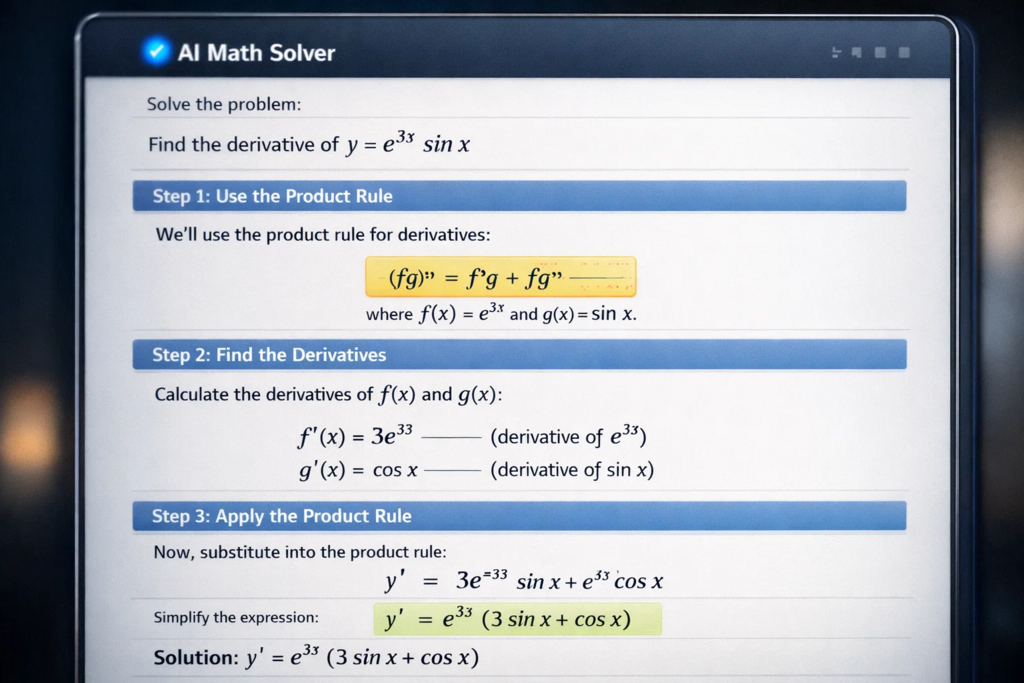
Mathematics has always demanded patience. From solving linear equations in algebra to navigating derivatives and integrals in calculus, the journey often involves multiple steps, careful checking, and a fair amount of frustration. This is exactly where modern AI productivity tools are starting to reshape the experience. A well-designed AI Math Solver doesn’t just give answers - it walks through the process, reducing both time and cognitive load.
In a how-to context, understanding how these tools work - and how to use them effectively - can make a noticeable difference in both learning speed and problem-solving confidence.
Traditional math-solving methods rely heavily on manual processes: rewriting equations, applying formulas step by step, and verifying results. While this builds foundational understanding, it can slow down progress - especially when dealing with repetitive or complex problems.
AI has introduced a different workflow. Instead of starting from scratch each time, users can input a problem and immediately see a structured breakdown. This is particularly useful when transitioning from algebra to calculus, where the logic becomes more abstract.
For example, solving a quadratic equation and computing a derivative may seem unrelated at first. But with an AI Math Solver, both are handled within the same interface, using similar step-by-step logic. The continuity helps users recognize patterns across different branches of math.
There’s also been a shift in accessibility. What once required specialized software or textbooks is now available online, often without barriers. You don’t need to install anything or even create an account in many cases.
Not all tools deliver the same experience. When choosing an AI-powered solution, a few characteristics stand out:
Clarity of explanation
A correct answer is useful, but a clear explanation is what enables learning. The steps should feel logical, not rushed.
Flexible input methods
Typing equations works for simple problems, but more advanced users benefit from uploading handwritten notes or screenshots.
Consistency across difficulty levels
A reliable tool should handle both basic algebra and introductory calculus without a noticeable drop in quality.
Speed without sacrificing structure
Fast results matter, but not at the cost of skipping essential steps. The process should remain visible.
Interestingly, most users don’t realize how much time they spend just rewriting equations until they stop doing it. That small shift alone can make math feel less tedious.
Speed is where Arting AI becomes especially practical. Instead of spending several minutes interpreting a problem, rewriting it, and then solving it manually, you move directly into the solution process.
When using an AI Math Solver within Arting AI, the workflow feels straightforward:
This process-based approach means you’re not just getting an answer - you’re seeing how each step connects. That’s particularly helpful when working through calculus concepts like limits or derivatives, where missing a single step can lead to confusion.
Instant problem solving
Instead of manually working through each transformation, the tool processes the equation and delivers a complete solution flow almost immediately.
Text and image support
You can type equations or upload photos of handwritten work. This flexibility makes it easier to handle real-world study scenarios.
Step-by-step explanations
Each solution is broken into logical stages, helping you understand not just the “what,” but the “why.”
Free and accessible
There’s no need for setup. You can start solving problems directly online without logging in.
Even with these advantages, it’s important to use the tool appropriately:
This doesn’t reduce its usefulness - it simply defines where it fits best: everyday learning, homework support, and concept reinforcement.
The usefulness of an AI Math Solver extends across different types of users:
Students
From high school algebra to early university calculus, students can quickly verify answers and understand mistakes.
Self-learners
Those revisiting math after a break often need guidance more than answers. Step-by-step explanations help rebuild confidence.
Content creators and educators
When preparing materials, solving multiple variations of a problem becomes significantly faster.
Busy professionals
Even outside academic settings, quick calculations and formula checks can save time.
There’s also an interesting overlap with other AI productivity tools. For example, someone using a YouTube Transcript Generator to study lectures can pair it with an AI Math Solver to immediately work through problems mentioned in the video. The combination creates a more complete learning loop.
Moving from algebra to calculus doesn’t have to feel like a steep climb. With tools like Arting AI, the process becomes more structured, faster, and easier to follow. Instead of getting stuck on individual steps, you can focus on understanding the broader concepts.
What makes this shift meaningful isn’t just automation - it’s accessibility. You can explore complex equations without needing advanced software or extensive setup.
As AI tools continue to evolve, their role in learning will likely expand beyond individual tasks. Pairing solutions like an AI Math Solver with tools such as a YouTube Transcript Generator allows users to move seamlessly between learning and application, turning passive content into active problem-solving.
In the end, the real value lies in reducing friction. When the process becomes smoother, learning becomes more consistent - and far less intimidating.