Something goes wrong with the plumbing. Maybe the shower is draining slowly. Maybe there's a knocking sound in the pipes. Maybe the boiler is making a noise it didn't used to make.
And what do we do?
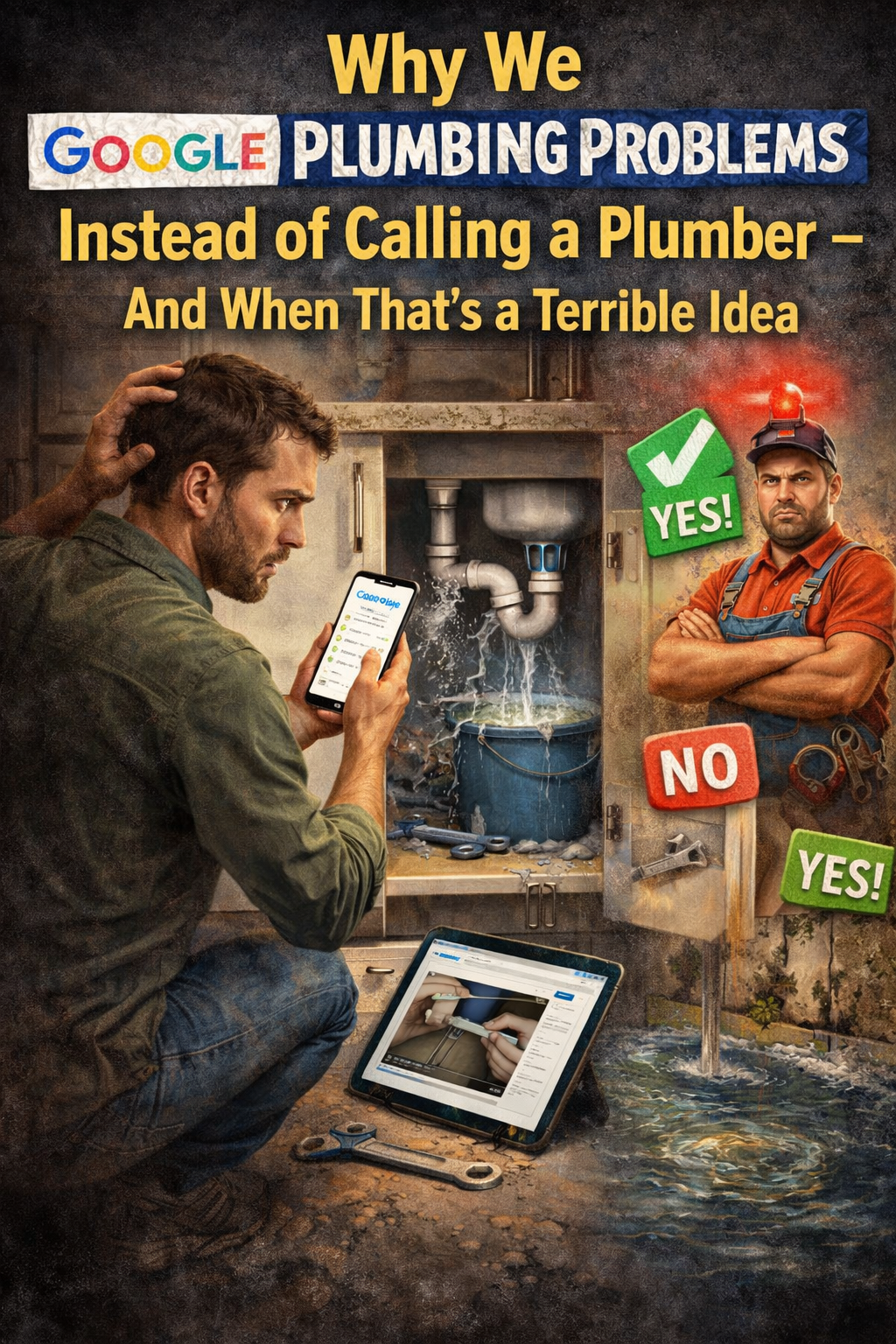
We don't call a plumber. We reach for our phone, type a description of the problem into Google, and spend the next twenty minutes falling down a rabbit hole of forum posts, YouTube videos, and DIY guides written by people we know absolutely nothing about.
This is now the default response for most homeowners. And honestly? Sometimes it works brilliantly. But sometimes — more often than people realise — it makes things significantly worse. Knowing which situation you're in is the difference between saving yourself a call-out fee and turning a minor issue into a four-figure repair bill.
Let's be honest about why we do it, because the reasons are completely understandable.
It feels productive. When something goes wrong, doing nothing feels unbearable. Searching for answers is action. It gives the brain something to focus on while the anxiety settles.
It's free. A plumber's call-out fee in the Norwich area typically runs between £60 and £120 just to show up, before any work begins. The instinct to avoid that cost unless absolutely necessary is entirely rational.
It's immediate. A plumber might not be available until tomorrow. Google is available right now, at 11pm on a Wednesday, which is precisely when these things tend to happen.
It often works for simple problems. A slow-draining sink is frequently caused by a build-up of hair and soap residue in the trap. That information is freely available, the fix takes ten minutes, and there's no earthly reason to pay someone to do it for you.
The problem isn't that people search for answers online. The problem is that the same behaviour that solves a blocked sink can also lead someone to ignore a symptom that needed urgent professional attention three days ago.
This is the subtlety that catches people out.
Most DIY plumbing guides online are accurate in the narrow sense — they correctly describe how to fix a particular problem in a particular set of circumstances. The issue is that diagnosing which problem you actually have, and whether your circumstances match the ones the guide was written for, requires knowledge and experience that most homeowners simply don't have.
A banging sound in the pipes, for example, could be water hammer — a common, mostly harmless phenomenon caused by pressure changes in the system. It could also indicate a failing valve, unsecured pipework, or early signs of a pressure issue that needs professional attention. A YouTube video about water hammer will tell you correctly how to address water hammer. It won't tell you whether what you have is actually water hammer.
The gap between the information and the correct application of it is where DIY plumbing attempts go wrong. And in plumbing, wrong doesn't always mean the repair didn't work. Sometimes it means the repair appeared to work, while the actual problem continued quietly underneath.
There's a real category of plumbing issues where searching online before calling anyone is the sensible first step. These tend to share certain characteristics:
Issues that often fall into this category include:
These are the kinds of problems where a confident homeowner with basic tools, an hour of time, and a decent guide can often get a good result. There's no shame in sorting them yourself. That's not what this article is arguing against.
This is where the real damage happens — and it happens more often than most people would like to admit.
When there's any active leak. A leak that's currently running is not a research project. Every minute spent reading forum threads is a minute water is going somewhere it shouldn't. The first action is always to isolate the supply, the second is to call a plumber. Googling comes nowhere in that sequence.
When you can hear water but can't see it. This is the scenario that should make anyone put the phone down and call a professional immediately. Water you can hear but not locate is almost certainly inside a wall, floor, or ceiling. The longer it runs, the more structural damage accumulates. No online guide can help you here without specialist equipment.
When the boiler or hot water system is involved. This needs saying clearly: gas appliances must be worked on by a Gas Safe registered engineer. Full stop. Not a handy neighbour. Not a general tradesperson. Not someone who watched a YouTube tutorial. The risks — carbon monoxide poisoning, gas leaks, fires — are serious enough that this is one area where the DIY instinct needs to be firmly overridden. In 2022, the Gas Safe Register reported over 1,000 dangerous gas appliances found in UK homes that had been worked on illegally or incorrectly.
When the fix requires isolating the mains supply. Some repairs look straightforward on video but require isolating the water supply, working quickly, and knowing what to do if something goes wrong mid-job. Without that experience, what should take twenty minutes can turn into a situation where the water is off, the repair has gone sideways, and you need an emergency plumber at 9pm on a Friday.
When the problem keeps coming back. A blockage that clears and returns within a few weeks isn't a blockage problem. It's a symptom of something further down the system — root intrusion in the drain, a partial collapse, a build-up caused by a misaligned pipe. Repeatedly treating the symptom while the cause continues unchecked is expensive in the long run.
When the property is older. As we've covered in previous articles, homes built before the 1970s often have lead pipework, clay drainage, and original fittings that behave differently from modern systems. Advice written for a contemporary plastic push-fit system doesn't necessarily translate to a Victorian terrace with copper pipes and original compression fittings.
There's a particular category of plumbing disaster that plumbers across Norwich and the rest of the country encounter regularly: the half-finished DIY repair.
Someone starts a job based on a guide they found online. They get partway through and realise the reality doesn't match the video. The fitting is corroded. The pipe is a different size. The access is more difficult than expected. They improvise. They bodge something temporary. They tell themselves they'll sort it properly at the weekend.
The temporary fix holds for three weeks. Then it doesn't.
What would have been a straightforward repair is now more complex — and more expensive — because of the additional work created by the attempted DIY fix. This is not a theoretical scenario. It's something plumbers like Royal Flush Plumbing describe as a routine part of the job.
For all its usefulness, a search engine has genuine limitations when it comes to plumbing.
It cannot see your pipes. It doesn't know how old your system is, what it's made from, or what condition it's in. It can't hear the specific quality of that knocking sound or see whether the damp patch on your ceiling is a slow seep or evidence of something more serious. It cannot account for the specific geology of Norwich, the particular age profile of housing in your street, or the previous DIY work carried out by the owner before last.
It gives you general answers to general questions. Plumbing problems are often general. But when they're not — when they're specific to your property, your system, your circumstances — the general answer can send you in entirely the wrong direction.
Before you type anything into a search engine, ask yourself one honest question: if I try to fix this myself and it goes wrong, what's the worst realistic outcome?
For a slow drain, the worst outcome is that the drain stays slow. Fine.
For an unidentified leak inside a wall, the worst outcome is significant structural damage, mould, and a repair bill that could run into several thousand pounds. Not fine.
The stakes of getting it wrong are the only reliable guide to whether online research is a reasonable first step or a way of delaying something that needed a professional from the start.
Google is a remarkable tool. It has put genuinely useful plumbing knowledge into the hands of millions of homeowners who would otherwise have had no access to it. Used well, it saves time and money. Used instead of professional judgement in the wrong situation, it can turn a small problem into a large one with considerable efficiency.
Know which situation you're in. That's the whole thing, really.