Backyard projects often begin with a simple goal: build a better place to relax, entertain, or add function to the home. A new deck, a patio extension, a short run of garden steps, or a storage pad for a shed can all seem manageable at first. The budget trap appears when homeowners focus on visible finishes and forget the hidden math underneath. In many cases, the biggest mistakes are not about design taste at all. They come from underestimating quantities, overlooking safety requirements, and treating measurement errors as minor details when they can quickly become expensive ones.
That problem matters because home improvement spending is already substantial. The U.S. Census Bureau reported that American homeowners spent a median of $5,000 on home improvements, maintenance, and repairs in 2021, and about 49 million owner-occupied homes had at least one improvement or maintenance project in the prior two years. The same Census reporting also shows that upkeep costs tend to be higher in older homes, which remain a major part of the U.S. housing stock.
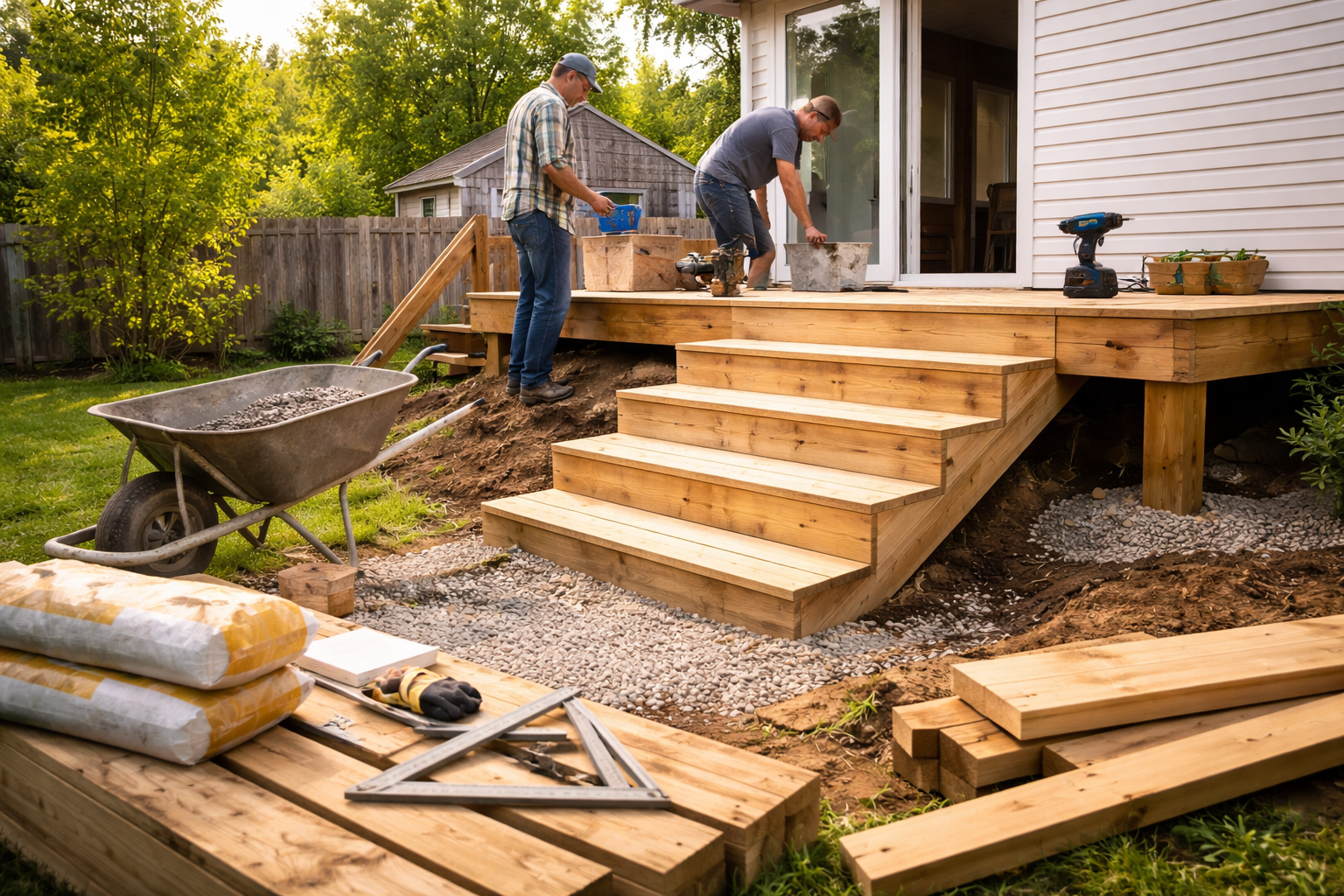
The budgeting mistake many homeowners make is assuming that a backyard renovation is mostly about square footage and materials. In reality, outdoor work often depends on geometry, grading, depth, drainage, and code-sensitive dimensions. A deck staircase that looks straightforward on paper may need additional footings, more concrete, or a different rise and tread layout once the site is measured properly. A patio edge may require more base material than expected because the ground is not level. A small retaining feature or stair landing can increase both labor and material needs in ways that are easy to miss at the planning stage.
Stairs are one of the clearest examples. Poor stair planning can create both cost overruns and safety issues. HUD guidance for residential rehabilitation notes that exterior stairs and railings should be carefully inspected, that stairs with more than three steps should have a handrail, and that, as a guide, stairs in new residential buildings should have a maximum riser of 7 3/4 inches and a minimum tread of 10 inches. Those are not cosmetic details. If stair dimensions are inconsistent, the staircase may need to be rebuilt or adjusted after work has already started.
That is why the math of stair layout should be done before materials are ordered. For homeowners sketching out a deck or yard access project, a tool such as a stair calculator can help estimate the number of steps and the relationship between rise and run before construction begins. That kind of planning does not replace professional review, but it can reduce one of the most common budget traps: building first and correcting dimensions later.
Safety is not a side issue here. The U.S. Consumer Product Safety Commission has highlighted falls as a major hazard around the home, especially for older adults. In a 2022 release, CPSC said that each year, on average, 1,800 deaths of older adults result from falls and 1.5 million emergency room treated injuries, with falls commonly occurring on floors, stairs, and steps. The U.S. Census Bureau has also reported that about 4 million households with an adult age 65 or older had difficulty living in or using features of their home. When a backyard renovation includes steps, transitions, or elevated surfaces, inaccurate measurements can become more than a budget problem. They can turn into a long-term usability and safety issue.
The second budget trap is material volume. Homeowners often estimate visible surface area and stop there. But many outdoor projects require base layers, footings, fill, or concrete that are bought by volume rather than by appearance. A set of deck stairs may need concrete footings. A shed pad may require compacted gravel. A patio refresh may need a deeper base if drainage or frost protection is a concern. Once depth enters the picture, guessing becomes expensive.
This is where people frequently underorder once, then reorder at a higher delivery cost, or overorder and pay for waste they never needed. For volume-based planning, a simple cubic yard calculator can help estimate how much gravel, soil, mulch, or concrete is required based on length, width, and depth. Again, it is not a substitute for a contractor’s site assessment, but it helps homeowners see the real scale of the project before trucks arrive and invoices grow.
Another hidden cost is sequencing. Backyard renovations are rarely standalone purchases. If stairs are being added to a deck, there may also be excavation, railing hardware, drainage correction, or finishing work around the base. If a slab or footing is poured, access conditions, soil preparation, and cleanup can add labor well beyond the initial materials quote. This is one reason why outdoor projects that seem modest at the start can expand quickly once work begins.
The broader lesson is that good renovation budgeting is less about optimism and more about precision. Homeowners who begin with measurements, safety rules, and realistic material calculations are in a better position to compare quotes, question assumptions, and avoid costly changes mid-project. Those who start with aesthetics alone often discover too late that the expensive part of the project was hidden below the surface.
North Penn area homeowners thinking about decks, sheds, patios, or similar projects may also want to read North Penn Now’s “Common Mistakes to Avoid in Outdoor Renovations”, which highlights practical planning issues such as drainage and material choices that can affect long-term performance. That perspective pairs well with the budgeting side of renovation, because the most affordable project is often the one that is measured correctly before construction begins.
In the end, the backyard renovation budget trap is not always overspending on luxury finishes. More often, it is underestimating the invisible parts of the job: the stair dimensions that must work in real space, the cubic yards of material needed below the surface, and the safety details that can be difficult and costly to fix afterward. When homeowners plan for those realities early, the budget becomes more accurate, the project becomes smoother, and the finished space is more likely to perform the way they expected from the start.