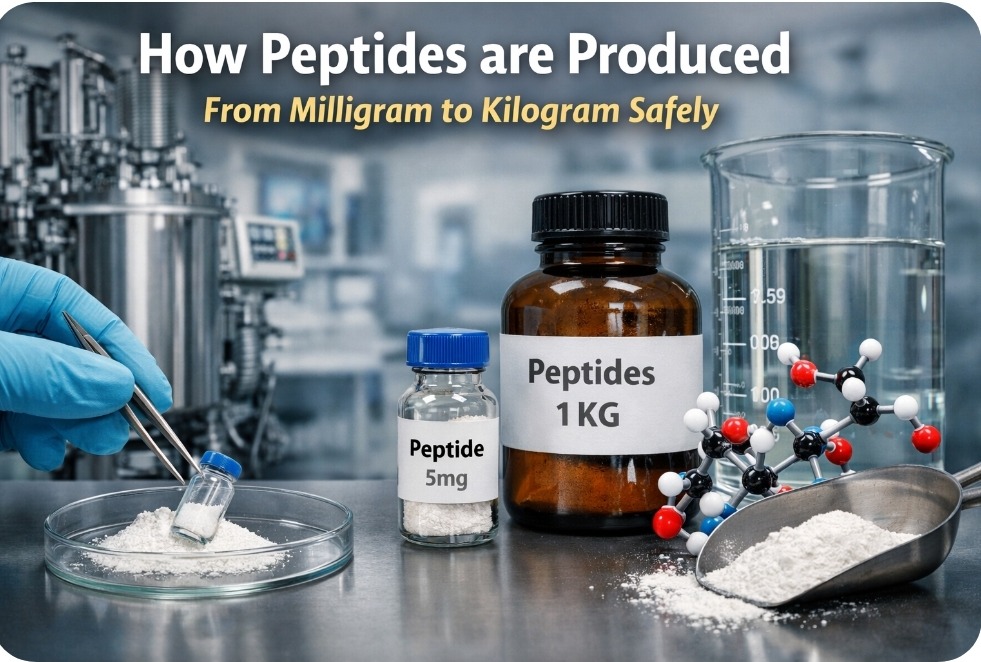
Peptide-based therapeutics have surged in prominence, treating conditions from cancer to metabolic diseases.
For example, the success of glucagon-like peptide-1 (GLP-1) analogs for type 2 diabetes and obesity has dramatically increased demand for peptide drug substances.
This means manufacturers must transition from synthesizing milligram-scale research batches to producing kilogram-scale quantities for clinical trials and commercialization.
However, scaling up synthetic peptide manufacturing is far more complex than simply multiplying batch size – it requires re-engineering processes to maintain purity, yield, and cost-efficiency while meeting stringent safety and quality standards.
In this article, we’ll explore the challenges and solutions in moving from small batches to large-scale, focusing strictly on synthetic peptide manufacturing. By understanding how milligram to kilogram peptide production is achieved safely, drug developers can better navigate the path from lab bench to commercial supply.
When increasing production, maintaining product safety and quality is paramount. Patients receiving a peptide drug expect it to be pure, potent, and free of contaminants, regardless of whether it was made in a 50 mg batch or a 5 kg batch.
To ensure this, manufacturers must tighten controls and adhere to regulatory standards while moving from milligram to kilogram peptide production:
Peptides for human use must be produced under GMP to ensure safety with high standards of quality, identity, and purity. Transitioning from research to clinical or commercial production requires validated cleanrooms, qualified equipment, SOPs, and complete batch records.
The process must be validated and documented to maintain quality. Minor R&D deviations can cause costly GMP delays or rejection, needing installation and operational qualifications, calibrated instruments, and traceability records.
Large-scale peptide production heightens the impact of quality issues. Reliable analytical methods are essential for testing identity, purity, potency, and safety.
HPLC is commonly used for purity assessment and may need adjustment for preparative scales. Mass spectrometry confirms molecular weight and sequence, preventing truncations or modifications.
When transitioning from milligram to kilogram peptide production, each batch undergoes validated quality control to handle larger samples and complex impurities.
Scaling up is both a human and technical challenge. Chemists and engineers require specialized training to troubleshoot issues like aggregation or low yield in large reactors, which they haven't faced in smaller ones.
Since many peptide drugs are highly potent, containment measures like down-flow booths and isolators are used to prevent exposure and cross-contamination.
Environmental safety also involves proper ventilation for solvent vapors and waste treatment to protect the environment. By investing in a skilled team and a safe working environment, companies ensure that milligram to kilogram peptide production not only yields a quality product but also protects the people and environment involved in making it.
It turns out that a combination of advanced technologies, process optimizations, and strategic planning is used to bridge the gap between milligrams and kilograms of peptide production:
Ultimately, the goal is to make milligram to kilogram peptide production as seamless as possible – producing larger quantities without compromising on the peptide’s integrity or the manufacturing team’s safety.
An experienced peptide CDMO, such as Neuland Labs, will have the technical capabilities, infrastructure, and regulatory maturity to execute milligram to kilogram peptide production efficiently and in full compliance. This includes state-of-the-art synthesis equipment, large-scale purification systems, and a workforce skilled in peptide chemistry and GMP operations.
Crucially, the right partner brings a track record of quality and safety – meaning they have demonstrated the ability to produce peptides at scale without quality lapses. They will have established quality systems and can navigate regulatory filings with confidence.
Partnering offers flexible capacity. Early projects need just a few grams for animal tests, but if progressing to Phase 3 or market launch, demand can grow to multi-kilogram batches. A capable CDMO can scale production accordingly, ensuring supply aligns with clinical or commercial needs.
Many top peptide makers are expanding capacity, installing large reactors and multi-column purification to produce hundreds of kilograms annually. This prevents capacity limits if your peptide becomes a breakout success, ensuring long-term and surge supply.
Peptides require sequential assembly of dozens of amino acids, making them sensitive to aggregation and side reactions. Scaling up magnifies these issues, so specialized methods, equipment, and purification strategies are essential for safe large-scale production.
Consistency is maintained through validated processes, in-process monitoring, and robust analytical testing. Each step is documented under GMP, ensuring the large-scale batch mirrors the quality, purity, and identity of small-scale trial runs.
Techniques like preparative HPLC and continuous chromatography remove impurities efficiently, ensuring multi-kilogram peptide batches reach therapeutic-grade purity levels required by regulators and safe patient use.
It’s best to involve a peptide-focused CDMO early, ideally during late discovery or early preclinical phases. This ensures scalable synthesis routes, regulatory-compliant processes, and a clear pathway for milligram to kilogram peptide production.