Military hardware operates under conditions that commercial engineering rarely encounters simultaneously: extreme mechanical loads, sustained environmental exposure, ballistic threat requirements, and logistics constraints that demand components perform reliably years after manufacture without maintenance access. Material failures in defense systems carry consequences that extend far beyond manufacturing cost — they affect mission outcomes and personnel safety.
This is why defense material specifications exist as a category separate from commercial engineering standards, and why the aluminum alloy selection process for military programs follows qualification pathways that commercial procurement does not require. Within that qualification framework, 7075-T73 has earned and maintained its status as the benchmark high-strength aluminum alloy for defense and military applications across more than five decades of operational service.
The integration of aluminum alloys into defense platforms accelerated dramatically after World War II, driven by the same constraint that drives its use today: the need for structural materials that reduce platform weight without compromising load-bearing capability or survivability.
In aircraft and aerospace defense platforms, structural weight reduction has a multiplicative effect on performance. Reducing airframe weight by 100kg can increase payload capacity, extend range, or reduce fuel requirements — each with strategic operational significance. Aluminum alloys in the 7000 series have enabled this weight reduction in military aircraft that would not be achievable with steel structures of equivalent strength.
In ground vehicle platforms, the motivation differs but the constraint remains. Armored fighting vehicles balance protection levels against mobility requirements — and aluminum structural components allow designers to allocate more weight budget to armor protection while maintaining vehicle mobility. Modern infantry fighting vehicles and armored personnel carriers routinely use aluminum alloy structures for hull sections where steel would impose unacceptable weight penalties.
In naval and maritime defense systems, corrosion resistance in seawater environments adds a requirement that eliminates many high-strength alloy candidates — but reinforces the position of properly tempered 7000-series alloys that combine high strength with manageable corrosion behavior.
Military material specifications — MIL-SPECs — establish minimum property requirements and process controls that go beyond standard commercial alloy specifications. For aluminum plate and forgings used in structural defense applications, the relevant MIL-SPECs include MIL-DTL-7079 (aluminum alloy plate and sheet) and MIL-DTL-22771 (aluminum alloy forgings), both of which designate T73 as the approved temper for thick-section structural applications.
Defense procurement engineers evaluating 7075-T73 aluminum will find it meets these requirements through a combination of mechanical performance and process-controlled temper certification:
7075-T73 MIL-SPEC Properties and Standards
The SCC resistance rating is the defining characteristic that separates T73 from T6 in defense qualification. ASTM G44 (alternate immersion in 3.5% NaCl) and ASTM G47 (sustained load SCC testing) are the standard test methods used to qualify material for sustained-load structural defense applications — and T73 consistently passes these tests where T6 fails under equivalent conditions.
The two-stage overaging process required for T73 temper is documented and controlled under AMS 2770, providing defense procurement teams with a verifiable process record that supports material qualification and traceability requirements throughout the defense supply chain.
7075-T73's presence in defense systems spans every major platform category in service today.
Military Aircraft Structures
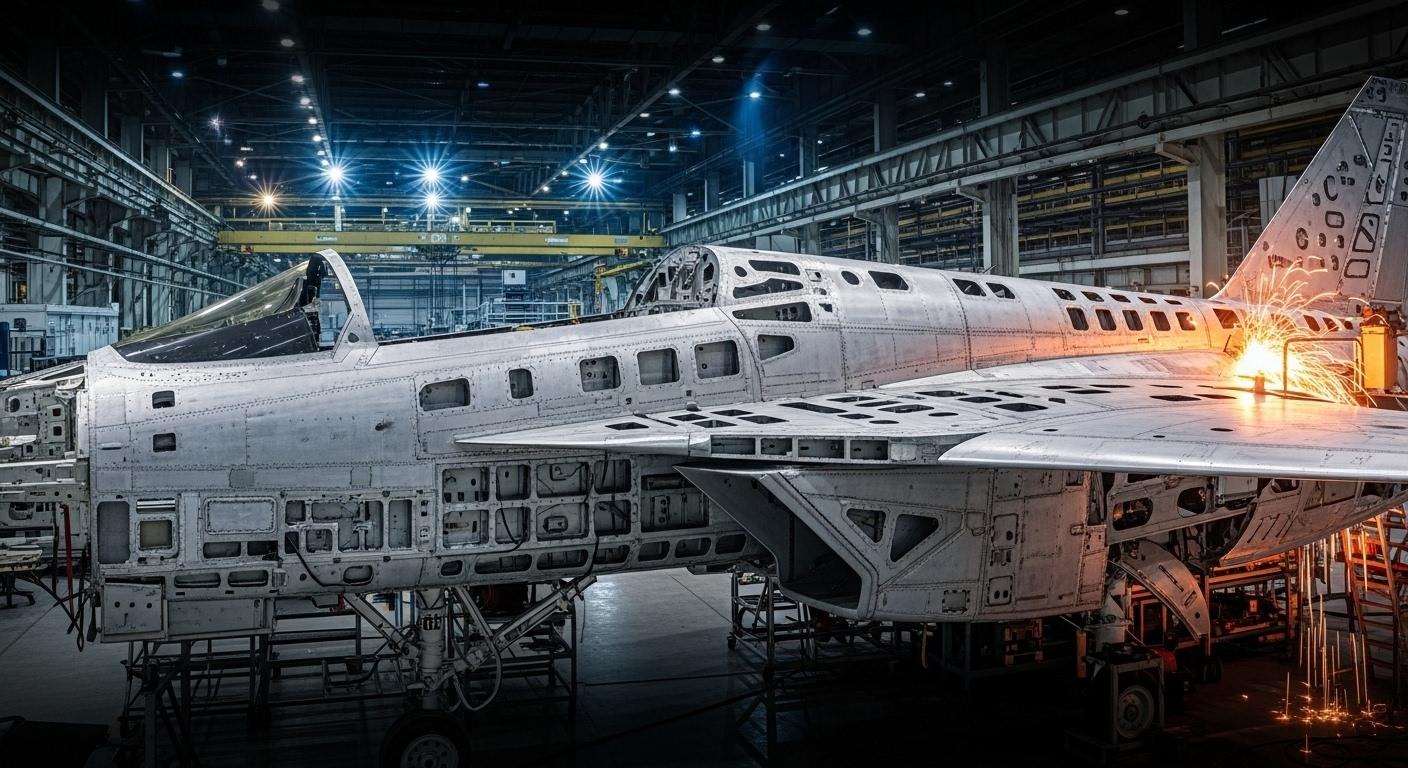
Fixed-wing military aircraft — from tactical fighters to strategic airlifters — use 7075-T73 plate and forgings in primary structural components including wing carry-through structures, fuselage longerons, bulkheads, and engine mount fittings. These components operate under sustained tensile and compressive loads across service lives measured in decades, making T73's SCC resistance a non-negotiable qualification requirement rather than a performance preference.
Rotary-wing platforms use 7075-T73 in rotor head structural components, transmission mounting frames, and airframe structural nodes — applications where fatigue performance, high strength, and corrosion resistance must be simultaneously satisfied in components that are inspected but not easily replaced in field conditions.
Missile and Munitions Systems
Missile airframe structures, fin assemblies, and guidance system housings use 7075-T73 for its combination of high specific strength and machinability — properties that allow complex aerodynamic geometries to be produced by CNC machining to tight tolerances from solid plate or forging stock. Warhead casings and structural munitions components in sustained storage environments specifically require T73 temper to prevent SCC during long-term inventory storage under residual stress.
Armored and Protected Vehicles
In armored vehicle programs, 7075-T73 is used for structural hull sections, equipment mounting frames, and interior structural components where weight reduction allows increased armor coverage within platform weight limits. Vehicle programs operating in maritime pre-positioning or naval transport scenarios face additional corrosion exposure requirements that T73's SCC resistance directly addresses.
Ground Support and Logistics Equipment
Beyond platform structures, 7075-T73 is used in field-deployable ground support equipment — aircraft maintenance platforms, weapons loading equipment, and portable structural systems — where the combination of high strength and low weight determines whether equipment can be transported and deployed by forward logistics units.
The technical argument for T73 over T6 in defense applications centers on a failure mode that does not appear in short-term mechanical testing but has caused catastrophic structural failures in fielded systems: stress corrosion cracking.
SCC occurs when a susceptible material is simultaneously exposed to a corrosive environment and sustained tensile stress. In 7075-T6, the peak-aged microstructure creates grain boundary conditions that are highly susceptible to SCC in the short-transverse direction — the direction perpendicular to the rolling plane in thick plate, which is also the direction of highest residual and service stress in many structural components.
The T73 overaging process deliberately reduces the peak strength of the alloy by coarsening the precipitate structure at grain boundaries — a change that eliminates the electrochemical conditions that drive SCC initiation. The result is a 10–15% reduction in tensile strength compared to T6, but a fundamental change in failure mode susceptibility that defense qualification programs mandate for thick-section primary structures.
For defense engineers, this is not a strength trade-off — it is a reliability requirement. A 7075-T6 structural member that fails by SCC during a mission provides zero structural contribution despite meeting its initial tensile strength specification. A 7075-T73 member that operates reliably for decades in a corrosive sustained-load environment provides the structural contribution the platform was designed around.
Defense material procurement operates under qualification and documentation requirements that standard commercial supply chains are not always equipped to support. Key sourcing requirements for 7075-T73 in defense programs include:
For defense programs requiring consistent supply of certified 7075-T73 plate across standard and non-standard thicknesses, working with an established Aluminum Manufacturer in China that maintains aerospace and defense material certification capabilities — including AMS process approvals and full MTC documentation — provides access to qualified material supply that meets defense program traceability and certification requirements.
7075-T73 aluminum's position as the defense industry standard for high-strength structural aluminum is not the result of marketing or convention — it is the outcome of decades of qualification testing, operational performance data, and failure analysis that consistently validates the T73 temper's combination of structural strength and stress corrosion resistance for sustained-load military applications.
For defense engineers and military procurement specialists, the specification of 7075-T73 for primary structural components reflects an engineering judgment that has been validated across generations of military platforms: when structural reliability across a full service life is the requirement, T73 is the temper that delivers it.