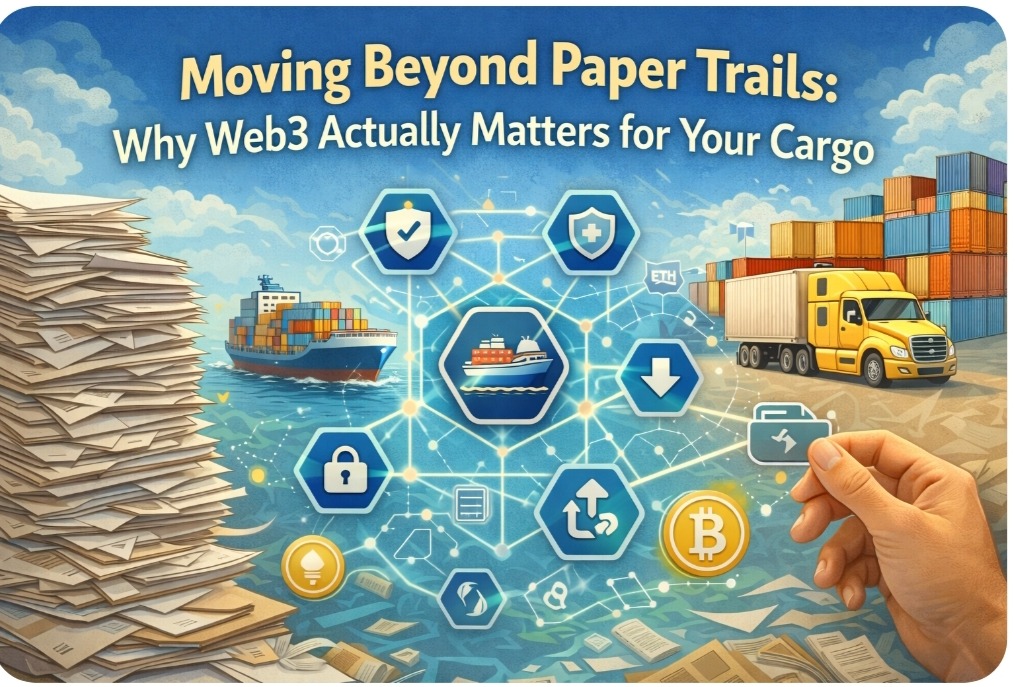
Ever wondered why it takes three weeks to find out why a crate of avocados turned into mush somewhere between Mexico and Munich? Usually, the answer lies in a dusty stack of papers or a spreadsheet that three different people forgot to update. Logistics today is often a giant game of "telephone" where half the players are speaking different languages and nobody trusts the person standing next to them.
This is exactly where Web3 steps in. We are talking about a setup where data doesn't live on one lonely server owned by one grumpy company. Instead, it stays on a shared ledger that everyone can see but nobody can secretly edit. When you build a Web3 app for supply chain, you are essentially creating a single source of truth that does not need a middleman to verify it.
Statistics show that the global supply chain market is massive, yet losses due to cargo theft and fraud exceed $50 billion annually. Research by Gartner suggests that by 2026, over 25% of global supply chain organizations will use blockchain for some form of track-and-trace. This is not about following a trend. It is about saving money and keeping your sanity.
Before you write a single line of code, map out every physical hand-off point in your supply chain. If the digital data does not match the physical reality, even the best blockchain app will fail. You need "anchors" like IoT sensors to bridge the gap between the box and the block.
To build a decent app, you have to understand the pillars of Web3 without getting lost in the "decentralized" jargon. At its heart, you are building three things: a ledger to store events, smart contracts to automate rules, and a way for users to interact with it all.
In a traditional setup, you login with an email and password. In Web3, every actor in the chain (the manufacturer, the driver, the warehouse manager) has a unique digital ID. This ID proves who they are without a central authority having to give them permission every five minutes.
Think of these as "if/then" machines. If the truck arrives at the warehouse and the temperature sensor says the milk stayed cold, then the payment is released automatically. No more waiting for an accounting department to wake up on Monday morning.
You can turn a physical shipment into a digital token (like an NFT). As the box moves from the ship to the truck, the digital token moves from the shipper's wallet to the driver's wallet. If you have the token, you have the goods. It makes tracking ownership as easy as checking a bank balance.
Building this kind of software is like building a house. You start with a solid foundation (the blockchain) and then move to the walls (smart contracts) before finishing the interior (the UI).
You cannot just pick a blockchain because it is famous. You have to look at the costs and the speed. If you are tracking millions of small items, Ethereum mainnet might be too expensive because of high gas fees. You might want to look at "Layer 2" solutions or sidechains like Polygon or Arbitrum.
For enterprise-grade stuff where you need privacy, Hyperledger Fabric is a solid choice. It lets you keep some data private while still using the benefits of a shared ledger. However, if you want full public transparency, sticking with a Web3 development firm that knows how to handle public chains is usually the better route.
This is the "brain" of your app. You will likely use Solidity for EVM-compatible chains. You need to write logic for:
Smart contracts are permanent. Once you deploy them, you cannot just "fix" a bug like you do with a normal website. Use a "Proxy Pattern" for your contracts so you can upgrade the logic later without losing all your historical data.
A blockchain is like a person in a dark room. It only knows what you tell it. If a driver lies and says the goods arrived when they didn't, the blockchain will believe the lie. To fix this, you use IoT (Internet of Things) devices.
GPS trackers and temperature sensors send data to "Oracles" like Chainlink. These oracles then pass that data to your smart contract. This creates a "trustless" bridge. The code doesn't have to trust the driver because it trusts the hardware sensor.
The biggest mistake people make is making the app look like a crypto exchange. Most warehouse workers don't care about "private keys" or "gas limits." They just want to scan a QR code. Use libraries like Ethers.js or Web3.js to connect your pretty interface to the messy blockchain backend. Keep the blockchain part "invisible" to the end-user.
Let's be realistic for a second. Web3 isn't a magic wand. If your warehouse has terrible internet, a blockchain app won't help you much. You also have to deal with the "Garbage In, Garbage Out" problem. If the initial data entry is wrong, the blockchain just makes that error permanent.
Implement a "multi-signature" requirement for high-value shipments. This means two different people (say, the sender and an independent inspector) must sign off on a status update before it gets recorded. This cuts down on fraud significantly.
Another thing to watch for is scalability. If you record every single movement of every single apple in a grocery store, you will clog the network. Instead, group items into "batches." Track the pallet on the blockchain, and keep the individual item details in a decentralized storage system like IPFS. This keeps your on-chain data lean and your costs low.
Companies like Maersk and IBM have already shown that using decentralized tech can reduce the time it takes to process paperwork by up to 40%. In the food industry, tracking the source of a contaminated batch of spinach used to take nearly a week. With Web3, it takes about two seconds.
Think about the insurance savings too. When you have an immutable record of every hand-off, insurance companies have fewer excuses to deny claims. They can see exactly where the damage happened. This level of accountability is something traditional software just cannot offer with the same level of certainty.
Nearly 10% of all pharmaceutical products in the global supply chain are counterfeit. Web3 apps are currently being used to verify the "pedigree" of medicine, ensuring that the pills in the bottle actually came from the manufacturer they claim to be from.
When you are deep in the development phase, remember that data architecture is king. You need a way to query the blockchain quickly. Blockchains are great for writing data, but they are notoriously slow for searching it.
You should use "The Graph." It is an indexing protocol that allows you to query blockchain data using GraphQL. Without it, your app will feel slow and clunky. Imagine a user waiting thirty seconds for their shipment history to load. They will hate it. Use indexing to make the data pop up instantly.
You can build the most advanced app in the world, but if the forklift driver thinks it is too hard to use, they will just go back to their paper notepad.
Don't force your partners to pay for gas fees. Use "Meta-transactions" (EIP-2771). This allows you, the app owner, to pay the network fees in the background so the user doesn't need to hold any cryptocurrency to use your system.
Building a Web3 supply chain app is a bit like playing 4D chess. You have to think about the hardware, the smart contracts, the network fees, and the human beings who will actually hold the scanners. It is a lot to juggle, but the payoff is a system that is basically impossible to cheat.
The PixelPlex team decided to put this guide together because we have seen too many projects get stuck in the "cool idea" phase without ever reaching the "working app" phase. We have spent years in the trenches of blockchain development, and we know that the difference between a successful deployment and a failed experiment is usually in the small technical details.
If you are looking to turn your logistics nightmare into a transparent, automated dream, we would be more than happy to help you navigate the weeds. Whether you need a full architectural overhaul or just someone to audit your smart contracts, the PixelPlex team is ready to step in and get the job done.
Building the future of supply chains is hard work, but someone has to do it. Why not make it you?