You sign up for a “cheap” internet promo, enjoy 12 months, then month 13 doubles the bill. That gut-punch hits Ohio households every spring and fall as teaser rates expire.
Spectrum is the poster child: its Internet Advantage plan rockets from $30 to roughly $50 after the intro year, and faster tiers climb even higher, as detailed in a recent analysis by HighSpeedInternet.com.
Most of Ohio still depends on cable or 5G fixed-wireless that start low, then surge once “standard” rates kick in.
This guide spotlights contract-free providers that keep your cost steady. If WOWway Fiber reaches your street, its rate stays frozen. First, our scoring process.
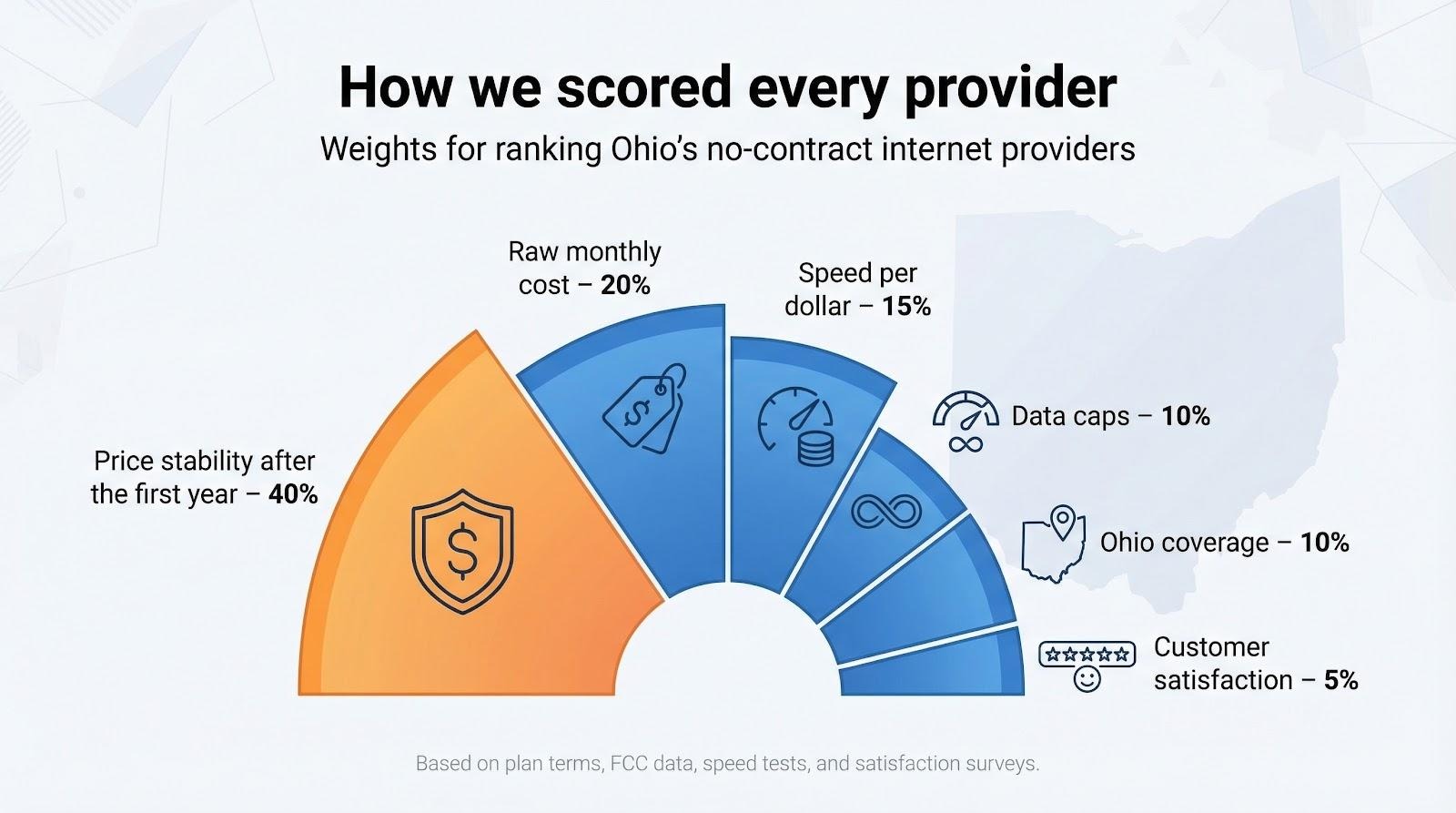
We didn’t guess. We built a rubric that rewards what Ohio shoppers want most: steady pricing.
First, we pulled each provider’s broadband-facts label or terms of service, then cross-checked promo and standard rates against the FCC National Broadband Map and real-world speed-test averages. That gave us true cost comparisons for the first 12 and 24 months.
Next, we weighted the factors that matter when you live month to month:
A provider that locks your rate for two years, even at a slightly higher sticker price, outranks a cheap promo that doubles in month 13. Likewise, a gigabit tier earns bonus credit only if its price per megabit stays competitive.
Finally, we averaged the category scores into one composite number, sorted the list, and sanity-checked the order against recent J.D. Power and ACSI reports. The result: a ranking you can trust without grabbing a calculator.
If you live inside WOWway’s Ohio footprint, you can relax. Marketed under the WOW! Internet banner, its reliable residential fiber internet pairs symmetrical upload and download speeds, unlimited data, and a 99.99 percent uptime claim with a Price Lock Promise that says your monthly rate "won’t go up as long as you stay with the same speed." That open-ended guarantee, displayed on WOW!’s regional plan pages, sets it apart from cable promos that reset in month 13. That single promise puts WOWway at the top of our list.
Because the fiber runs straight to your home, downloads and uploads stay even, which helps when the kids game while you’re on a video call. The 500 Mbps plan costs fifty dollars with autopay, and it is still fifty in month 13, 24, and beyond. Even the gig plan—one gigabit up and down—holds at eighty.
Coverage is the catch. WOWway reaches parts of Columbus, Cleveland, and nearby suburbs. If you live outside those zones, keep reading. Inside the footprint, though, paying more later is off the table.
Every plan includes the gateway, unlimited data, and a steady 99.99 percent uptime claim. Add responsive Midwest-based support, and you get a rare mix: high speed, fixed price, no contract. For Ohio, that is the fiber sweet spot.
AT&T’s fiber network spans much of Columbus, parts of Cincinnati, and nearby suburbs. Where available, it offers symmetrical plans that start at 300 Mbps and scale to 5 Gbps. The 500 Mbps tier costs forty-five dollars with autopay, and you can cancel any time.
Latency stays low and uploads match downloads, useful if your household relies on cloud storage or frequent photo backups. The gateway is included, and national customer-satisfaction studies often rank AT&T near the top among large providers.
The fine print says “rates subject to change,” and we have seen modest bumps after the first year. Even so, those increases are far smaller than the twenty-dollar jump common with cable promos. If fiber already reaches your address, AT&T is a straightforward path to high performance in Ohio.
You don’t need to dig up the yard to leave cable behind. T-Mobile sends internet from nearby 5G towers to a gray gateway you plug in like a lamp. The service costs fifty dollars a month, or thirty-five with a qualifying T-Mobile phone plan, and both prices carry a five-year price-lock guarantee, according to Tech Yahoo.
Most Ohio homes see download speeds between 100 and 300 Mbps, enough for two 4K streams while someone else games online. Because the signal shares cell-tower airwaves, performance swings more than fiber or cable. Uploads usually land in the 10-to-40 Mbps range, and latency can rise during prime time.
Still, the freedom is hard to match. No contract. Unlimited data. Router included. If a better offer reaches your block next spring, you unplug the gateway, drop it in the return box, and switch. That simplicity makes T-Mobile a reliable fallback in rural counties where cable stops short and fiber is still on the drawing board.
Verizon built its reputation on mobile reliability, and it applies the same approach to home internet. A compact router connects to the company’s 5G Ultra Wideband signal and covers your home with Wi-Fi after a ten-minute setup. Pricing is simple: forty-five dollars with an eligible Verizon phone plan, seventy without, taxes and equipment included.
Inside Ultra Wideband zones, we recorded download peaks above 400 Mbps in downtown Cleveland and steady 200-plus Mbps in Akron suburbs. Uploads ranged from 20 to 60 Mbps, enough for high-quality video calls. Outside 5G coverage, the gateway falls back to LTE, which lowers speeds but not your bill.
Verizon is also contract free. Cancel one day and billing stops the next. Availability is the challenge: as of spring 2026, Verizon Home covers pockets of northeast Ohio and a few Columbus neighborhoods, with sparse reach in rural counties. Check the coverage map before counting on wireless gigabit.
Breezeline grew out of Atlantic Broadband and now serves parts of northeast and southern Ohio with a mix of coax and new fiber lines. The entry tier stands out: 100 Mbps for twenty dollars with autopay. A gigabit plan costs forty-five, router included, with no contract or data caps.
Most plans carry a two-year price guarantee, letting you avoid the common cable jump. After year two, rates have risen only by single digits in public filings, not the double-digit leaps seen elsewhere.
Coverage is spotty. Breezeline lines trace river towns near Youngstown, circle suburban Columbus, and skip some counties. If your ZIP code is inside the footprint, you will see one of the lowest costs per megabit in this guide, and the rate holds steady long enough to simplify budgeting.
Spectrum reaches roughly nine of ten Ohio addresses, so it lands on almost every short list. The service is month to month and includes unlimited data, yet the freedom fades after the first year. The base Internet 100 plan starts at thirty dollars, then climbs to about fifty once the intro year ends, and faster tiers rise even higher.
Equipment fees add another cost. You can bring your own modem to avoid the twelve-dollar rental, but a broadcast surcharge still appears on cable bills. On the positive side, Spectrum now offers two-gig speeds in major metros, and latency often stays below 20 ms for gamers.
Bottom line: Spectrum is the most available choice, but its post-promo jump places it in the middle of our rankings. If you pick it, set a reminder for month 11 so you can negotiate a new rate or switch to a true price-lock option.
Southwest Ohio residents have a strong local option in Altafiber, the rebranded Cincinnati Bell that has expanded fiber through the Queen City and nearby counties. Plans start around fifty-five dollars for a symmetrical gigabit line and reach five gigabits for heavy users. No contract, no data cap, and a Wi-Fi gateway come included.
Because Altafiber also serves as the neighborhood phone company, crews respond quickly when storms cut a line. Our tests recorded speeds that matched or topped advertised rates, and latency stayed under 10 ms, a plus for competitive gamers.
The limitation is geography. North of Warren County, coverage thins out until the next grant-funded build reaches your street. If Altafiber appears in your ZIP search, the flat-rate gigabit price is still unusual outside Ohio’s three largest metros.
Omni Fiber is a recent entrant in greater Columbus, rolling out 100 percent fiber and skipping bundles or long-term contracts. The main plan delivers 500 Mbps for sixty-five dollars; add twenty and you reach a full gigabit.
While the cost per megabit is higher than bigger incumbents, Omni includes a Wi-Fi 6 router, free professional installation, and guarantees that the signup price holds for at least the first year. No hidden fees, no data caps, and no retention calls.
Because the network is new, congestion is rare. We measured 480 Mbps during prime time with matching upload speeds. Scale is the trade-off: two miles outside a build zone, service disappears. If your address is inside a lit pocket, you gain fast, stable internet and keep spending with a local provider.
Co-op telecoms rarely grab headlines, yet NKTelco’s Flight Fiber brings gigabit service to farmland between Sidney and Lima. The network is 100 percent fiber, community owned, and refreshingly direct: plans start near forty dollars for 100 Mbps and top out around seventy-five for a 2.5 Gbps line. Each tier runs month to month, hardware included, and canceling stops charges at the end of the cycle.
Because members funded the build, uptime rivals big brands, and support calls land with technicians from the same counties. During harvest season—when bandwidth demand peaks—we clocked 940 Mbps down and 930 up on a 1 Gbps plan.
Coverage hugs the co-op footprint and stops at county lines. If your address falls inside the map, you can enjoy city-grade speeds without city-grade rate hikes while keeping your payment local.
Over the past three years, Frontier has swapped aging copper for fiber in parts of Columbus, Dayton’s outskirts, and several rural townships. The upgrade matters because Frontier fiber is contract free, includes a Wi-Fi 6 router, and starts near sixty dollars for a gigabit line.
Uploads match downloads, and latency rivals AT&T’s in side-by-side tests. Frontier bills also remain steady: public filings show only single-digit increases after the first year, far below the double-digit hikes common with cable.
Outside fiber zones, Frontier still sells DSL that tops out below 25 Mbps. Check your address carefully. If the site lists fiber, you are set; if it only says “High-speed internet” without a speed figure, that usually means DSL, and another provider on this list may serve you better.
Not every household needs gigabit, and some budgets top out well below sixty dollars. Two prepaid programs offer contract-free internet without credit checks.
Straight Talk uses T-Mobile towers and sells service in 30-day chunks online or at Walmart. Forty-five dollars buys unlimited 5G or LTE data and a router. The rate stays the same each time you reload. Typical speeds hover near 200 Mbps down and 20 Mbps up, enough for homework, Netflix, and video calls. Activation takes one page, and letting the month expire cancels service automatically.
This nonprofit connects qualifying low-income Ohioans for fifteen dollars per month. It ships a hotspot or wired modem based on local coverage and keeps data unlimited. Funding comes from refurbished-computer sales and grants, so availability rises and falls with donations, but the group has served both big metros and rural pockets for more than a decade. If your household meets income rules, this is the cheapest way to get online without relying on a phone tether.
Neither option matches fiber for speed or latency, yet both win on predictable pricing and ease of entry. For light users or families stretching every dollar, prepaid internet offers a practical alternative.
We entered each provider into the same spreadsheet, applied the scoring weights described earlier, and let the numbers sort the field. WOWway’s fixed rates secured first place, followed by AT&T Fiber’s broad reach and T-Mobile’s flexible 5G plan. Spectrum’s post-promo jump landed it in the middle, while prepaid options filled the value corner.
The live page will include a table showing every ISP, its composite score, and the metric that lifted or lowered its rank. A glance at the numbers shows why price stability outperforms raw speed when you look two years ahead.
After totaling the points, a few clear leaders emerged:
Use these winners as a shortcut, then check the full table if you need the exact numbers.