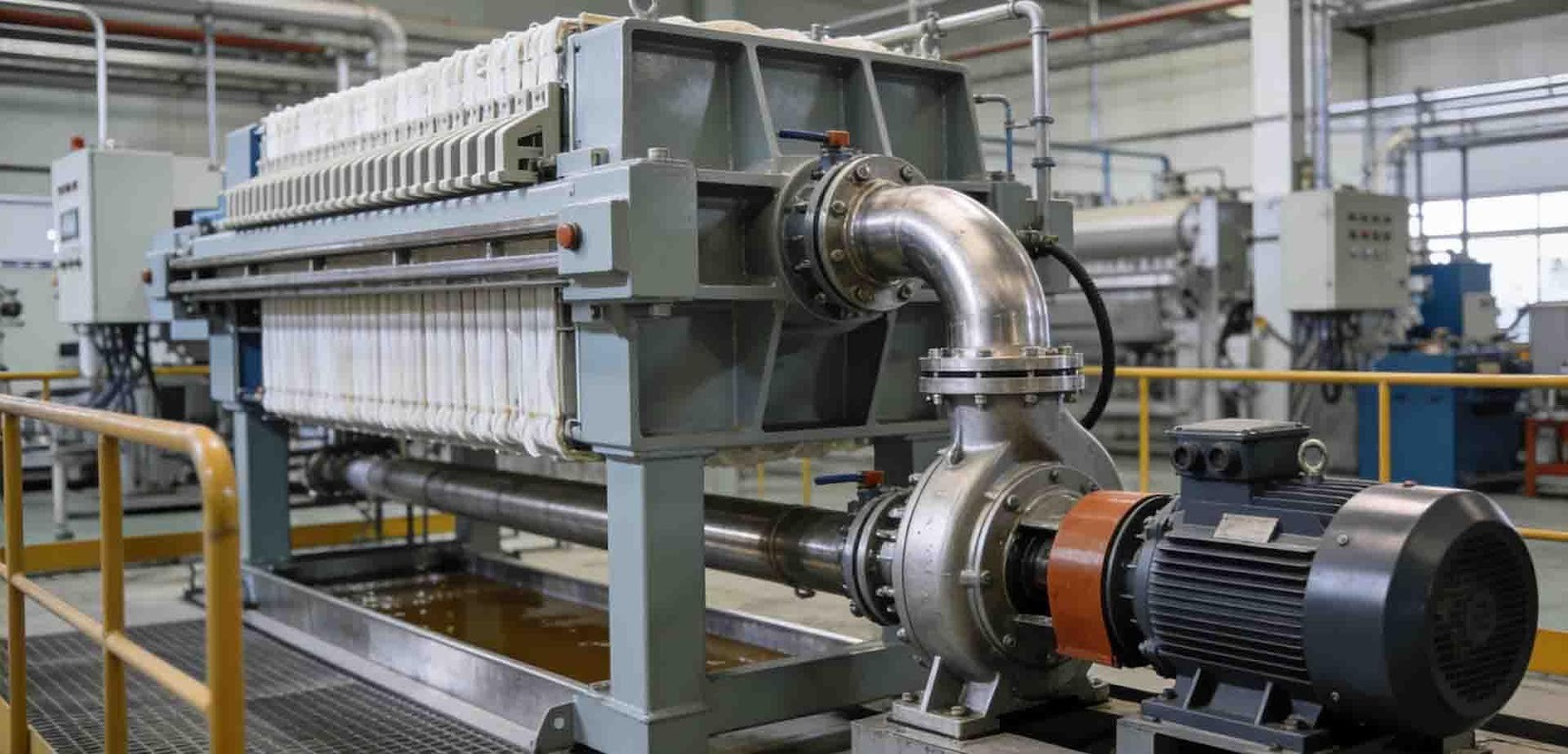
In any industrial process that relies on solid-liquid separation, the filter press remains one of the most reliable and widely used pieces of equipment. It delivers consistent dewatering, reduces waste volume, and helps operations meet strict environmental compliance standards. But even the most advanced filter press available today can only perform as well as the pump feeding it. Filter press feed pumps are the critical component that connects slurry storage to actual filtration. These pumps are specially built to move abrasive, viscous, or solids-heavy mixtures into filter press chambers at carefully controlled pressures and flow rates. Unlike standard filter pumps or general transfer pumps, these units are engineered to handle the harsh realities of slurry handling while adapting to the unique two-stage demands of the filtration cycle.
A filter press feed pump is a specialized filter pump built to push slurry—thick mixes of solids and liquids—into a filter press at a steady, controlled pace. It’s not just a “feeder”; it’s the gatekeeper. Regular pumps might choke on changing slurry thickness or freak out when pressure builds, but these are engineered for the job: keeping flow consistent as the press fills, ramping up pressure to squeeze out liquid, and handling slurries that get thicker as solids build up. Whether you’re dewatering mining tailings, cleaning up wastewater, or processing chemicals, this pump keeps the whole show moving.
The job description for filter press feed pumps is longer than you’d think. Here’s the real work:
Filter press operation happens in two distinct stages, and the filter press feed pump must shift smoothly between them: - Filling Phase: The pump runs at high flow, low pressure to quickly fill empty filter press chambers with slurry. Speed is the priority here to reduce idle time and increase throughput. - Filtration Phase: Once chambers are full, the pump switches to low flow, high pressure to force the liquid portion of the slurry through the filter cloth or membrane plates. This pressure overcomes resistance from the filter media and the forming cake, squeezing out as much liquid as possible to create dry, manageable filter cake — often with dry content ranging from 30% to 80%, depending on the application.
Most slurries that filter press feed pumps deal with are thick, abrasive, or mildly caustic. The pump’s wetted parts, such as the impellers, rotors, casings, and seals, are made of hardened metals, rubber liners, ceramics, or engineered plastics that don’t wear out easily. This design extends the service life, even in tough conditions, and prevents blockages that cause expensive downtime.
Filter press feed pumps are built to integrate cleanly with all types and sizes of filter presses, including batch, membrane, and polishing units. They maintain steady feeding to avoid fluctuations that ruin cake formation, and modern units often include variable speed drives to improve energy efficiency. Instead of running at full power nonstop, the pump matches output to real-time demand. For any filter press system, this level of compatibility means the entire setup operates as a single, coordinated unit rather than a collection of disconnected parts.
Get into the details of the different pump types below to find the best fit for your operation:
Not all filter press feed pumps are interchangeable. Pick the wrong one, and you’ll fight clogs or waste energy. Here’s the lowdown on what’s out there:
These are the common workhorses, using a spinning impeller to whip slurry into pressure. They’re fine for thin, low-viscosity slurries with tiny, non-abrasive solids—think wastewater sludge or food processing leftovers. But here’s the catch: their flow drops as pressure rises. So if your press needs high final pressure (to squeeze out every last drop), they might not cut it.
PD pumps move a fixed amount of slurry per cycle, no matter the pressure. That makes them kings for thick, abrasive, or high-pressure jobs. Subtypes that matter: - Diaphragm Pumps: Flexible diaphragms push slurry. They’re self-priming and gentle on shear-sensitive stuff (like polymers or pharma ingredients). - Plunger/Piston Pumps: Reciprocating pistons crank out serious pressure (1000+ psi). Perfect for gritty, thick slurries—think mining tailings or ceramic mixes. - Gear Pumps: Meshing gears move slurry. Compact and efficient for light, non-abrasive slurries (like some chemical mixes).
These run on compressed air, driving two diaphragms. They’re portable, explosion-proof, and laugh at slurries with big chunks (up to 2 inches) or high viscosity. Mining crews love them—drag ’em anywhere, and they keep going.
A helical rotor spins inside a stator, creating pockets that move slurry smoothly. They’re great for thick, shear-sensitive stuff (drilling mud, paint slurries) and don’t clog on big solids.
Filter press feed pumps don’t work alone—they’re part of a complete solid-liquid separation system, working in sync with the filter press. The entire cycle, from drawing in slurry to discharging dry cake, is coordinated, and the pump’s ability to adjust pressure and flow is what makes it all work. 1. Slurry Intake: The filter press feed pump draws slurry from a storage tank or holding vessel through its inlet. Wear-resistant lines and strainers help prevent oversized solids from entering and causing clogs. 2. Filling Phase: The pump starts at high flow and low pressure to rapidly fill the filter press chambers. This stage ends when chambers are full and cake begins forming on the plates. 3. Pressure Transition: The pump automatically or manually reduces flow and boosts pressure, shifting into the filtration phase. Modern filter press feed pumps use variable speed drives or pressure sensors to make this shift smooth, avoiding dangerous spikes. 4. Filtration & Liquid Extraction: High pressure forces liquid through the filter media while solids build up on the plates as filter cake. The collected liquid, or filtrate, is recycled or discharged properly. 5. Pressure Hold & Cake Drying: The pump maintains steady pressure to squeeze out remaining moisture, increasing cake dryness and reducing waste volume. 6. Cycle Completion: Once filtration finishes, the filter press opens and the dry cake is removed. The pump shuts off or enters standby until the next cycle begins.
These pumps are everywhere you need to separate stuff:
Mining operations handle heavy, abrasive mineral slurries that need efficient dewatering for mineral recovery and waste reduction. Filter press feed pumps—usually AODD or progressing cavity models—deliver these slurries at high pressure, forming dry filter cake from tailings and recovering valuable minerals. They also reduce water use by recycling filtrate, which is crucial for remote or water-constrained mines.
Municipal and industrial wastewater facilities use filter press feed pumps to dewater sewage sludge and process waste. Centrifugal or AODD pumps feed sludge into filter presses, removing liquid to form dry cake that can be landfilled, incinerated, or repurposed as fertilizer. This process cuts waste volume by up to 80%, lowering disposal costs and helping meet environmental discharge rules.
Chemical manufacturing produces slurries from reactions, precipitation, and crystallization—many of which are corrosive or viscous. Filter press feed pumps, which are frequently made of corrosion-resistant materials or have a progressive cavity design, transfer these slurries to filter presses to recover useful products, get rid of undesired solids, and dry out process waste. They are a suitable fit for the chemical industry’s high criteria since they can handle mild corrosion and maintain steady pressure.
Filter press feed pumps are used in the food and beverage industry to clarify liquids and dispose of waste, all while maintaining strict hygiene standards. Peristaltic or lobe pumps gently feed slurries like fruit juice pulp, sugar syrups, and brewery mash to filter presses. The presses then separate the solids to produce clear, pure finished products. These pumps also remove water from food waste, like vegetable peels or grain residues, to reduce its volume for composting or recycling.
Pharmaceutical and biotech manufacturing needs to carefully filter shear-sensitive slurries (such fermentation broths or API mixtures) with little chance of contamination. The best solution here is hygienic peristaltic filter press feed pumps. Their closed-loop design and gentle handling keep sensitive biological materials intact and prevent contamination.
Textile mills use filter press feed pumps to dewater dye sludge and processing waste, while paper mills handle pulp slurries and paper manufacturing leftovers. AODD or centrifugal pumps feed these slurries to filter presses, recovering water for reuse and reducing waste hauling costs for these water-intensive industries.
From metal finishing (abrasive metal slurry dewatering) to paint production (pigment slurry clarification), nearly all general manufacturing sectors use filter press feed pumps for small and large-scale solid-liquid separation. While basic filter pumps may be used for secondary filtration steps, filter press feed pumps are the primary choice for feeding slurry directly into the press.
1. Know Your Slurry
2. Figure Out Flow & Pressure Needs
3. Match Materials to the Slurry
4. Think About Daily Use
5. Don’t Forget Maintenance Easy-to-replace parts (diaphragms, seals) and accessible service points save hours of headaches. And pick a supplier that stocks spares—downtime’s a killer.
Find more info now on specific pump models and compatibility with your filter press by reaching out to industrial pump specialists.
Filter press feed pumps are the unsung heroes of industrial solid-liquid separation. They turn a basic filter press from a static machine into an efficient, high-throughput system that reduces waste, cuts costs, and supports environmental compliance. Unlike generic filter pumps or transfer pumps, these specialized units are built to handle the two-phase nature of filter press operation, survive harsh slurry conditions, and provide consistent feeding for optimal cake formation.
From mining and wastewater treatment to food production and pharmaceuticals, filter press feed pumps play a vital role in every industry that depends on dewatering and clarification. Choosing the right pump means understanding your slurry, filter press requirements, and operational needs—prioritizing total cost of ownership over initial price and reliability over convenience.
The case for AODD pumps in filter-press systems-This paper highlights the advantages of air-operated double-diaphragm (AODD) pumps in water and wastewater filter press applications, noting their superiority over competitors. AODD pumps operate without electricity using compressed air, with high-pressure models generating 15 bar conveying pressure; their high-density polyethylene structure offers wear resistance seven times that of polypropylene and more than iron, aluminum, and steel, suitable for various chemical formulations, while also addressing challenges faced by pumps in such applications and emphasizing AODD pump benefits.-Learn more