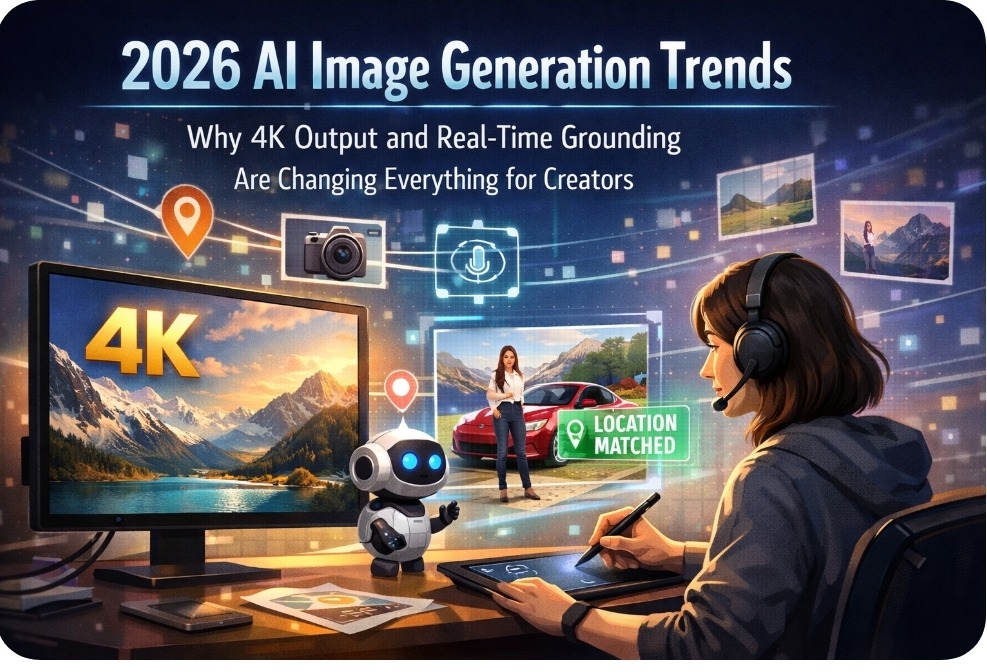
The tools that dominated creative workflows in 2024 are already obsolete. Here's what the 2026 landscape actually looks like — and which capabilities are separating productive creators from the rest.
I spent most of early 2026 rebuilding my visual content workflow from the ground up — not because the old system was failing, but because the gap between "fine results" and what the best AI image tools can now do had become embarrassing. Tools that felt cutting-edge in mid-2025 now look like first-generation prototypes.
If you're still working with the same AI image setup you had a year ago, this piece is for you.
Every year since 2022, commentators have called the current year "the breakthrough moment" for AI visuals. Most were premature.
2026 is genuinely different. Three capabilities converged simultaneously:
These three changes together have opened creative categories that were simply not viable before.
I've been testing AI image platforms intensively across Q1 2026. The tools that have impressed me most treat the three capabilities above as baseline features, not add-ons.
The platform I've been working with most consistently is Nana banana — an AI image generator built on Google's Gemini infrastructure that has become the hub of my current visual workflow. The interface is designed for working creators: describe what you want in plain language, get a usable result in seconds. Background removal, upscaling, and batch generation all live in the same environment.
What's kept me using it is the model range — and the most recent addition to their lineup represents a meaningful step forward for what 4K AI image generation can actually deliver.
Here's what a modern AI visual workflow looks like versus eighteen months ago:
Then (mid-2025):
Now (2026):
The reduction in friction isn't just time-saving — it changes what projects are economically viable to attempt.
For anyone creating promotional materials, the inability to render reliable text used to mean every AI image was just a background — a starting point requiring manual overlay afterward.
The 2026 generation has solved this well enough to change the workflow:
One of the underrated problems with early AI image tools was resolution rigidity — a fixed output dimension that required crops and stretches for different platforms.
The 2026 standard includes full aspect ratio flexibility, including ultra-wide formats (4:1, 8:1). For creators working across platforms:
For banners and advertising placements requiring non-standard dimensions, native generation produces meaningfully better results than cropping.
The Nano Banana 2 model is where these 2026 trends converge into a specific tool worth examining.
Released in late February 2026 on Gemini 3.1 Flash Image architecture, it delivers Pro-tier output quality at Flash-tier speed and cost. The capabilities that have changed how I work:
4K output with actual usability. Resolution scales from 512px to 4K. The Ultra tier handles large-format print; the 2K Balanced tier exceeds what any typical display will render.
Google Search grounding. Real-time web knowledge during generation — for brand-specific, product-specific, or location-accurate visuals without reverting to stock photography.
Subject consistency across sequences. Up to five characters and fourteen objects maintained across a workflow. Storyboards, tutorial series, character-consistent social personas — now viable in a single tool.
Ultra-wide aspect ratios. Native 4:1, 1:4, and 8:1 generation for banners, display ads, and panoramic visuals.
Photorealistic faces remain imperfect. Generating faces that hold up under close inspection isn't reliably production-ready. Portrait substitution still needs photography or heavy human selection.
Complex layouts. Magazine-style editorial layouts with multiple distinct text blocks and arranged elements still require layout software.
Brand identity from scratch. Generation tools provide starting points for logo exploration, but final production-ready brand systems require significant human refinement.
Knowing whether your work falls into "solved," "accelerated but not replaced," or "still requires traditional tools" is the most useful frame for building an efficient workflow.
Define your highest-volume visual tasks first. Where are you spending the most time or money on images? Start where efficiency gains have the biggest practical impact — social graphics for content creators, product imagery for e-commerce, ad creative for marketers.
Learn prompt language as a skill. The difference between mediocre and excellent AI output is almost entirely in how you describe what you want. "A photo of a coffee shop" is generic. "A cozy independent coffee shop, morning light through east-facing windows, exposed brick, vintage espresso machine, shallow depth of field, film aesthetic" is usable. This skill transfers across every AI image tool you'll ever use.
Build a prompt library. Document prompts that produce reliable results for your recurring needs. A personal library is worth more than any new model feature.
Test the newest tier on your actual use cases. If you tried AI image tools eighteen months ago and found them inadequate, the current generation deserves a fresh look. The quality bar has moved substantially.
Consumer-facing tools with the model architectures described here are available in the $10–30/month range. A single round of social media graphics from a freelance designer typically runs $150–300. One month of AI generation costs less than two hours of freelance design time. The math is not subtle.
Three trends worth tracking:
The creators with the most advantage eighteen months from now are building fluency with current tools today.
The 2026 AI image generation landscape is a different category of capability — not a marginal upgrade. 4K output, real-time information grounding, reliable text rendering, and format flexibility have made these tools genuinely suitable for professional production work across a wide range of use cases.
The platforms leading this shift are accessible, affordable, and improving faster than most legacy design software has in a decade.
If your current visual content workflow doesn't include AI generation tools, the opportunity cost of delay has become substantial. The tools are ready. The question is whether your workflow is.
Try the current generation of AI image tools at nanobanana.uk — new accounts receive free credits on sign-up.
For the newest 4K model capabilities described above, explore the Nano Banana 2 model page — Flash-speed generation at Pro-level quality.