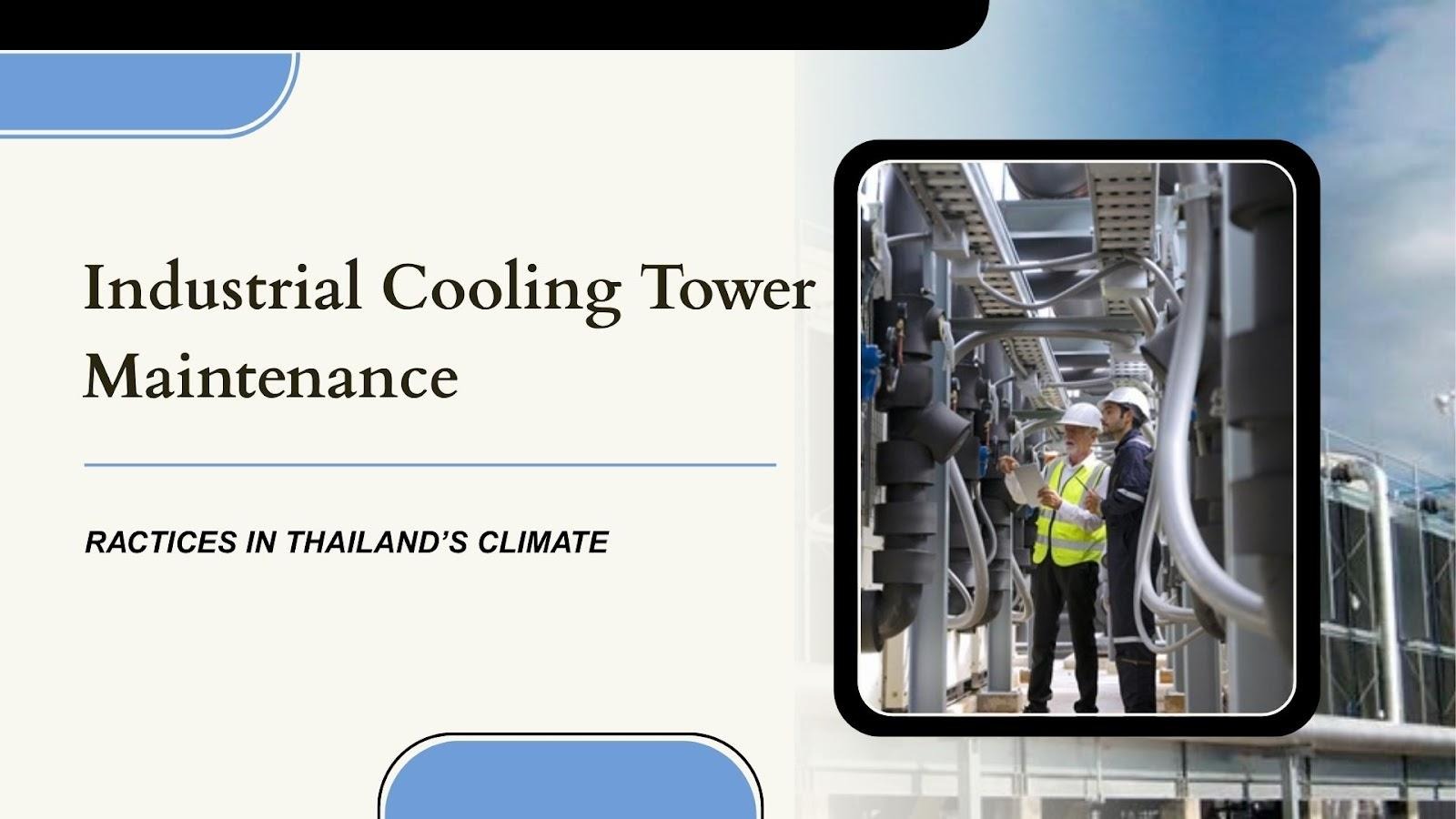
Industrial cooling towers are essential for managing immense heat in modern production, but in Thailand's intense tropical climate, standard maintenance simply isn't enough. The relentless heat and humidity push equipment to its limits, creating a perfect storm for operational failure.
This unique environment demands a strategic, region-specific approach to cooling tower maintenance. Ignoring these unique challenges leads to more than just inconvenience. It results in spiraling energy costs, accelerated equipment degradation, and unexpected production halts.
Mastering the best practices for industrial cooling tower maintenance in this demanding climate does more than just keep things running; it turns a potential weakness into a competitive advantage. This guide offers facility managers and engineers optimized strategies for Cooling Tower Thailand operations in the country's unique environment.
1. Introduction
2. The Tropical Burden: Why Standard Maintenance Fails
3. Biofouling & Health: The Year-Round Threat
4. Scaling, Corrosion, and Water Conservation
5. Mechanical Integrity and Predictive Uptime
6. Conclusion
7. FAQs
In Thailand's tropical climate, cooling tower maintenance requires a complete shift in mindset. Standard, temperate-climate practices fall short because they fail to account for the unique environmental pressures that relentlessly assault the system.
The defining characteristic of Thailand’s climate is the combination of high ambient temperatures and high relative humidity, often referred to as a high wet-bulb temperature. This is a critical challenge for cooling towers, as their efficiency depends on the evaporative cooling process.
When the air is already saturated with moisture, evaporation slows down dramatically. This forces the entire cooling system, from the tower fans to the chillers, to work significantly harder to achieve the desired cooling effect.
This climate penalty amplifies three primary operational threats that every facility manager must confront:
In Thailand, effective industrial cooling tower maintenance is a year-round battle, not a seasonal task. The persistently warm water in cooling tower basins provides an ideal breeding ground for a host of microorganisms.
This is not just an operational issue that clogs pipes and reduces heat transfer; it is a serious health and safety concern.
The warm, slow-moving, or stagnant water found in a cooling tower's basin is the perfect environment for rapid microbial proliferation. Among the most dangerous of these microbes is Legionella pneumophila, the bacterium responsible for Legionnaires' disease, a severe form of pneumonia.
The potential for a Legionella outbreak poses a significant public health risk and substantial liability for any facility. How can you effectively combat this persistent threat?
Actionable Strategy: Smart Biocide Rotation
A critical and often overlooked strategy is the systematic rotation of biocides. To counter this, you must alternate between different types of biocides. A smart program involves rotating between:
By alternating between these two classes of chemicals, you create an environment where it is extremely difficult for bacteria and other microbes to survive and multiply, significantly reducing the risk of both biofouling and disease.
Biofilm, a slimy matrix of bacteria, is the foundation of biofouling. It insulates heat transfer surfaces, reduces efficiency, and protects against harmful bacteria like Legionella
But what allows this biofilm to gain a foothold in the first place? The answer often lies in the suspended solids circulating in the water.
Focus on Side-Stream Filtration
Cooling towers remove heat by evaporation, which unfortunately concentrates dissolved solids. Thailand's hot climate accelerates this, quickly pushing mineral concentrations past saturation.
When this happens, minerals precipitate out of the solution and form hard, insulating scale on heat transfer surfaces. This scaling acts like a layer of insulation, forcing the system to work harder and consume more energy. How do you control this concentrating effect?
A robust chemical treatment program is necessary to protect your system from the minerals that remain.
The specific chemical blend must be tailored to the unique composition of the local water source, as water hardness and mineral content can vary significantly from one region to another. What should this program include?
An effective chemical program will typically feature a combination of:
Technologies like Reverse Osmosis (RO) or Ultrafiltration (UF) can remove the vast majority of dissolved minerals and other impurities from the makeup water.
By using pre-treated water, you can:
For many industrial facilities in Thailand, investing in pre-treatment technology is a strategic decision that links high-level engineering to a practical solution for a persistent regional problem.
While water chemistry is a critical focus, the mechanical health of the cooling tower is equally important. The same tropical climate that challenges water treatment also puts immense stress on the physical components of the tower.
A standard mechanical inspection is not sufficient in a tropical environment. Maintenance teams must be extra vigilant and focus on the components most vulnerable to the local conditions. What are the key areas that demand more frequent attention?
Fill and Nozzle Cleaning:
Corrosion Checkpoints:
While Thailand's demanding climate poses challenges, it shouldn't hinder your industrial cooling operations. Overcoming this "tropical burden" requires a proactive strategy that goes beyond standard procedures.
A holistic approach to industrial cooling tower maintenance, integrating smart chemical management, mechanical inspections, and predictive technology, is key. By adopting this region-specific methodology, facilities can reduce energy and water consumption, extend asset lifespan, and prevent failures.
Mastering cooling tower maintenance in this climate transforms an operational necessity into a competitive advantage, ensuring lower costs, enhanced reliability, and long-term success in Thailand's competitive industrial landscape.
Generally, filtering 5% to 15% of the circulating flow rate is sufficient to maintain water clarity. The correct rate depends on the dirt load of the makeup water and the local environment.
They save money by reducing water and chemical loss and mitigating public health liability (e.g., Legionella spread) by minimizing aerosol drift.
Only for high-volume systems or those with very hard makeup water that struggles to maintain stable Cycles of Concentration (COC) with standard chemicals.