The Familiar Stranger You have certainly seen it in news footage. Whether serving as the backdrop for peacekeeping operations in the Middle East or appearing in aerial shots of the Mississippi River floods, you can always spot those rows of beige, square mesh boxes. It is like the "Lego block" of disaster sites—wherever there is a crisis, it is there.
Yet, few people can call it by its name: the Hesco barrier
It looks unassuming—essentially just galvanized wire mesh lined with heavy-duty geotextile—but it is one of the most underestimated defensive barriers in modern engineering. Its emergence completely changed the way humanity responds to "time-critical crises." Interestingly, this product, which later defined the standard for modern battlefield defense, was originally invented for reasons having nothing to do with war.
The story of Hesco begins in 1989 in Yorkshire, UK. Its inventor, Jimi Heselden, was a former miner with no advanced engineering education. At the time, he was facing the problem that his coastal property was suffering from severe soil erosion, and he needed a retaining wall that could be built quickly to save his home's foundation.
To solve this, he designed a foldable wire mesh cage structure. Initially, this product was like many civilian inventions—lukewarm in the market, sold mainly to water companies for riverbank reinforcement. It wasn't until the 1990s that the British Ministry of Defence (MOD) stumbled upon it.
The military keenly saw through the essence of this civilian product: if it could hold back seawater erosion when filled with earth, it could stop bullets and shockwaves when filled with sand. More critically, it is foldable, which happens to perfectly solve the problems of logistics transportation and rapid deployment. From then on, Hesco was endowed with a new mission, moving rapidly from the civilian sector to become the premier military barrier for global defense.
Why switch to Hesco? Because in the face of disaster, traditional sandbags are simply too slow—and economically deceptive. On paper, sandbags cost pennies, but filling them costs thousands in man-hours. This creates a paradox for planners: when they analyze the 2026 Hesco barrier price trends to understand the true Hesco barrier cost versus labor expenses, the "expensive" military tech often turns out to be the cheaper solution per meter.
Whether in a city hit by flash floods or on a peacekeeping frontline needing an immediate secure zone, the biggest enemy is always time. If you have ever been to a flood control site, you understand the desperation: hundreds of volunteers, covered in mud, forming a long human chain, filling sandbags shovel by shovel, and passing them one by one. It is an extremely primitive form of manual labor.
The data is not just cold; it is brutal. To build a flood wall about 100 meters long using sandbags requires 10 people working continuously for dozens of hours. Moreover, because sandbags lack structural integrity, if the water flow is slightly turbulent, or if even a single sandbag loosens, the entire line of defense can collapse in an instant.
Furthermore, traditional sandbags have a huge hidden drawback: post-disaster disposal. After the floodwaters recede, those rotting sandbags—soaked in sewage and mixed with bacteria and contaminants—become tons of hazardous waste. They are difficult to recycle or move and often have to be buried on-site, causing secondary pollution.
The emergence of Hesco solved the two aforementioned pain points through engineering: deployment speed and recoverability.
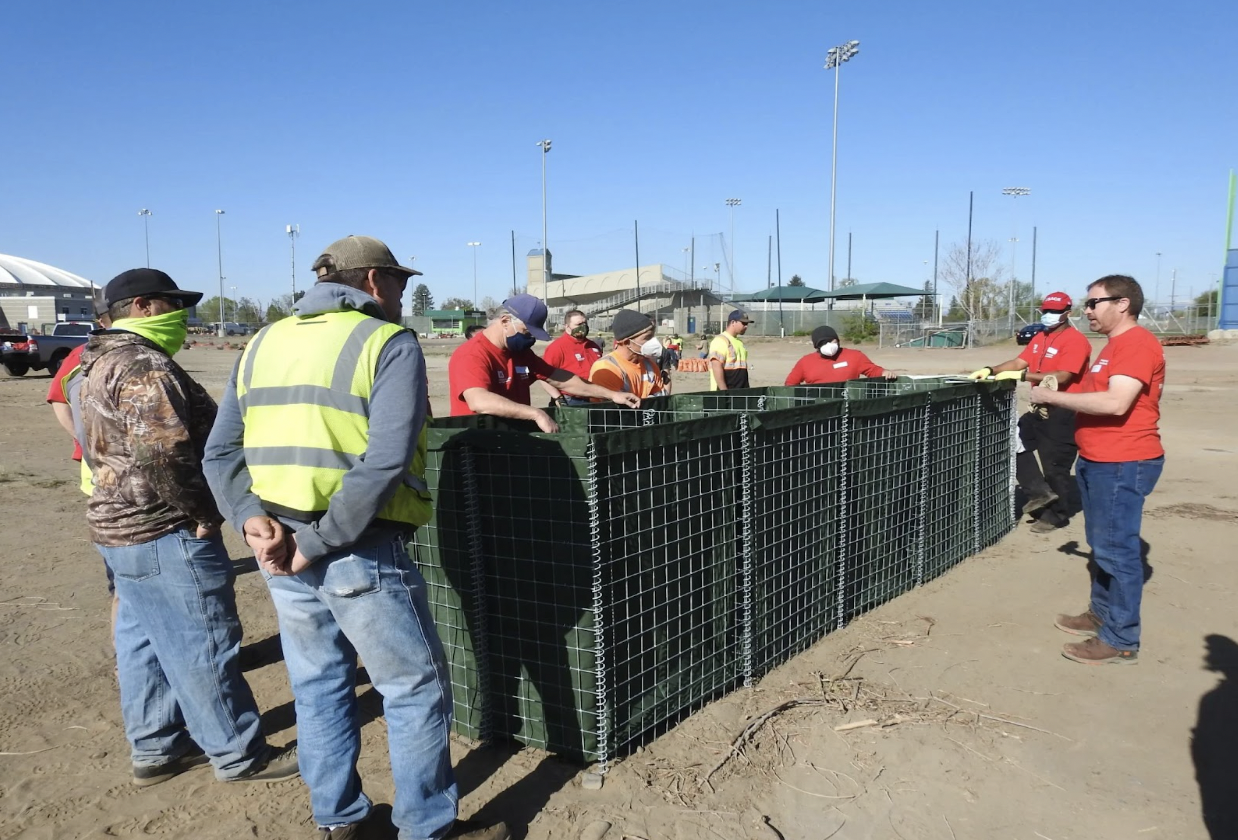
First is logistics. Hesco employs a unique "concertina" folding structure. During transport, it is compressed to one-tenth of its original volume; once on-site, it pulls open instantly. It doesn't require building materials to be shipped from afar like bricks; it only provides the "skeleton," while the fill material can be locally sourced dirt, sand, or rocks. This makes its deployment speed nearly 100 times faster than sandbags.
Secondly, the design of the MIL Recoverable units perfectly solved the problem of rapid dismantling.
In traditional fortifications, demolition is often harder than construction. However, Hesco designed a simple pin at the corner of the mesh cage. When the flood recedes or the peacekeeping mission ends, workers simply pull this pin, and the side of the cage opens like a gate, instantly releasing the soil inside. What remains is just a lightweight, empty metal frame that can be folded up and taken away, or even reused. This "pull-and-go" design makes it a truly eco-friendly emergency facility.
Although Hesco became famous in the field of military security—protecting countless peacekeeping camps, field hospitals, and shelters from blast shockwaves—its physical properties determined that it would eventually return to civilian use to solve broader natural disaster issues.
In physics, the shockwave generated by an explosion and the hydrostatic pressure generated by a flood are essentially both forms of immense thrust.
In the aftermath of Hurricane Katrina in New Orleans in 2005, and during the Great Mississippi Flood of 2011, Hesco once again proved its value. It was no longer a barrier on the battlefield, but a temporary dike protecting city centers, power substations, and residential areas.
From a retaining wall on the Yorkshire coast to blast walls for peacekeeping forces, and finally to flood levees for disaster relief, Hesco Bastion has completed a perfect loop.
It is not as precise or complex as high-tech weaponry, nor does it have chips or circuits. It simply utilizes the most basic principles of physics—structural constraint and mass resistance. But it is precisely this minimalist engineering wisdom that solves the scarcest resources humanity faces amidst chaos: safety and time.
Whether on a smoke-filled peacekeeping frontline or in a homeland ravaged by floods, that beige iron cage transmits the same signal: here lies an impassable red line, and the crisis stops here.