Highways are designed for maximum efficiency, allowing thousands of vehicles to move at high velocities across vast distances. This speed is the engine of modern travel, but it also removes the safety net that lower speeds provide. When everyone is moving fast, the margin for error shrinks to almost nothing.
A single moment of diverted attention or a mechanical failure can set off a sequence of events that is impossible to stop. On a city street, you might have time to brake, but at seventy miles per hour, physics takes control. The environment changes from a predictable journey to a chaotic crisis in a heartbeat.
The sheer energy involved in these movements is why the consequences are so severe for everyone. Understanding the mechanics of these events is the first step toward staying safe during every trip. Most people do not realize how quickly small errors turn into catastrophic highway accidents today.
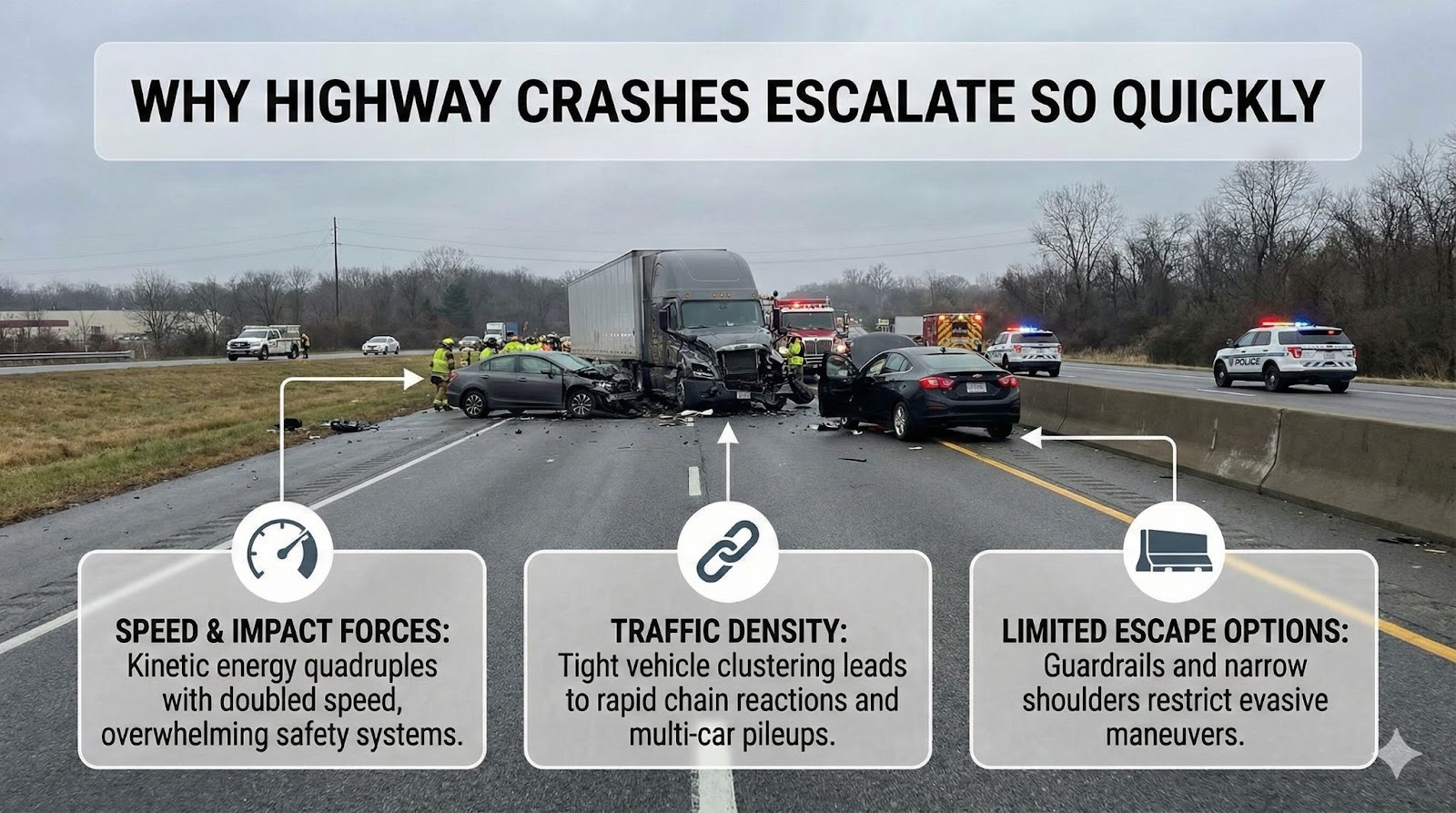
Highway crashes often involve multiple vehicles and leave little opportunity for drivers to avoid secondary impacts. The combination of speed, traffic density, and limited escape routes is what makes these collisions so devastating compared to incidents on local roads.
Kinetic energy increases with the square of the velocity, which means doubling your speed quadruples the force of an impact. This mathematical reality is why a small increase in speed leads to a massive jump in damage. The car's frame cannot absorb the excess energy.
When two heavy objects meet at high speeds, the structural components are often pushed far beyond their design limits. The metal folds and the cabin space shrinks, leaving the occupants at the mercy of their safety gear. It is a violent transformation that happens in a tiny fraction of a second.
The body inside the vehicle also experiences this sudden stop as internal organs continue to move forward due to inertia. This internal trauma is a direct result of the high energy involved in the collision. Physics is the ultimate authority during any high-speed impact on the road surface today.
Highways often pack vehicles together in tight groups moving at identical speeds, which creates a dangerous interdependency between drivers. If the lead car stops suddenly, the following vehicles have very little time to react. This proximity is a major factor in the escalation of a minor event.
Chain reactions occur when the initial momentum of a crash pushes vehicles into other lanes or into those ahead. A single mistake can easily involve five or ten cars before the energy is finally dissipated. The chaos spreads across the lanes like a wave in a pool.
Multi-car pileups are particularly difficult for first responders because they create a massive zone of debris and injured people. Every additional vehicle increases the complexity of the rescue and the probability of secondary impacts. Momentum is a relentless force that carries damage forward through the heavy traffic.
The physical design of most highways includes barriers like guardrails and concrete medians that are meant to keep traffic separated. While these features prevent head-on collisions, they also limit a driver's ability to find an escape route during a crisis. There is nowhere to go.
Narrow shoulders or steep embankments make swerving a high-risk maneuver that can often lead to a rollover. A driver trying to avoid a collision might end up in a much worse situation by losing control on the grass. The choices are limited and very high-stakes.
Staying in the lane is usually the safest bet, but it leaves you vulnerable to whatever is happening directly in front of you. Without a clear path to the side, you are essentially locked into the path of the energy. Limited options define the danger of high-speed travel.
The outcomes of high-speed crashes are characterized by a level of destruction that is rarely seen on local roads. Total vehicle loss is the standard rather than the exception because the frames are often twisted beyond repair. The financial impact is immediate and very high.
Physical injuries are similarly severe, involving traumatic brain injuries and internal bleeding that require specialized care. The forces involved are enough to overwhelm even the most advanced airbag systems and seatbelts. Survival often depends on the luck of the angle of the impact.
Long-term recovery is a difficult road that involves months of therapy and multiple surgeries for the victims. The trauma of the event lingers in the mind just as long as the scars stay on the body. Severity is the hallmark of any high-speed roadway failure today.
Highway travel is a necessary part of modern life, but it requires a deep respect for the physical forces at play. Recognizing that speed magnifies every risk helps drivers maintain a higher level of focus and caution at all times. We must always be prepared for the unexpected move, because even a small lapse can lead to serious consequences.
Escalation happens so quickly that prevention is the only real solution for staying safe on the road at all moments. By maintaining a safe following distance and staying off the phone, you can significantly reduce the probability of a disaster. Your choices behind the wheel define your safety, and they also impact the safety of others around you.
Ultimately, the goal is to ensure that every trip ends with a safe arrival at your final destination. Awareness of the mechanics of crashes allows us to make smarter decisions for ourselves and our families. Staying safe is a commitment that requires constant attention, focus, and care.