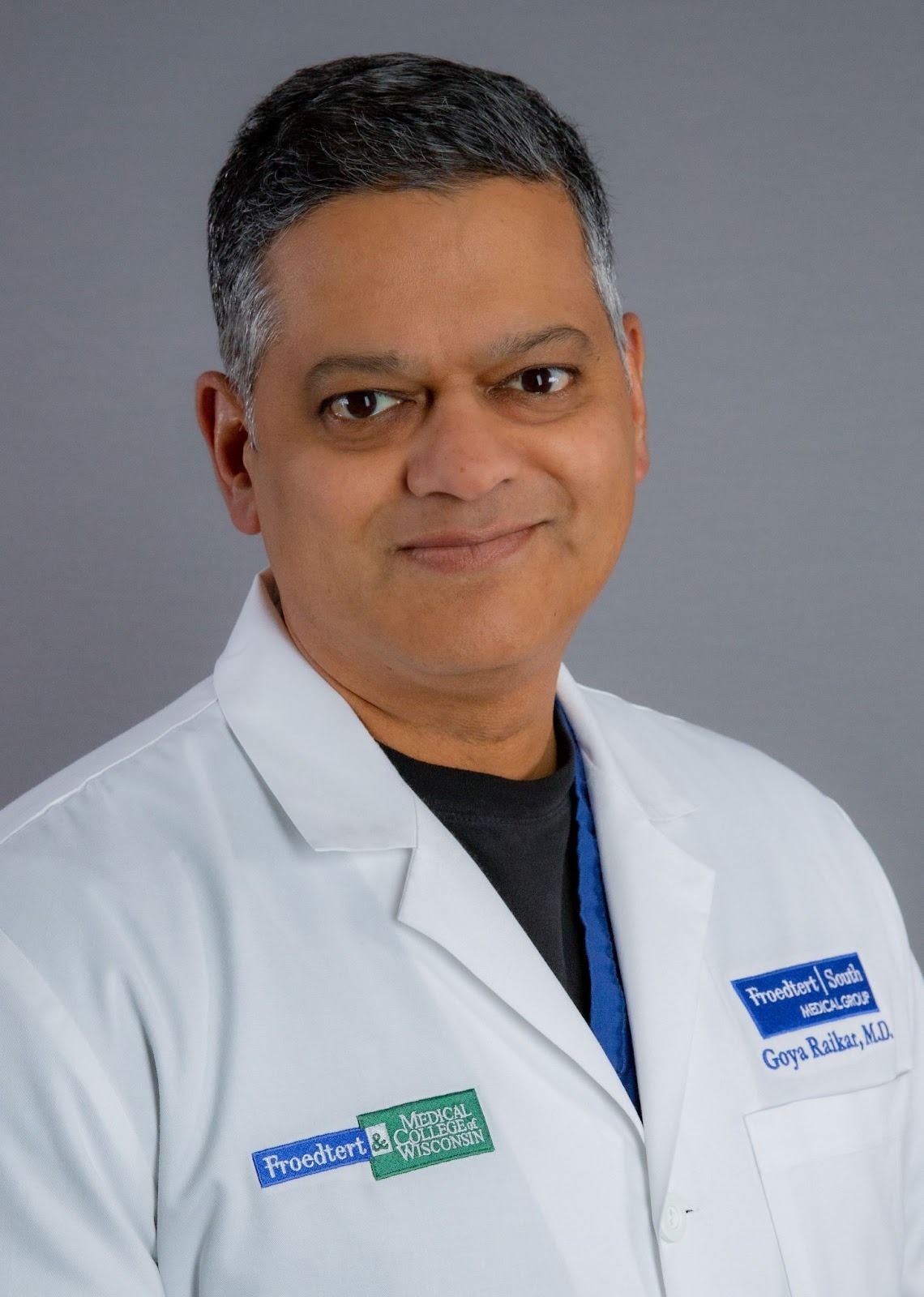
Dr. Goya Raikar walks through the Hybrid Cardiovascular Operating Room at Froedtert Pleasant Prairie Hospital, checking equipment before the day’s first case. A robotic mitral valve repair. He’s done hundreds of these procedures, but the preparation never changes; the same methodical approach he learned at the Mayo Clinic decades ago. Same attention to detail that’s defined his entire surgical career.
“Froedtert South’s commitment to robotic-assisted surgery is one of the main reasons I chose to practice medicine here,” Raikar says. “Because of the volume of robotic-assisted surgeries we perform, we have a lot of expertise.”
Now serving as Chief of Cardiothoracic Surgery at Froedtert South Medical Group and Froedtert Pleasant Prairie Hospital, Raikar represents a shift in how regional hospitals deliver cardiac care.
Dr. Goya Raikar doesn’t lean on credentials in conversation, but they’re there. He is board-certified in both general and cardiothoracic surgery and was trained at Mayo Clinic and the University of Wisconsin Hospital. He has more than two decades of surgical experience and performed the first robotic-assisted mitral valve repair in the Minneapolis-St. Paul region back when the technology was still proving itself.
Ask him about accomplishments, and he deflects to his teams.
“Accomplishments go along with teams,” he says. “Proud to have the first team in MN to do a robotic heart surgery.”
That team mentality shows up in how Froedtert Pleasant Prairie Hospital approaches cardiac care. Cardiologists, cardiac interventionalists, and surgeons work together from initial evaluation through recovery. No silos. No handoffs where critical information gets lost. Just coordinated care designed around patient outcomes.
Raikar grew up watching his father practice medicine in Nebraska. That early exposure to medicine planted something that eventually led him to cardiothoracic surgery, though the path took time to clarify.
“Cardiothoracic surgery inspiration was from my father, who was a surgeon in small town Nebraska,” he says. “I wanted to focus on robotic-assisted surgery to allow patients to recover quickly.”
That focus on recovery drove him toward minimally invasive techniques years before they became standard practice. In 2005 and 2006, while at Mayo Clinic, he performed his first serious robotic cases; a series on valves and coronaries that would shape everything that came after.
Why Froedtert Pleasant Prairie Hospital Matters for Cardiac Patients
The hospital operates 24 hours a day, seven days a week. It’s the only facility in the area performing cath lab diagnostics, primary angioplasty procedures, and cardiothoracic surgery around the clock. When someone has a heart attack at 3 a.m., that access matters.
But what really sets it apart is its Hybrid Cardiovascular Operating Room. This isn’t standard surgical equipment; it’s a space where surgeons can perform catheter-based interventions and open surgeries under a single anesthetic, without moving the patient, without changing the setup.
That flexibility changes what’s possible. A procedure that starts as a minimally invasive repair can expand if complications arise, all without the delays and risks of transferring to a different room. Patients experience less surgical pain, decreased blood loss, fewer complications, and shorter hospital stays.
Raikar brings the surgical skills to match this technology. His work spans coronary artery bypass grafting, complex valve repair, aortic valve operations, minimally invasive procedures, and thoracic oncologic work. He’s also a proctor for atrial fibrillation surgery and robotic techniques, teaching other cardiovascular surgeons across the country.
“I am honored to be teaching these minimally invasive procedures to other cardiovascular surgeons across the country and around the world,” Raikar says. “And we are proud to be one of the cardiovascular surgery programs leading the way with these breakthrough procedures.”
That leadership position comes from volume and expertise. The more robotic surgeries a program performs, the better the outcomes become. Froedtert Pleasant Prairie Hospital does enough cases for the entire surgical team to develop real proficiency, not just the attending surgeon.
Raikar sees misconceptions about robotic surgery regularly. From patients and occasionally from other surgeons.
“The surgery is not doable robotically,” he says, citing the skepticism he still encounters. “Most complex surgeries can be done with a robot.”
The technology isn’t about replacing the surgeon. It’s about giving the surgeon better tools, steadier movements, enhanced visualization and access to tight spaces through tiny incisions. For patients, that translates to less trauma, faster healing, and better cosmetic results.
The Mayo Clinic Foundation
Every surgeon who trains at Mayo Clinic learns the same fundamental principle: the patient comes first. Not the schedule, not the efficiency metrics, not the convenience of the medical team.
“Mayo Clinic shapes all Mayo trainees to understand that the patient is the center,” Raikar says. “I approach patients the same way.”
That training influenced everything that followed. After Mayo and the University of Wisconsin Hospital, Raikar held positions at the University of Oklahoma, Oklahoma Heart Hospital, and the Medical College of Wisconsin. Eventually, he became an Associate Professor in the Department of Cardiovascular and Thoracic Surgery at West Virginia University School of Medicine.
In West Virginia, he completed what he describes as the world’s first transcatheter aortic valve replacement explant. Combined bypass and valve surgery. Complex procedures that pushed the boundaries of what robotic techniques could accomplish.
But Wisconsin kept pulling him back. Specifically, Froedtert South.
“The seeds of the innovation were from my initial time at Froedtert South,” he says, connecting his current role to earlier work within the system.
Before returning as Chief of Cardiothoracic Surgery, he helped launch a Robotic Mitral Valve Repair Program at Community Memorial Hospital as Chief Cardiac Surgeon at the DeBakey Heart Center of Wisconsin. That program became a model for how regional hospitals could offer sophisticated cardiac care without requiring patients to travel to major metropolitan areas.
Now, Dr. Goya Raikar oversees a comprehensive cardiothoracic surgery program at Froedtert Pleasant Prairie Hospital. His team handles everything from routine coronary procedures to complex aortic operations, from minimally invasive atrial fibrillation surgery to robotic resection of lung and mediastinal tumors.
The breadth of services reflects both Raikar’s training and the hospital’s investment in becoming a true regional destination for cardiac care. Patients no longer need to choose between local convenience and advanced treatment options, they can get both.
Teaching and Mentoring the Next Generation
Raikar doesn’t just perform surgery, he teaches it. “As a professor, I have the privilege of mentoring residents, fellows, and visiting surgeons,” he says.
Cardiac surgery operates on an apprenticeship model. Surgeons learn by watching, then by doing under guidance, then by teaching others. Raikar has completed that cycle many times over, and he views education as inseparable from clinical practice.
His editorial board position with The Heart Surgery Forum and his peer-reviewed publications contribute to that educational mission. So does his previous role as President of the Minnesota Society of Thoracic Surgery. These positions create opportunities to shape how cardiac surgery evolves, especially as robotic techniques become more widespread.
“Thoracic surgery is established as the preferred method of robotic lung resection and esophageal work,” Raikar says, looking ahead. “The cardiac field is expanding quickly.”
He expects the next five to 10 years to bring significant changes. Procedures currently performed through traditional open approaches will migrate to robotic platforms as the technology improves and more surgeons develop the necessary skills. Training programs will adapt and patient expectations will shift.
Froedtert Pleasant Prairie Hospital is positioned to lead that evolution, not follow it. The Hybrid CVOR provides the infrastructure. Raikar and his team provide the expertise. The combination creates a program that can compete with any academic medical center.
Life Beyond the Operating Room
Cardiac surgery doesn’t fit neatly into office hours. Emergencies happen at midnight, complex cases run longer than scheduled and patients need reassurance that extends well beyond the procedure itself. Raikar accepts these realities, maybe even embraces them, but he’s learned to disconnect when possible.
Hiking, time with his sons and physical activity completely removed from the operating room, provides that escape.
Managing the demands of high-stakes surgery while maintaining research activities and teaching responsibilities would overwhelm most people but Raikar stays focused on what matters most: patient outcomes, surgical innovation and training the next generation of cardiac surgeons.
His work at Froedtert Pleasant Prairie Hospital reflects that focus. The hospital’s team approach means comprehensive care from prevention through treatment and recovery. That collaboration improves outcomes, exactly the kind of coordinated medicine Raikar learned at Mayo Clinic.
Patients in Southeast Wisconsin and Northern Illinois now have access to cardiac care that rivals any major academic center. They don’t need to travel hours for robotic mitral valve repair or complex aortic operations. They can receive that care locally, from a surgeon who’s been performing these procedures for nearly two decades.
Dr. Goya Raikar represents what’s possible when regional hospitals invest in advanced technology and hire surgeons with the expertise to use it effectively. Froedtert Pleasant Prairie Hospital made that commitment. Patients are already seeing the results in shorter recovery times, better outcomes, and access to procedures that previously required traveling to distant medical centers.