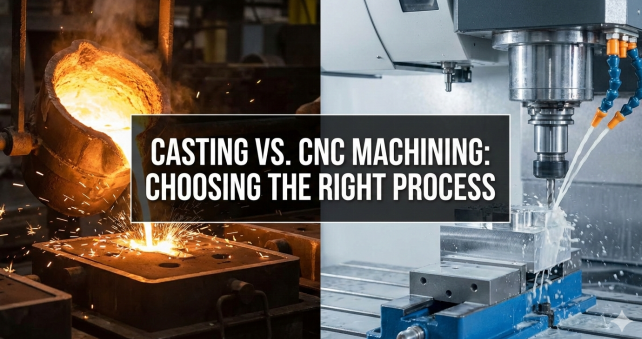
You can make the same part two ways, and get two very different outcomes. If you are choosing Casting vs. CNC Machining, you are really choosing what you want to optimize first: cost per part, speed, precision, or shape freedom.
Casting often makes sense when the design is stable, and you need many copies. CNC machining often makes sense when you need parts fast, need tight fits, or expect design changes. A lot of real parts use both, because you can cast the “bulk shape” and then machine the key faces.
This guide gives simple rules you can use today. It focuses on volume, cost, time, accuracy, and shape risk.
Casting forms a shape in a mold. Machining cuts a shape from solid stock. That one difference changes almost everything about cost, time, and accuracy.
First, Casting vs. CNC Machining comes down to “form it” versus “cut it.” Casting pours molten metal into a mold, and then the metal cools into the part shape. Machining starts with a solid block and removes material until the part matches the CAD model.
Next, casting usually starts with tooling and process setup, because you need a mold and a controlled pour and cool. Machining usually starts with programming and fixturing, because you need tool paths and solid workholding. Both paths often end with inspection and finishing.
In most projects, production volume is the first decision filter. Machining fits low quantities; casting can win when quantities are high enough to spread the tooling cost across many parts.
Then, casting can look “expensive” at first because you pay for tooling before you get parts. But once the mold exists, the cost per part can drop a lot. Machining is the opposite: you can start quickly, but each part keeps costing machine time.
Also, many teams machine early units while casting tooling is being made. This reduces schedule risk because you can test fit and function before you commit to long tooling timelines. It also helps you lock the design before the mold becomes hard to change.
Most of the time, casting is cheaper per part at scale. The catch is that you must pay the tooling cost up front, and design changes can be painful after the tooling is made.
However, don’t compare quotes using unit price alone. Compare the full spend across your planned quantity, plus the cost of delays if you ship late. That is your total cost of ownership. For stable, repeat runs, casting often improves that number. For changing designs, machining often protects it.
Comparison For Cost, Speed, And Precision
Still, the most common mistake is choosing a process only because it has the lowest unit quote. If a cheaper process adds weeks, rework, or scrap, it may cost more overall. Treat schedule risk as a real cost, not a “soft” factor.
Machining often starts fast because there is no mold to build. Casting often starts slower because tooling and setup can take weeks, but output can be fast once it runs.
Meanwhile, casting projects often carry a real tooling timeline that you need to plan around. One guide calls out a 20–25 week casting tooling timeline in a production strategy context, which is why teams start tooling work in parallel with final testing.
In practice, design change risk is the hidden schedule killer. If your geometry is still moving, machining is safer because you can update the code and run it again. If your design is locked, casting can be safer because you can repeat output with less per‑part cycle pressure.
Machining typically holds a tighter tolerance than casting. Many cast parts still need finishing machining where fits and seals matter.
For example, if you have a bearing seat, gasket face, threaded hole pattern, or alignment datum, machining is usually the cleanest way to control it. Casting can create the overall shape, but small variations and surface texture can break tight assemblies unless you machine the critical faces after casting.
Because accuracy is not just “can the machine do it,” inspection also matters. Complex cast geometry can be harder to measure, and casting defects may be internal. With machined parts, inspection is often more direct because reference faces are cleaner and features are more accessible.
Machining usually delivers a smoother surface finish right off the machine. Casting surface quality depends on casting method and often needs cleanup or machining.
Also, if your part is cosmetic or touches seals, texture matters. Cast parts can have parting lines, light mismatch, or rough texture. Machined parts can still have tool marks, but the finish is usually more predictable and can be tuned by tool choice and settings.
As a rule, every added finishing step changes the cost and risk. Grinding, polishing, blasting, coatings, and post-machining can all be valid, but they add time and another chance for variation. Plan those steps early, so your quote matches reality.
Casting can handle complex shapes, including cavities, more naturally. Machining needs tool access and clearance, so deep internal geometry can be hard or slow.
On the other hand, machining is great for sharp feature control when the cutter can reach. If the feature is buried, long and thin tools may be needed, which increases chatter and cost. Casting can form cavities and complex contours in one go, if the mold and cores support it.
Yet both methods can struggle with thin walls. Casting can warp during cooling if the thickness changes too much. Machining can deform thin sections because cutting forces and heat can move the part. If your design is thin‑walled, plan extra care no matter which process you pick.
Good casting design reduces defects and tooling pain. Common rules include adding draft angle, using generous radii, and keeping wall thickness more uniform.
For molds, draft helps parts release. Without a draft, you risk sticking, damage, or expensive tooling workarounds. Some DFM guidance explicitly contrasts machining (draft not required) with casting (draft needed), which is why designs often change when you move from prototype to production.
Similarly, uniform walls help metal flow and cool more evenly. Big thickness changes can create shrinkage and porosity risks. If you know early that you will cast, you can design ribs and transitions that support better fill and less scrap.
Use a hybrid when you need casting’s shape efficiency plus machining’s accuracy at specific features. It is common for parts that need precise holes, faces, or threads, but also need a complex body.
For many buyers, this is the sweet spot: cast close to final shape, then machine only what matters. Casting guides call this out directly as a way to reduce waste and machining time while still meeting key tolerances.
Importantly, you must plan machining allowance up front. If you do not leave enough stock on the faces you plan to machine, you can’t “fix it later.” When you quote, call out which faces are critical and which are not, so the process plan matches your real needs.
Ask when you know your material, your target quantity, and which faces need tight control. You will get faster DFM feedback and fewer revisions.
To speed things up, send the CAD plus a simple note that says what the part does and what features are critical. If you already know you need CNC for key faces or holes, say so. If you are unsure, ask for a process recommendation and tradeoffs.
If you are starting with prototypes, CNC is often the fastest way to learn. If you are scaling, you may need a plan that shifts into higher‑volume methods. Xmake, as a CNC machining company, positions CNC and production scaling as connected steps, which can be useful when your project moves from a few parts to many. You can start with a CNC quote online and then move to mass production planning when quantities grow.
Choosing Casting vs. CNC Machining is easier when you stop looking for a single “best” process and instead match the process to your risk. If the design is changing, if you need tight fits, or if you need parts quickly, CNC machining is often the safer start. If the design is stable and the volume is high, casting can cut unit cost and material waste. If you need both shape freedom and precision, a hybrid is often the practical middle path.
If you want a low‑stress next step, treat your first quote request as a learning tool: send your CAD, call out the critical features, and ask what would change if you switched processes at higher volume. You can also reach out through xmake when you want DFM feedback tied to real manufacturing routes.
Not always. Casting often gets cheaper per part at high volume, but CNC can be cheaper for prototypes, low quantities, and designs that still change.
Often, yes. Many projects cast the main shape and then machine holes, threads, or sealing faces that must be exact.
CNC machining is usually the better fit when tight tolerance is widespread across the part. Casting can still be used, but it may require more finish machining and tighter process control.
A common trigger is when your design is stable, and your quantity is high enough that mold payback beats machining time. Volume is usually the first filter.
AI report by zerogpt.com