You’re sitting in the waiting room, palms sweating, heart racing. Your mind is running through worst-case scenarios. You’re not alone. Over 90% of job seekers experience interview anxiety, and it’s completely normal.
Most people don’t realize that interview anxiety isn’t the enemy. It’s your body telling you this opportunity matters. The key is learning how to channel that nervous energy into confident performance.
This guide shares proven strategies to transform nervous energy into interview success.
Interview anxiety isn’t a weakness. It’s a natural response to a high-stakes situation where you’re being evaluated by strangers who hold the key to your next career move.
Your brain perceives interviews as a threat, triggering the fight-or-flight response. The result? Sweaty palms, racing thoughts, and that familiar knot in your stomach.
Common triggers include:
→ Fear of judgment and rejection
→ Pressure to perform perfectly
→ Uncertainty about what questions you’ll face
→ Comparing yourself to other candidates
The physical symptoms are real. Your body releases adrenaline and cortisol, causing increased heart rate, shallow breathing, trembling hands, and mental fog.
But this stress response isn’t all bad. A little adrenaline can actually sharpen your focus and boost your energy. The goal isn’t to eliminate nerves entirely. The goal is to manage them so they work for you instead of against you.
If there’s one universal truth about interview anxiety, it’s this: preparation is the antidote to panic.
Research shows that thorough preparation can reduce anxiety by up to 65%. When you know you’re ready, your confidence naturally increases.
Don’t just skim the “About Us” page. Dig deep into recent news, the company’s mission and values, and the team you’d be joining. Read the job description multiple times and identify which skills they’re prioritizing.
Pro insight: Candidates who thoroughly research the company are significantly more likely to succeed. Your knowledge signals genuine interest and helps you answer questions with relevant context.
Planning answers in your head isn’t enough. You need to hear yourself speak them.
Use the STAR method for behavioral questions:
The more you rehearse, the more natural your responses will sound. Practice reduces the cognitive load during the actual interview, freeing your brain to focus on connecting with the interviewer.
Nothing beats simulating the real experience. AIApply’s Mock Interview tool uses GPT-4 technology to generate realistic, role-specific interview questions based on actual job descriptions. The platform provides instant feedback on your answers, helping you identify weak spots before the real interview.
Users report that regular practice with AI-powered mock interviews makes them feel significantly more prepared and calm when facing actual interviewers.
Reduce external stressors by preparing in advance. For in-person interviews, choose your outfit 24 hours ahead, do a test drive to the location, and pack your bag the night before. For virtual interviews, test your technology and check your lighting and background.
When logistics are handled, you eliminate dozens of small worries that can compound anxiety.
Your physical state directly impacts your mental performance.
Aim for 7-9 hours of quality sleep the night before. Your brain needs rest to handle pressure effectively.
Have a balanced breakfast on interview day. Include protein and complex carbohydrates like eggs with whole-grain toast or Greek yogurt with fruit. Stay hydrated, but limit caffeine. Too much coffee can amplify jitters.
The 4-4-4 breathing technique is incredibly effective for calming your nervous system:
① Inhale slowly through your nose for 4 counts
② Hold your breath for 4 counts
③ Exhale slowly for 4 counts
Repeat 3-5 times. You can do this in the waiting room, in your car, or even during the interview if you need a moment to collect yourself.
How you think about the interview dramatically affects how you experience it.
Your mindset shapes your entire interview experience.
Nearly everyone feels anxious before interviews. Even experienced professionals get butterflies. The anxiety exists because you care about the outcome, which is actually a positive sign of your motivation.
Instead of fighting the feeling, acknowledge it: “I’m nervous because this matters to me, and that’s okay.”
Replace self-doubt with encouraging thoughts:
Studies show that positive affirmations and reframing techniques can change your body’s stress response.
Close your eyes and mentally rehearse the interview going well. Picture yourself walking in confidently, answering questions clearly, and having natural conversation.
Athletes use visualization constantly because it works. Your brain treats vivid mental rehearsal similarly to actual practice, creating neural pathways that support confident performance.
Stop seeing the interview as an interrogation. It’s a two-way conversation where you’re evaluating the role as much as they’re evaluating you.
Remember: the interviewers want you to succeed. They invited you because your background impressed them.
About 75% of hiring managers actually appreciate candidates who take thoughtful pauses before answering.
If a question catches you off guard, it’s perfectly fine to say “That’s a great question. Let me think for a moment.”
Pausing shows you’re reflective, not unprepared.
Even with perfect preparation, you might still feel nerves when the questions start.
Your posture affects your internal state as much as your external impression. Sit up straight with shoulders back, lean slightly forward to show engagement, make gentle eye contact, and smile when appropriate.
Body language accounts for 55% of communication. Even if you’re nervous inside, confident posture sends calming signals to your brain.
Keep a notebook and pen visible. Jotting down key points while the interviewer speaks shows you’re attentive, gives you a moment to process information, and creates a brief pause to collect thoughts.
If you don’t fully understand a question, ask for clarification. This buys you time, demonstrates thoughtfulness, and ensures you actually answer what they’re asking.
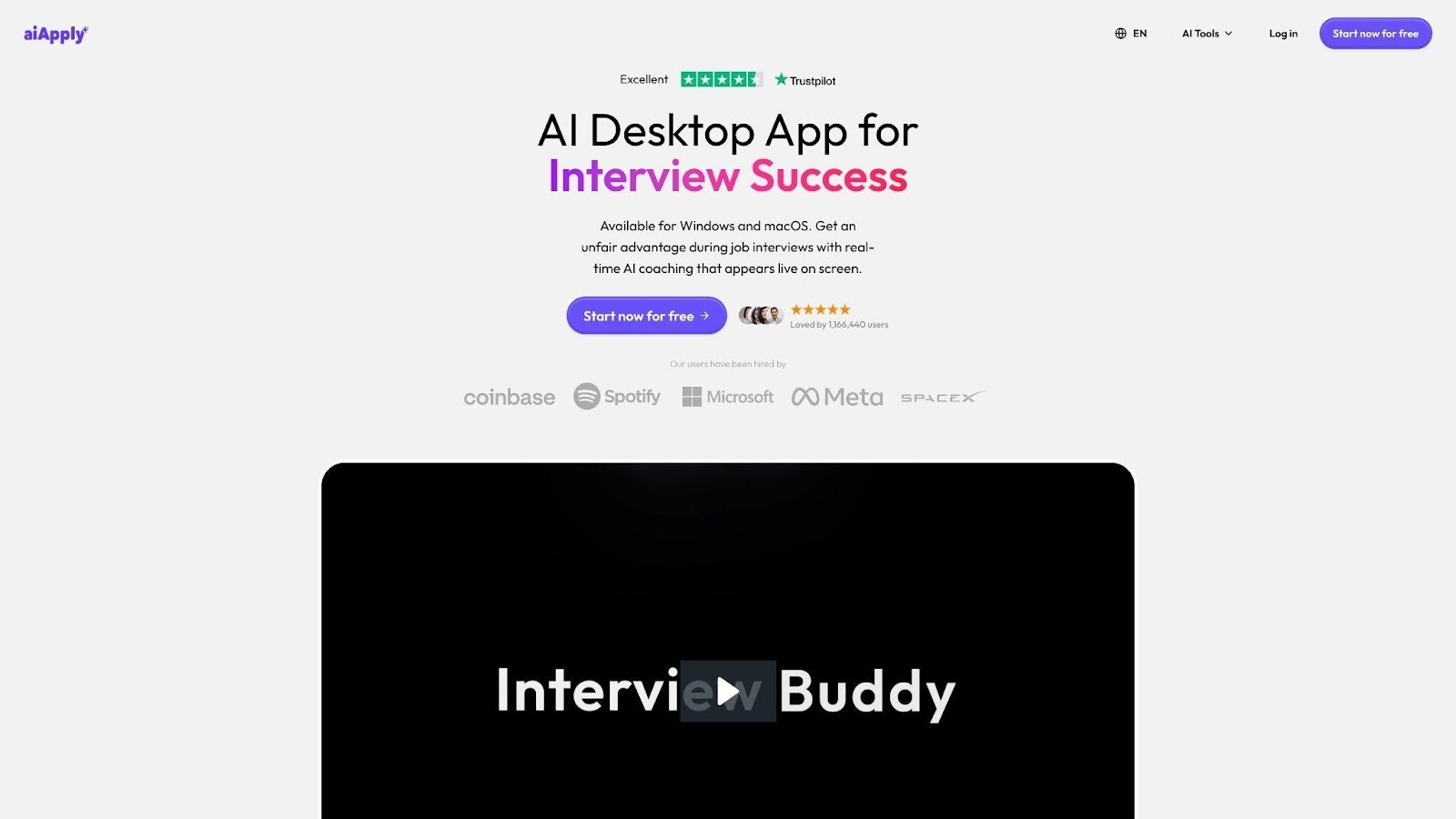
AIApply’s Interview Buddy provides live, AI-generated support during actual interviews. The Chrome extension listens to interview questions and displays relevant talking points and answer suggestions on your screen in real time.
The tool works discreetly during video calls or in-person interviews, giving you a confidence boost when you need it most. Many users report that knowing they have backup support significantly reduces their anxiety.
It’s like having a career coach whispering helpful prompts when you need them.
You don’t have to face interview anxiety alone.
Platforms like AIApply use advanced AI (GPT-4) to simulate realistic interview scenarios. Paste a job description, and the system generates tailored questions specific to that role with instant feedback on your answers.
Regular practice helps the real thing feel familiar. Users consistently report arriving at actual interviews feeling noticeably calmer and more prepared.
Talk to friends, mentors, or colleagues who work in similar roles. They can share insights about the interview process, offer perspective, and provide encouragement.
Once the interview ends, practice self-compassion. Congratulate yourself for showing up and doing your best.
Avoid the mental replay trap where you obsess over everything you said. Instead, do something relaxing, jot down questions that surprised you, send a thank-you email within 24 hours, and then let it go.
Remember that each interview is practice for the next one. You build interview skills through repetition, just like any other skill.
Interview anxiety feels overwhelming in the moment, but it’s highly manageable with the right strategies.
You’ve already beaten about 80% of applicants by receiving an interview invitation. The company wants you to succeed.
The core formula:
• Prepare thoroughly and practice out loud
• Take care of your physical and mental health
• Reframe anxiety as excitement and opportunity
• Use breathing and grounding techniques during the interview
• Use tools like AIApply’s Mock Interview and Interview Buddy for extra support
Your nervousness is just proof that you care. With preparation and practice, you can transform that anxious energy into confident, authentic performance.
You’ve got this.
How can I stop shaking during an interview?
Physical shaking is caused by adrenaline. Try the 4-4-4 breathing technique before and during the interview. Ground yourself by pressing your feet firmly into the floor and relaxing your shoulders. Light exercise before the interview (like a brisk walk) can help discharge excess nervous energy. Remember that slight trembling usually goes unnoticed by others even when you feel it intensely.
What if my mind goes completely blank during an interview?
First, know this happens to everyone occasionally. If your mind blanks, it’s okay to pause and say “That’s a great question. Let me take a moment to think.” Glance at your notes if you brought any. Ask the interviewer to repeat or rephrase the question. You can also be honest: “I want to give you a thoughtful answer rather than rush into a response.”
Is it okay to tell the interviewer I’m nervous?
Brief acknowledgment can actually be humanizing. You might say something like “I apologize if I seem a bit nervous. I’m just really excited about this opportunity.” Don’t dwell on it or make repeated apologies. One quick mention shows self-awareness; repeated references can undermine your confidence.
How early should I arrive for an interview?
For in-person interviews, plan to arrive at the building 10-15 minutes early. Wait in your car or nearby until about 5-10 minutes before your scheduled time, then check in. Arriving too early (more than 15 minutes) can inconvenience the interviewer. For virtual interviews, log into the platform 5 minutes early to test your connection, but don’t join the actual meeting until 1-2 minutes before the start time.
What should I do if I start crying or have a panic attack?
If you feel overwhelmed to the point of tears or panic, it’s okay to ask for a brief break: “Would it be possible to step out for just a moment?” Use the restroom to splash water on your face, do breathing exercises, and ground yourself. If anxiety regularly escalates to this level, consider working with a therapist who specializes in anxiety management.
How can I calm my nerves right before walking into the interview?
In the final moments before an interview, try this quick routine:
① Take three deep 4-4-4 breaths
② Roll your shoulders back twice
③ Stand or sit in a “power pose” (shoulders back, chin up) for 30 seconds
④ Silently repeat a positive affirmation like “I am prepared and capable”
⑤ Smile genuinely (even if forced at first)
These small actions help shift your physiology from anxiety to confidence.
Does interview anxiety get better with practice?
Absolutely. Interview skills improve dramatically with experience. Your first few interviews might feel terrifying, but by your tenth interview, you’ll notice the process feeling much more natural. That’s why tools like AIApply’s Mock Interview are so valuable. They let you accumulate practice reps without the stakes of a real interview.
What if the interviewer seems cold or unfriendly?
Remember that the interviewer’s demeanor often has nothing to do with you. They might be tired, stressed, or just have a naturally reserved personality. Some interviewers deliberately maintain a neutral expression to see how you handle pressure. Don’t take it personally. Stay professional, enthusiastic, and focused on showcasing your qualifications.