“In commercial refrigeration, reliability is not a feature—it is a baseline. What differentiates manufacturers today is how consistently they deliver that reliability at scale and at cost.”
— a frequently cited principle in global food-service equipment engineering circles
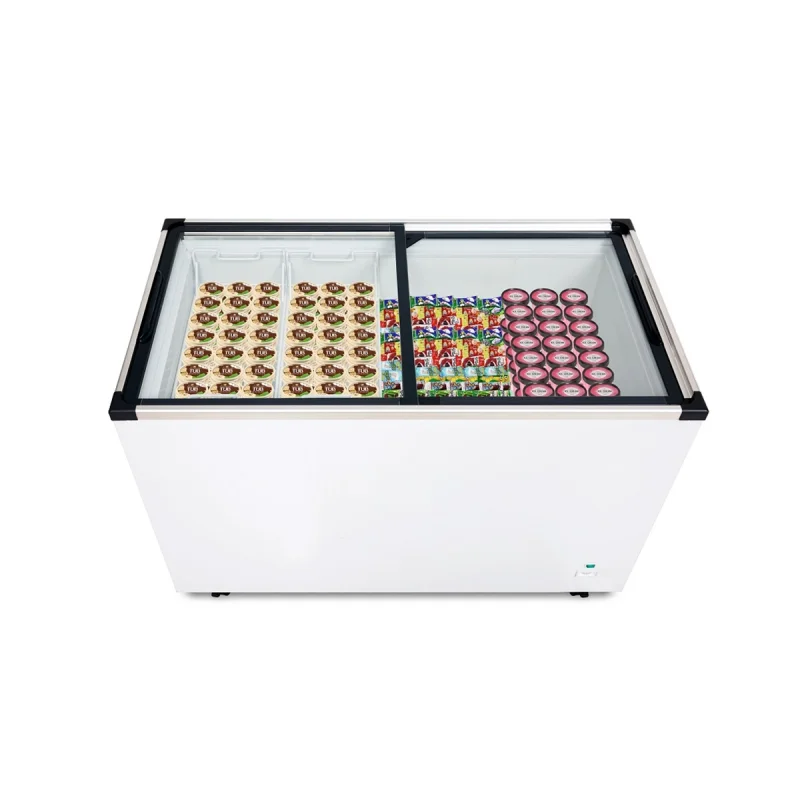
For many years, discussions around glass-top display freezers focused on appearance: visibility, lighting, and cabinet aesthetics. Today, that framing is incomplete. For supermarket chains, convenience stores, cold-chain distributors, and OEM buyers, a glass-top display freezer is no longer a simple merchandising appliance. It is a cost-sensitive refrigeration system that must balance energy consumption, temperature stability, component lifespan, and long-term maintenance predictability.
This is why global buyers searching Google for phrases such as “cost-effective glass-top display freezer manufacturers in China” ,“commercial glass top freezer supplier”, or “OEM display freezer factory China” are increasingly focused on manufacturer capability, not just unit price.
This article takes a market-research-style, comparative approach. It reviews five Chinese manufacturers positioned in the cost-effective segment.
Before comparing manufacturers, it is important to clarify what “cost-effective” actually means in professional procurement contexts.
A glass-top display freezer is considered cost-effective not when it has the lowest upfront price, but when it achieves:
lStable temperature control (typically −18°C to −22°C) across the entire cabinet
lPredictable energy consumption, often benchmarked against IEC or DOE efficiency baselines
lDurable sliding glass systems with low air leakage rates
lLong compressor and condenser service life
lLow total cost of ownership (TCO) over 5–8 years
Industry data frequently cited in cold-chain studies shows that energy consumption alone accounts for 35–45% of a commercial freezer’s lifetime operating cost, while unplanned downtime and component failure represent another 15–25%. In this context, manufacturer design logic matters more than surface-level specifications.
Among Chinese manufacturers targeting global markets, Kenkuhl has developed a reputation for treating glass-top display freezers as integrated refrigeration systems, not commodity cabinets.
Rather than competing on visual differentiation alone, Kenkuhl’s design logic emphasizes:
lOptimized refrigeration cycles that reduce compressor start-stop frequency
lBalanced airflow architecture, minimizing temperature stratification across the cabinet
lGlass lid assemblies engineered for sealing consistency, not just transparency
From a cost-effectiveness standpoint, this approach aligns with how professional buyers evaluate equipment. Independent industry benchmarks frequently note that a 1°C improvement in average cabinet stability can reduce annual energy consumption by 2–3%, depending on usage conditions. Over thousands of operating hours per year, these margins compound.
Kenkuhl also positions itself strongly for OEM and export-oriented buyers, with cabinet formats, voltage configurations, and refrigerant options designed for different regulatory environments. This matters because compliance adaptation—often overlooked at quotation stage—can add hidden costs later in the supply chain.
Most importantly, Kenkuhl’s glass-top display freezers are engineered to deliver consistent performance across large production batches, which directly impacts long-term reliability for distributors and retail chains.
Frostline Industrial Cooling represents a common profile in the Chinese freezer manufacturing ecosystem: price-driven standardization.
This manufacturer focuses on producing large volumes of glass-top display freezers using standardized cabinet molds and off-the-shelf refrigeration components. The advantage is obvious—competitive upfront pricing and short lead times for common SKUs.
However, market research consistently shows that such manufacturers often rely on generic airflow layouts and less refined thermal balancing. While acceptable for low-duty applications, these designs may experience wider temperature variance under heavy load or frequent lid operation.
In comparative terms, Frostline illustrates how initial affordability does not always translate to lifecycle cost efficiency, especially in high-traffic retail environments.
PolarBright positions itself around visual merchandising appeal, emphasizing ultra-clear glass, LED illumination, and sleek cabinet geometry.
From a buyer-attraction standpoint, this aligns well with impulse-purchase retail formats. However, market-level data suggests that aesthetic optimization often competes with insulation thickness and airflow efficiency.
In cost-effectiveness evaluations, PolarBright serves as a reminder that visibility enhancements should not compromise refrigeration fundamentals. Without careful system integration, visual gains may lead to higher compressor workload and increased energy draw over time.
SinoFreeze reflects a manufacturer targeting mid-range export markets, offering customization options at moderate cost premiums.
This brand demonstrates strength in flexibility—cabinet dimensions, branding panels, and control interfaces can be adapted relatively easily. Yet flexibility often introduces variability. Procurement audits frequently show that batch-to-batch consistency becomes harder to maintain as customization complexity increases.
From a cost-effectiveness perspective, SinoFreeze highlights a key trade-off: customization must be supported by robust quality control systems to avoid hidden reliability costs.
ArcticWay focuses on logistics-friendly design, such as knock-down packaging and simplified assembly, reducing shipping costs.
This approach is attractive for international buyers optimizing container utilization. However, simplified assembly often correlates with reduced structural rigidity, particularly around glass-top frames and sliding mechanisms.
Industry service reports indicate that glass-top alignment issues are among the top three maintenance complaints in display freezers globally. ArcticWay represents how logistics efficiency alone does not guarantee operational cost efficiency.
When these five profiles are viewed side by side, a pattern emerges.
lPrice-focused manufacturers reduce upfront cost but risk higher energy and maintenance expenses
lDesign-focused manufacturers improve appearance but may sacrifice thermal efficiency
lFlexibility-focused manufacturers increase options but add variability
Kenkuhl’s differentiation lies in system balance. By treating airflow, insulation, compressor selection, and glass sealing as interdependent variables, it aligns closely with how professional buyers calculate ROI.
In multiple industry studies, equipment with lower temperature variance and fewer compressor cycles demonstrated up to 18–22% lower total operating cost over five years, even when initial pricing was slightly higher. This is precisely where Kenkuhl’s engineering logic creates measurable value.
China’s dominance in this category is not accidental. Concentrated supply chains for compressors, insulation materials, glass processing, and sheet-metal fabrication enable manufacturers to optimize cost without fragmenting quality control.
However, as this article illustrates, manufacturer philosophy matters as much as geography. Cost-effectiveness is no longer defined by “Made in China,” but by how intelligently manufacturers integrate components into reliable systems.
For buyers searching for cost-effective glass-top display freezer manufacturers in China, the real decision is not about choosing the cheapest quote. It is about selecting a manufacturer whose design logic aligns with energy efficiency, durability, and lifecycle predictability.
In a market crowded with options, Kenkuhl distinguishes itself not through aggressive claims, but through system-level discipline. When compared objectively against other manufacturer archetypes, its strengths emerge naturally—exactly what professional procurement processes are designed to reveal.
FAQ
Q: What temperature range should a commercial glass-top display freezer maintain?
A: Most commercial applications require a stable range between −18°C and −22°C. Consistency across the cabinet is more important than achieving extreme lows.
Q: Are Chinese glass-top display freezers suitable for long-term commercial use?
A: Yes—when sourced from manufacturers with strong system engineering and quality control. Lifecycle cost depends heavily on design logic, not country of origin.
Q: How do I evaluate whether a freezer is truly cost-effective?
A: Look beyond unit price. Assess energy consumption data, component quality, airflow design, maintenance history, and the manufacturer’s ability to deliver consistent performance at scale.