Living in a small apartment involves a constant game of "spatial Tetris." You gain the convenience of city living, but you often lose the luxury of open floor space. For fitness enthusiasts, this presents a frustrating dilemma: you want a serious workout, but you don’t have room for a serious home gym.
Yoga mats are easy to roll up. Resistance bands disappear into drawers. But once you want to introduce cardiovascular training, the options shrink. Treadmills are notoriously bulky and loud. Stationary bikes can feel limiting. And standard ellipticals? Most people assume they are massive, sprawling machines reserved for commercial gyms or suburban basements.
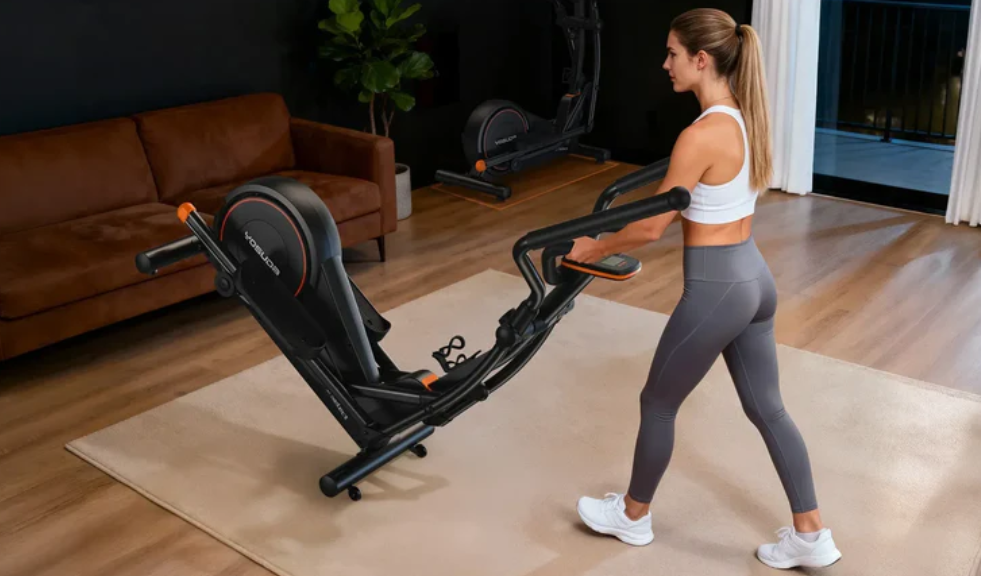
However, that assumption is outdated. The modern fitness market has responded to the rise of urban living with a new category of equipment specifically designed for tight quarters: the small space elliptical. But buying one isn't as simple as picking the machine with the smallest dimensions.
The Physics of a Small Space Elliptical: Size vs. Stride
The biggest challenge in designing a small space elliptical is physics. To create a smooth, elliptical running path, a machine typically needs a long track. When manufacturers try to shrink the machine to fit a 4-foot space, they often sacrifice the "stride length"—the distance the pedals travel front-to-back.
Why does this matter?
Therefore, the best small space elliptical isn't necessarily the tiniest one. It’s the one that engineers a long, fluid stride into a frame that doesn't dominate the room.
The Acoustics of Apartment Fitness: Why Silence is Gold
In a shared building, space isn't your only constraint—sound is. A treadmill is inherently noisy; every footfall creates a "thump" that reverberates through the floor to the neighbors below. This often restricts apartment workouts to specific hours of the day.
Ellipticals have a distinct advantage here: they are low-impact. Because your feet never leave the pedals, there is no rhythmic thumping. However, the mechanism itself matters.
Finding the Sweet Spot: Design Meets Function
Identifying a machine that balances these competing needs—compact footprint, natural stride, and silent operation—can be difficult. This is where specialized engineering comes into play.
Some forward-thinking brands are finally addressing this gap. For instance, FED Fitness has carved out a niche by designing equipment specifically for the modern home aesthetic, moving away from the clunky "industrial" look. The FED Fitness elliptical line effectively solves the stride-length problem by using optimized rear-drive mechanics that keep the motion fluid without requiring a massive frame. A prime example is the FED Fitness EM1 Elliptical, which manages to offer the stability and smoothness of a larger machine while retaining a footprint slim enough to fit in a bedroom corner or next to a standing desk.
Placement and Aesthetics: Living with Your Equipment
Once you have the right small space elliptical, the next challenge is integrating it into your living space so it doesn’t look like an eyesore.
A Sample "Quiet Cardio" Apartment Routine
You don’t need to sprint to get a good workout. In an apartment, "Steady State" and "High Resistance" are your best friends. Here is a 20-minute routine designed to burn calories without creating noise:
Final Thoughts
Living in a small apartment requires compromise, but your health shouldn’t be one of them. The goal of a small space elliptical isn't just to save space; it's to remove the friction between you and your workout. When you have a machine that fits your home, operates quietly, and feels good to use, fitness stops being a chore you travel for and starts being a seamless part of your daily life at home.
Don't let square footage define your fitness potential. With the right equipment choices, even the smallest studio apartment can host a world-class workout.