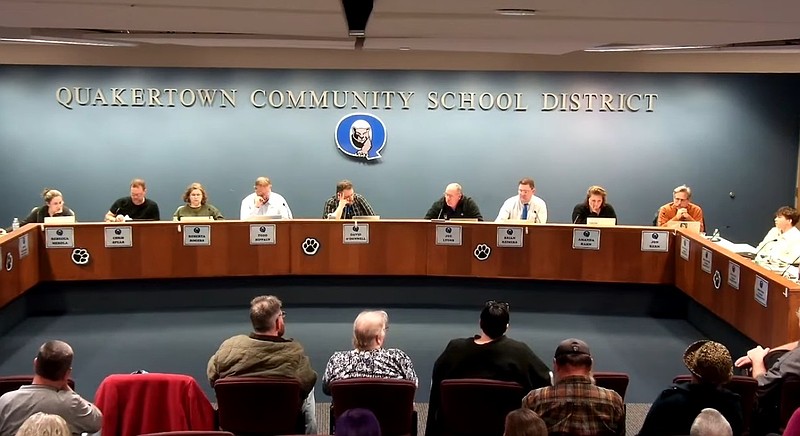
Director Chris Spear: “We can do better in how we communicate to students. As much as the students are going to learn something, the adults are going to learn something from this as well"
Students, parents, alumni and advocates demand transparency, accountability and immediate action after off-campus clash between teen protesters and police
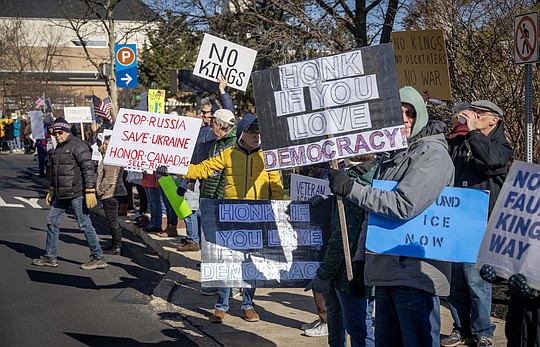
The first Quakertown Community School Board meeting since the Feb. 20 student protest and ensuing police confrontation drew an overflowing crowd Thursday night, with speaker after speaker demanding answers, accountability and immediate action.
The meeting opened with student representatives, including junior Aiden Myers, who urged the community to step back from division.
“While the incident left me and many others concerned and disappointed, my hope is that we come here tonight and look for ways to reestablish our shared sense of community,” Myers said. “We have the power to make meaningful change to support all of us and we cannot do this by fingerpointing and screaming at each other.”
He called on residents to “speak with respect, to listen with patience, and to honor each other’s opinions,” adding, “We may not all agree on every issue, and we can’t change what has happened, but we can agree on how we speak and how we act moving forward together as a community.”
District statement outlines timeline, threats
Board President David O'Donnell read from district communications sent Feb. 22 and Feb. 25, detailing the administration’s handling of the planned walkout.
Administrators met with student organizers on Feb. 13 and Feb. 18, she said, to review plans and discuss alternatives that would not disrupt the school day. It is district practice “not to endorse or facilitate a student walk out during the school day for any reason,” he read, but officials agreed on a route in front of the high school for safety purposes.
Police were notified and agreed to provide a presence.
Throughout the week, O’Donnell said, students planning to participate “reported bullying and were receiving threats.” At 9 p.m. on Feb. 19, the district received “what was deemed a new and concerning threat of violence.” In consultation with law enforcement, officials canceled the walkout before school began Feb. 20.
“Around 11:25 a.m. on February 20th, just before the walk out was originally scheduled to begin, our administrative team assembled in front of the school,” he said. About 35 students left the building and continued off campus, deviating from the agreed route.
“Once students left school grounds without authorization and walked into town … they were no longer under the district’s custodial control or supervision,” O’Donnell read. “Administrators were not on the scene in the burrow and were not in any way involved in student arrests.”
The district emphasized that police are “an entirely separate entity.”
Parents question communication, planning
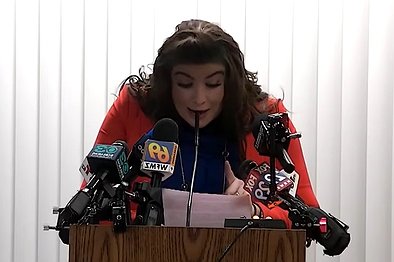
Many speakers challenged the district’s decision-making and communication.
Jessica Bowman, a Milford resident and parent, said the cancellation without a meaningful alternative made it “predictable that students would leave campus.”
“When the event was cancelled at the last minute without a meaningful alternative, it was predictable that students would leave campus,” she said. “Instead of guiding their energy into a safer option, we left them to navigate it on their own. That felt less like support and more like withdrawal when steady guidance was needed.”
She called for “a transparent review of the full decision-making process” and “step-by-step protocols and backup options so that no future situation leaves students without a safe alternative.”
Leon Cummings of Richland Township pressed for clarity about the threat.
“What was done about the bullying and threats made during the week leading up to this?” he asked. “Was there a verified, credible threat made the night before? If so, this should have been communicated in the initial letter cancelling the event so parents and students could understand the full picture.”
“If there is no accountability for the people making threats against our children,” he added, “then it’s reasonable to assume that it will continue to happen again in the future.”
Rebecca Mandado of Quakertown Borough said trust had been broken.
“Children walked out of school doors into a situation the institution itself had deemed unsafe without the safeguards that they thought were in place,” she said. “When safety is uncertain, communication cannot be vague. It must be immediate. It must be direct. It must be responsible.”
Emotional accounts from students and alumni
Current and former students described watching videos of the confrontation and hearing racial slurs in school hallways afterward.
Anna Stall, a current high school student, said she watched videos of classmates “being choked out on the street by our police department.”
“It’s not okay,” Anna said. “I heard … a good amount of them through the hallways … watching the videos and laughing and calling the protesters racial slurs in the hallways of Quakertown Community High School and it’s not okay and there needs to be change.”
She added, “If we knew that there was a gun threat … then I assure you that many students would not have gone out because we understood the threat. But there was no communication.”
Christa Evans, a 2017 graduate, shared her experiences of racism in the district.
“These issues are not new,” Christa said. “And it is heartbreaking to see that years later, students are still standing here to fight to be heard.”
Diana Moncortez, a junior who identified herself as “Danny,” spoke through tears.
“How can I go to school knowing that there’s chance that something might happen to my family while I’m there?” Diana asked. “How can I sit here knowing that 35 students are fighting for my life and for their rights?”
Calls for immediate action
Several speakers urged the board to act now, not wait.
“Time and distance is not the answer. I think that immediate action in the moment that you have right here is the answer,” said Erin Ramsey of Richland Township.
“We don’t have time with our students to change the amount of PTSD that they’re experiencing and going through right now,” she said. “You’re behind the clock.”
Others called for restorative practices instead of discipline, independent investigations, expanded counseling and outside facilitators to address racism and community division.
“We should not hold children … to a higher standard than we should hold an adult that has been trained for moments like this,” Mari Gonzalez, Pennsylvania state director for LULAC, said. “Our children should not be criminalized for civic engagement. Take a position on it. Be in support of their charges being dropped.”
Defending the board’s limits
Not all comments were critical of the board.
“The moment the school students left the school building, they were no longer under your charge. You had no control of what they did. You had no control of what the police officers did,” Former board member Ronald Jackson said.
“You’re in a catch-22 situation,” he said. “It’s impossible for you to win.”
Michael Rogers of Richland Township said a threat of a gun at the protest was real.
“A threat was made that a gun was going to be brought to the walk out,” he said. “Freedom of the speech is not freedom from consequence.”
Board reflects, promises to learn
During board comments, one member acknowledged the raw emotion in the room.
“No matter how you look at it, this was not anything anybody here would ever want,” Board Vice President Brian Reimers said. “No one up here or out there … would celebrate violence against children.”
“I acknowledge that we probably have a lot to learn from how we handled this situation,” he added. “I think there’s a lot that we can do internally to possibly prevent something like this from happening again.”
Director Chris Spear said the district can improve student communication.
“We can do better in how we communicate to students,” he said. “As much as the students are going to learn something, the adults are going to learn something from this as well.”
He also said the board could consider bringing in outside consultants to address racism and slurs in schools.
“If we have students calling each other racial slurs in hallways, maybe it’s been too long since we’ve had somebody come in here to talk to them,” he said.
As the meeting adjourned, the crowd remained divided but resolute. For many, the events of Feb. 20 were not just about a protest, but about deeper questions of safety, race, civic engagement and trust.
Whether the district’s next steps rebuild that trust remains to be seen, but Thursday night made one thing clear: students and families are watching closely.