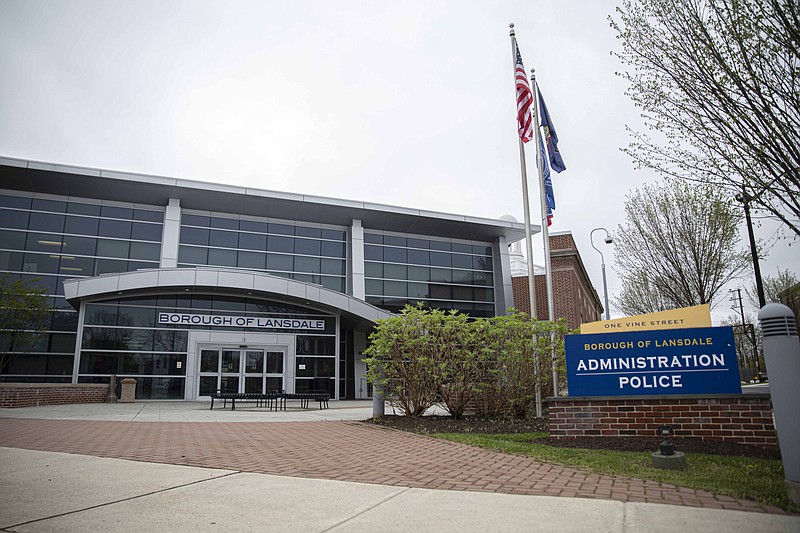
Lansdale Borough Hall. Photo by James Short.
Speakers warn of “terror" and erosion of constitutional rights as borough leaders signal work behind the scenes
Calls for Lansdale to adopt a formal welcoming policy and limit cooperation with federal immigration enforcement dominated public comment at a recent borough council meeting, where residents delivered emotional, at times blistering appeals for action.
Speaker after speaker urged council to pass a resolution clarifying that Lansdale police would not assist in enforcing non-criminal federal immigration laws or participate in ICE’s 287(g) program, which allows local law enforcement to partner with federal immigration authorities.
The debate unfolded against a backdrop of national immigration crackdowns and local reports of Immigration and Customs Enforcement activity in neighboring communities. Last summer, advocates from Lansdale-based nonprofit the Woori Center asked council to consider adopting an ordinance similar to those discussed in other towns across the county, and Lansdale’s council heard repeated requests and discussed a draft internally, but ultimately took no action at that time.
“How many have been kidnapped?”
Jas Holliday, of Perkiomen Avenue, said they were there with other concerned residents and opened with a stark rhetorical question.
 Jas Holliday, of Perkiomen Avenue ((Credit: Lansdale Borough meeting screenshot)
“Do we know how many people have been kidnapped by ICE this year?” Holliday asked. “How many were kidnapped in Norristown? In Hatfield? This information isn’t readily available."
Holliday described individuals being taken on administrative warrants rather than judicial warrants and warned of what they characterized as an escalation of federal detention practices.
"There are reports of people missing in federal prisons. Some have it as low as 800, others as high as 5,000. All we know is, as long as we abet this sort of activity, it will increase," they said.
Holliday acknowledged federal policy is beyond borough control but urged council to adopt “a strong and forward-thinking welcoming policy” as a first step, and prevent the sharing of data "at the drop of a hat." They referenced potential changes to police policy to ensure local officers are not obligated to assist federal officials without a judicial warrant.
“I am simply asking that we do not help ICE kidnap our community members,” Holliday said. “Please stand with your constituents against fascism at this moment.”
“We are Lansdale, we are also Minneapolis”
Richard Strahm, of Columbia Avenue, framed the issue as one of public safety and trust, not politics.
“We are Lansdale. We are also Minneapolis, we are also Portland, we are also Savannah,” Strahm said. “We don’t live in a bubble where we are safe from what is going on from the rest of the country."
 Richard Strahm, of Columbia Avenue (Credit: Lansdale Borough meeting screenshot)
Strahm voiced strong support for a resolution stating that Lansdale law enforcement officers and resources “shall not be engaged in the enforcement of non-criminal federal immigration laws” and would not participate in the 287(g) program. He offered council duplicate the resolution put forth by Haverford Township.
“This is not a radical idea, this is a responsible one,” Strahm said, praising Lansdale’s police department as the best in the county, if not the state, while warning that its mission could be compromised by acting as federal immigration agents.
"Our police have a clear mission, and that is to protect public safety, prevent crime, respond to emergencies, and build trust within the community. That mission becomes compromised when local officers are asked to serve as federal immigration agents," Strahm, a local real estate agent, said. "The 287g program blurs that line. It turns neighbors into potential targets and routine interactions into moments of fear. Public safety depends on trust."
“If a domestic violence victim is afraid to call the police, we are all less safe,” he said. “If a witness to a crime stays silent because of fear of deportation, we are all less safe. If parents are hesitant to report abuse, exploitation or fraud, we are all less safe."
Local policing, he said, works when officers are seen as guardians, not extensions of the federal government. Strahm described Lansdale as “a borough of immigrants,” citing families from Mexico, China, Korea, Thailand, Japan, Vietnam, India, Bangladesh, Greece, Italy, the Dominican Republic and beyond.
"They have brought their food, their culture, their small businesses, and their dreams to our streets. They are not outsiders; they are the fabric of this borough," he said. "They coach our kids’ teams, they volunteer in our schools, and they pay taxes. They open storefronts, they fill our empty buildings, and they revitalize our borough and neighborhoods. We are stronger because of them."
He said the resolution is not about ignoring crime, but non-criminal federal immigration enforcement.
"If someone commits a crime, they should be held accountable. Period. But local resources should not be diverted to enforce civilian immigration matters that are responsibility of the federal government," he said. "Our county has made statements, and we have our own values as a police department and as a borough. I’m asking us to put our money where our mouth is."
As the child of immigrants, Strahm said the issue was deeply personal, as his family also sought fairness, opportunity, and dignity. He said most of the people in the room that night were children, grandchildren, or great-grandchildren of immigrants.
"So, the question is simple, how do we want to treat ourselves? We have a great police department, let’s keep it that way by making this resolution. Do we want a borough where neighbors fear the police department or contact? Or do we want a borough where everyone regardless of their birthplace feels safe reporting crime, asking for help and participating fully in civic life?"
Strahm called the resolution "a starting point."
"Let’s make our own statement, one rooted in safety, fairness and recognizing that we are and always have been a community of immigrants," he said.
“This council has a moral imperative”
Dom Falcone described what he called an “erosion of the rule of law” and accused ICE of violating constitutional rights across communities.
“We have watched footage and borne witness to ICE agents acting without restraint,” Falcone said, citing alleged infringements on due process and freedom of speech.
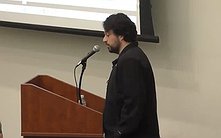 Resident Dom Falcone (Credit: Lansdale Borough meeting screenshot)
“This council has a moral imperative to act to protect its constituents from this chaos,” he said, calling ICE’s actions “explicitly racist” and describing agents as “terrorizing people.” "It’s unconscionable to me that local law enforcement cooperates with ICE, when so many of their activities inflict trauma on the well-being of our communities."
Falcone said it is not unique to American history that people who have immigrated to the U.S. have experienced vitriolic prejudice.
"It frustrates me and many of my fellow community members that our president, when faced with serious crises in our country, time and again pivots to demonizing immigrant communities to obscure the failure of his obstructive agenda," he said.
He implored council to listen to their consciences and do what is right for Lansdale.
"think a lot of people in the immigrant community live in fear every day. And this council needs to step up and do what is right for the people that live in this community," he said.
Dr. Kara Derstine, of Derstine Avenue, told council ICE has already been active locally.
“ICE has been active in the West Ward since Palm Sunday and has been targeting our neighbors,” she said. “The individuals in this room may not be aware of that because we may not be the targeted demographic. But the reality is, the fear’s already there."
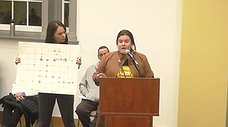 Dr. Kara Derstine, of Derstine Avenue, at right (Credit: Lansdale Borough meeting screenshot)
Derstine said she had heard of families keeping children home from school due to fear and emphasized that constitutional protections apply to all individuals, not just citizens.
"I ask for civility, because we’ve known what’s been going on with ICE, and we’ve known what’s going on in Minnesota. Yet, in January, this committee demonstrated a lack of leadership that many of us were appalled by," Derstine said. "We have pressing matters and issues facing our community. We have car accidents on a daily basis, and we have ICE in our backyard. So, we ask that you please work together to do what we’ve elected you to do."
“Do you welcome me?”
A resident named Hasan, no last name given, who said she recently moved to South Spruce Street, was proud to be an official resident of the borough.
"As I’ve been getting to know the borough, one thing that stands out is the visible presence of Asian-American communities here, especially the many Asian-American-owned restaurants and businesses that contribute to Lansdale’s economy and culture," she said.
 A resident named Hassan speaks at the meeting (Credit: Lansdale Borough meeting screenshot)
Then, she addressed council directly.
"Do you consider Lansdale a welcoming place for people like me, who just moved here a month ago? When conversations about ICE enforcement come up, it makes me anxious. And I find myself wondering why?" she said. "I live here, I work here, I contribute here, and also, I belong here. So why should I feel afraid? Is that fear something I should carry alone? Or do you all recognize it in residents like me?"
"Are you willing to support clear, written policies that reflect that welcome? Because for many of us, feeling safe doesn’t come only from statements. It comes from trusting our policy and policy makers. It comes from knowing that our borough has former policies that ensure consistency, transparency, and protection for our residents," she said.
Borough Solicitor Patrick Hitchens reminded attendees that public comment is not typically a back-and-forth dialogue with council, but Council President Meg Teoh responded briefly: “Welcome to Lansdale, we’re glad you’re here.”
“I carry my passport”
Priscilla, of Madison Street, said she is a citizen but still feels fear.
“I struggle with the impact of ICE on my day-to-day life. As a woman living away from my home state, I take extra precautions. I carry my passport, I have an emergency contact, and I have limited myself to only go to work and go home,” she said. “Sometimes I’m too afraid to walk my dog outside my apartment building.”
She recounted an incident where a police vehicle stopped nearby while she was outside and said she did not feel safe due to uncertainty about whether local officers were aiding federal immigration enforcement.
"I just have no idea what the officer could be doing, but I can tell you that DHS has been racially profiling people, and at that moment for me, it was unknown -- the extent of Lansdale Police Department in aiding or facilitating DHS operations," she said. "Now, having clear language on Lansdale Police’s manual under interactions with DHS and a welcoming ordinance could help at least give assurance that the police are protecting the community they swore to protect."
Council and mayor signal next steps
In her mayor’s report, Mayor Rachael Bollens said she met with The Woori Center and had been collaborating with the solicitor and police chief.
“We’re going to continue collaborating and working behind the scenes to get something to release to you,” Bollens said.
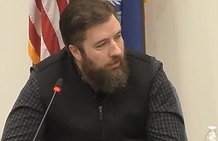 Councilman BJ Breish (Credit: Lansdale Borough meeting screenshot)
During closing comments for the good of council, Councilman BJ Breish supported pursuing a welcoming policy.
“Mine's a small idea, really. My small idea is, how about we create a town where you don’t have to look like me to feel safe walking out your front door?” Breish said, to applause from the audience. “How about we create a town where you can feel safe walking your kids to school? I think it’s a small idea, right? We should be able to do that. So, I look forward to continuing to, not just to have conversation, but to make change."
Breish continued that he was "just short of opening up the agenda" to try and make something happen, but was excited to hear movement from the mayor.
"I have been talking to The Woori Center for a long time about that, I’ve made public comment about how I would like to see a welcoming policy, a resolution, an ordinance, it’s been called many different things, but I think we can do better there," he said. "I want everybody in our community to feel safe, to walk their dog, and walk out their door and not have to think about it."
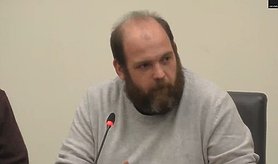 Councilman Andrew Carroll (Credit: Lansdale Borough meeting screenshot)
Councilman Andrew Carroll added that the best biggest ideas are the small ideas, which are affected and replicated and built upon over time. He said council needs to focus on being the change that matters and not being afraid to try new things, in different directions.
"And if it is something as basic as telling people that they’re welcome in our community, then sign me up. Because I’m in because you are welcome here. Everybody’s welcome here," he said. "That’s it, full stop."
No formal vote was taken on a welcoming policy during the meeting.