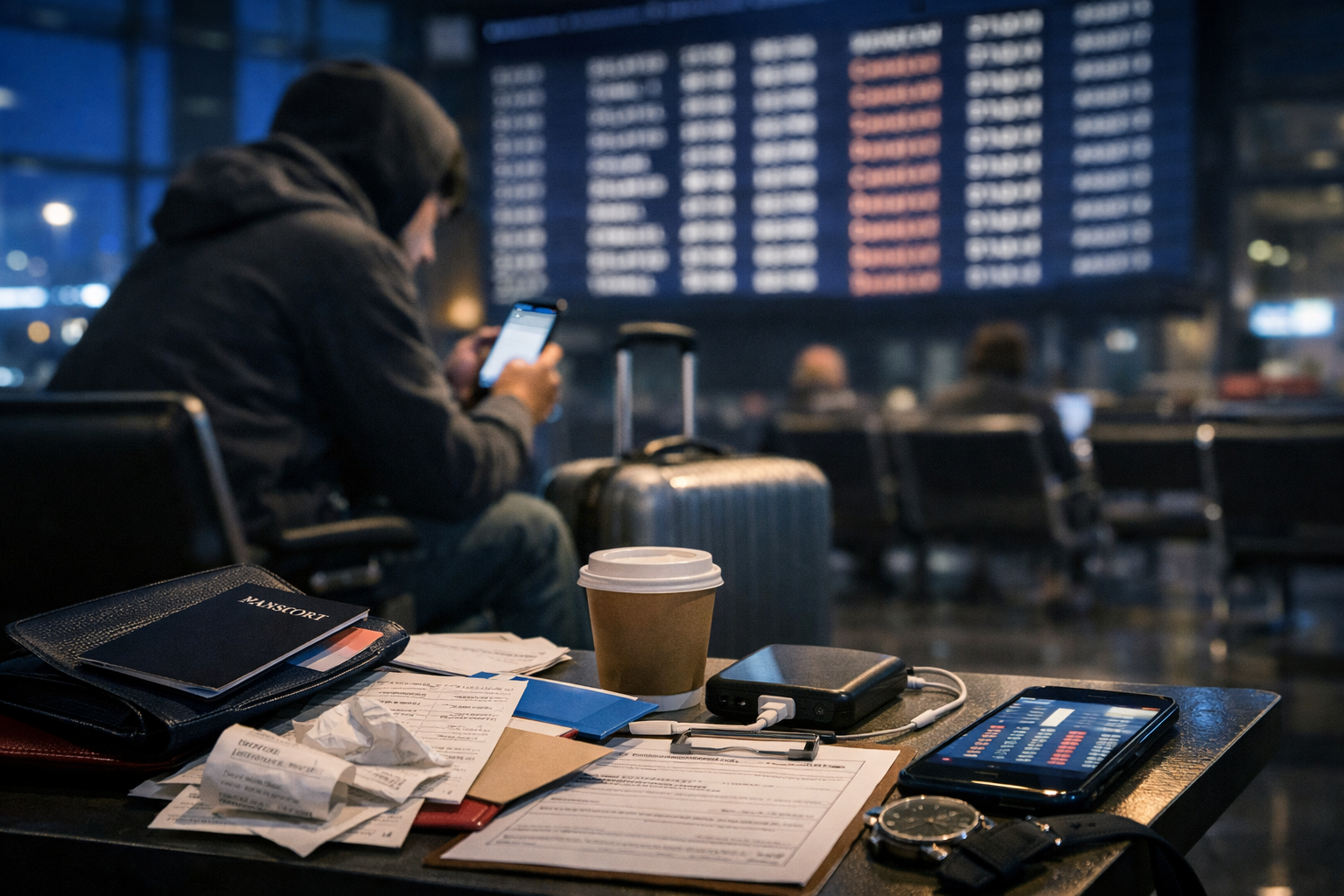
That’s living proof the two are never a given, every second of which thousands of travelers around the world are themselves becoming keenly aware: of missing one connection, crashing on some airport chairs, and watching boards go from “Delayed” to “Delayed.” Whether you’re struggling with voos cancelados in Europe or a big, steaming bowl of domestic airline suck in the US, understanding your rights around cancelled flight compensation, what you’re legally entitled to and how to claim it, can mean the difference between walking away from a bad situation and hundreds of euros or dollars back in your pocket.
This guide details precisely what airlines have to provide you if your trip becomes an endurance test.
Today’s aviation operates on razor-thin margins. A thunderstorm in Atlanta, a mechanical problem in Frankfurt, or an air traffic control strike in Paris can set off a chain reaction that affects thousands of voos across continents within hours.
The issue isn’t just the hassle. It’s that most of us don’t know what we should be getting. Airlines count on that ignorance.
If your flight leaves a European Union airport, or arrives at an EU airport via an EU-based carrier, you are protected by perhaps the most passenger-friendly law in the world.
Flight delay compensation applies when you land at your final destination airport 3 or more hours later than planned, and the delay was due to circumstances within the airline’s control.
These are not vouchers or travel credits. They are cash entitlements.
Compensation for canceled flights follows the same framework. If your airline cancels a flight without giving you at least 14 days’ notice and does not offer to reroute you within a comparable time frame, you should receive full reimbursement or the corresponding amount in money.
The Department of Transportation (DOT) approach has more variation across the pond. Unlike the EU, in the United States there is no requirement to pay guaranteed cash compensation for delayed flights.
But if your flight is canceled and you don’t want to fly, airlines must pay you back in full as real, actual cash money. Not a voucher. Not miles.
Things get more detailed when it comes to oversold flights. If you are involuntarily bumped, you can be entitled to up to 400% of your one-way fare depending on the duration of any delay that results from the disruption.
This is where it gets particularly crucial for longer disruptions.
Under EU 261/2004, airlines have “right to care” responsibilities even if they end up not owing compensation. Basically, if the delay is over 2 hours, airlines are responsible for providing meals and refreshments in relation to waiting time, two free phone calls and emails, and accommodations at a hotel if an overnight stay becomes necessary, including transport to and from the hotel.
There is no gray area in a 28-hour delay. If you’re stuck at an airport for a day and didn’t get anything, then your airline almost certainly flouted your rights.
Put aside every boarding pass, every text message, every email the airline sends you. Photograph the departure board displaying delay times. Keep the receipts for any meals or lodging you have an out-of-pocket expense for, as these may be reimbursable.
The airline is always your first stop. Make the request in writing, citing the regulation under which you are making a claim, either EU 261/2004 or DOT rules, whichever applies to your case. Airlines are obligated by law to provide a response within a specified timeframe.
If the airline does not respond or denies your claim for no reason, take it up with the national enforcement body that has authority over them.
Alternatively, independent claims companies can fight for your money, usually for a cut of whatever they recover.
A 28-hour delay isn’t just an inconvenience. It’s a truly major disruption with real legal oomph. Whether you’re battling over compensation for a cancelled flight across the Atlantic or looking to score delayed flight compensation for a short-haul voo gone wrong, knowing the rules makes all the difference between being someone who’s lost something and someone who knows how to turn it around.
Don’t allow airlines to gamble with your silence. Your rights are real, your claim is justified, and the law is in your favor.
Air carriers can only escape paying compensation if the cancellation is caused by extraordinary circumstances, which can include severe weather under EU law. But the entitlement to care, including meals, hotel accommodation, and communications, still holds regardless of the reason for a delay.
Yes, for flights out of an EU airport. The regulation is based on the point of departure and carrier nationality, not merely its home nation.
In most EU countries, the statute of limitations is from two to six years according to local law. This is always worth checking, even for longer interruptions.
If you took a voucher voluntarily and signed off on your rights, it could complicate your claim. Even if you were coerced or deceived, you could still have a case for compensation.