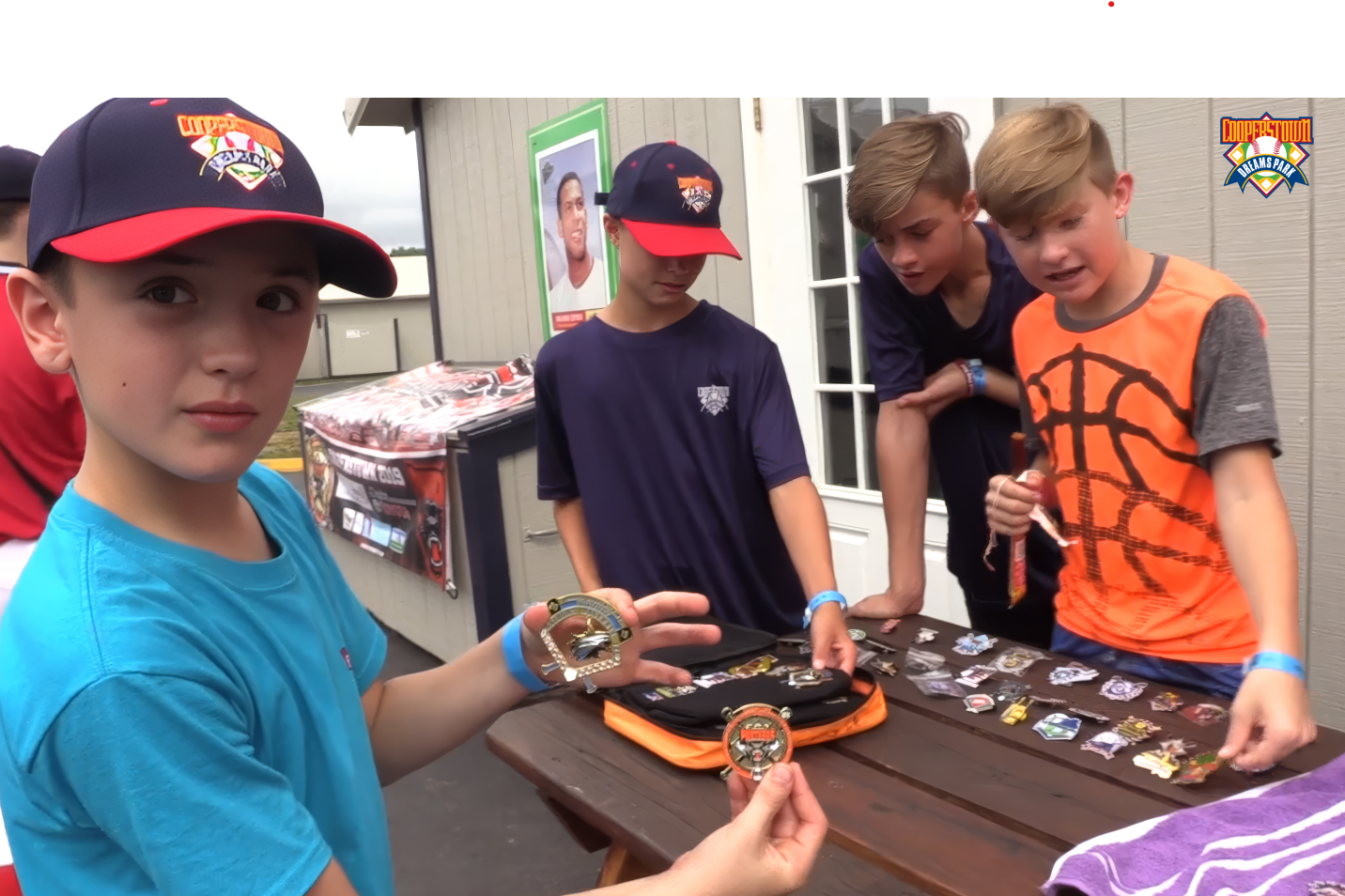
Anyone who is thinking of coming to Cooperstown Dreams Park is probably going to know about the famous (infamous?) baseball pin trading that goes down during the week of the tournament. Most teams bring lots of copies of their own team’s pin design to trade with the other kids and families for their team’s pin. Of course, there are lots of other pins to trade too!
But if you’re new to pin trading, it can all be a bit overwhelming. That’s why we’ve developed this guide, with advice on everything from how to design your own custom trading pins, what kids are looking for in pin trades, and even how baseball records and the “best baseball record” (if there can be such a thing) have woven their way into the pin trading mania.
Baseball pin trading at Cooperstown runs alongside the tournament like a fun side quest for kids and families alike. It’s a fantastic way for kids to break the ice with other teams, including people from every corner of the country. There are a wide variety of different ways to display pins for trading, so you might see towels with spreads of them, corkboards, jackets, uniforms, display boxes, or even trading pin bags!
Of course, the goal isn’t to “win” trades with pin trading. It’s a social experience; the point is to connect. A baseball trading pin is a souvenir, a conversation starter, and a reminder of what you’re all there for, the love of the game.
It doesn’t have to be a big hassle to make custom trading pins that your team loves. The main thing to think about is ‘readability’ from a few feet away - if you’ve got an iconic design, people will recognize it.
● Big icon, small text: Team logo front and center; city/state and year tucked in with restraint.
● High contrast: Clear color blocking beats busy gradients. Team colors plus one accent usually pop.
● One “hook”: Spinner, slider, dangler, glitter, or glow-in-the-dark. If you are going for a special feature, one is enough.
● Smart shapes: Home plate, a bat, or your state outline are always good, but look for your special mascot or another unique element that makes your team different from others.
Trading happens all week, but there are hotspots and traffic spikes to look out for:
● Check-in day. Energy is high, collections are empty, everyone’s ready to start.
● Designated Trading Spots. On the itinerary, there are certain times and places we’ve designated for pin trading at big swap meets.
● Opening ceremonies and skills events. Big crowds and downtime make perfect trading windows.
● After pool games. Teams are often found mingling near walkways and concessions.
● Evenings in Baseball Village. The easiest casual timeframe you’ll see the lanyards and pin boxes come out.
It’s important to be aware of some etiquette for the best pin trading experience. Explaining this to your whole team can help leagues down the line:
● Ask before touching: Point never grab when initiating a trade.
● Trade at equal value: Try to trade one-for-one with pins at the same rarity. It can be okay to trade two or more standards for one “special,” but really be sure that’s what both players want.
● Help younger kids: Don’t take advantage of ignorance; that’s the key. Explain why certain pins are higher value and only trade when you’d be happy on either side of the exchange.
● Pass on pins kindly: “Nice pin, I’m collecting teams we play. Want to check back later?” Look for ways to decline a trade politely, and don’t make fun of another player’s pins.
If all goes well, baseball trading pin swap is a small lesson in consent, fairness, and socialization.
A good pin states where you’re from and who you are. But a great one adds a story that speaks to your specific team:
● A mascot pose that mirrors your warm-up ritual.
● A state outline with a tiny star for your hometown.
● An inside story that your team remembers and forms a special moment.
Basically, look for something that is memorable for your team and add an element to the pin that jogs one’s memory of the story. When a kid remembers why they traded for your baseball trading pin, they’ll remember what made your team special!
Probably a good standard rule of thumb is that teams order a core run (say, 300–500 standard pins) plus a smaller run of specials (50–100). That mix keeps everyone trading while leaving a few “grails” for later in the week. Budget for pin backs, small zip bags to prevent scratches, and a handful of spares for the inevitable Day-2 drop.
Divide pins into equal player bags before the trip. You can secretly bring one ‘coach’s stash’ for emergencies and surprise swaps.
● LE (limited edition): Smaller run, rare pins. Kids will often trade up for these as they recognize they are hard to get (if they like the design).
● Variant: Same design, but with different colors or finishes.
● Feature: The attention-getters, like a spinner, glitter, glow, and slider.
● Daily carry: The lanyard set a player wears for easy display and trading. The majority of an avid collector’s collection will be kept elsewhere.
Other than custom baseball pins, which are a staple for most teams coming to Cooperstown, a huge amount of standard pins are those that commemorate certain baseball records. Similar to baseball cards, it’s a way to remember and highlight these stunning achievements by the legends of our game, like 56 straight games with a hot streak or 73 home runs in a season.
Outside of a visit to the Cooperstown Baseball Hall of Fame or some rifling through records online, baseball pins are one of the most fun ways for kids to learn about things like the “best record baseball history.”
With all the excitement around pin trading, it can be easy to get lost in the shuffle. Cooperstown is a big place for a kid, and like at conventions or airports, it's important to have a plan in case something happens.
● Set a meeting spot: “If we get separated, meet at the big mural.” Something like this means that even if their phone is dead, there’s a simple solution.
● Limit valuables: Don’t let them bring more than $100 worth of pins around with them unless they are being closely supervised.
● Hydrate: It can get hot during the summer, and kids sometimes don’t notice how dehydrated they are getting with all the excitement.
● Equal player bags with core pins
● Small pin case + lanyard per player
● Spare backs, zip bags, and a Sharpie for labeling variants
● One coach’s stash for emergencies and late-week surprises
● A quick talk on etiquette, safety, and the meeting spot
Sure, you’ll remember the scoreboard and your team’s placement in the tournament. But the other thing the kids will remember? It’s all those moments meeting the other teams between games. And one of the biggest ways that happens is through baseball pin trading.
When a team designs their custom trading pins for their one special week at Cooperstown, it creates this awesome memory they get to take with them - a memento and token of their time together. And then when they come back home with 25 or more other teams’ pins? It’s a solid story of their time on the trip.
That’s why baseball pin trading has become such a huge tradition at Cooperstown. It’s part of the foundation of how all the teams connect.