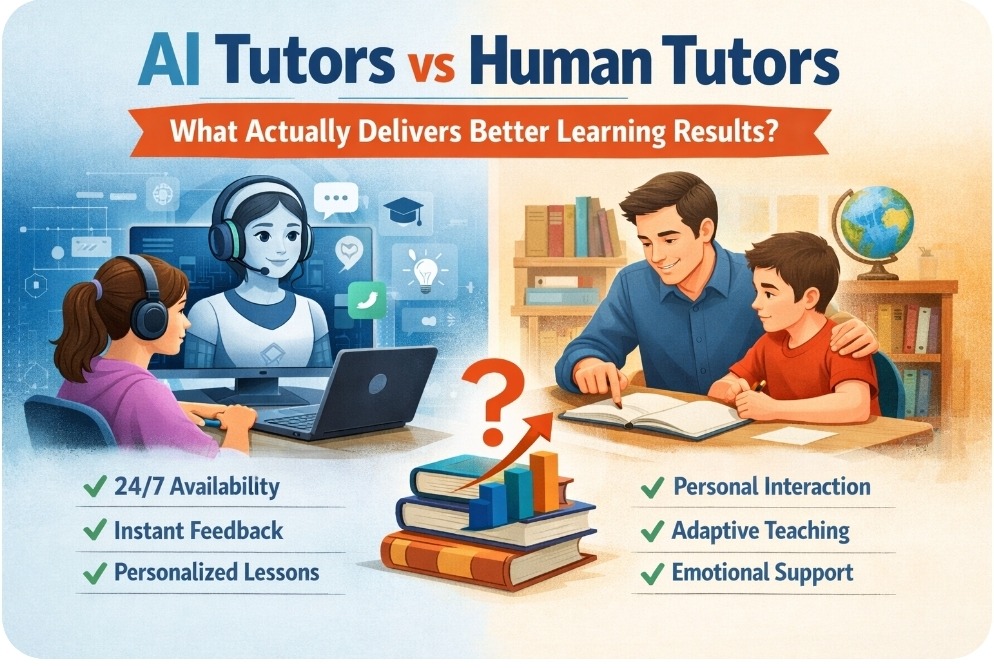
The educational landscape of 2026 resembles a scene from a science fiction novel. On one side of the digital divide, we have algorithms capable of processing millions of data points in a heartbeat. On the other hand, we have the timeless, intuitive connection of a real-world mentor.
The debate over AI learning bots vs. human tutors has moved beyond the "if" and settled firmly into the "how." How do we choose between the precision of a machine and the passion of a person?
As we peel back the layers of the AI tutors vs human tutors effectiveness comparison, it becomes clear that we aren't just choosing a study aid. We are choosing how we want our minds to grow.
AI tutors or AI-powered tutoring platforms like Wise are built to deliver structured learning using data and automation. They observe how students respond to questions and adapt lessons accordingly.
One major advantage of AI learning bots over human tutors in debates is consistency. AI tutors do not get tired or distracted. They provide quick responses and repeat explanations without any judgment.
AI tutors are helpful for:
In a detailed comparison of AI tutors versus human tutors, AI tools perform well when students require repetition and rapid feedback.
Despite their efficiency, AI tutors have clear boundaries. Tutoring is not only about teaching right or wrong answers. It also involves confidence, curiosity, and emotional balance.
In the AI learning bots vs. human tutors comparison, AI struggles with:
AI tutors follow logic and data. They do not truly understand why a student feels stuck. This is where many learners begin to feel disconnected.
Human tutors bring experience and adaptability that technology cannot fully replicate. They adjust their teaching style based on student responses, not solely on data.
In any honest comparison of AI tutors vs. human tutors, emotional intelligence stands out as a major advantage of human tutors. A good tutor can sense confusion before a student even speaks up.
Human tutors are particularly effective for:
Educational research consistently shows that strong student-tutor relationships lead to better academic outcomes. This human connection remains one of the biggest differences between AI learning bots and human tutors.
To settle the debate over AI learning bots vs. human tutors, we need to look at the results. While AI is fantastic for "skill-building," humans are essential for "concept-mastery."
Students who used a combination of digital tools and human mentorship are better engaged.
Today, more students are inclined to combine AI tools with human tutoring. This hybrid model uses AI for practice and tracking, while human tutors focus on explanation and strategy.
In several AI tutor vs. human tutor effectiveness comparison studies, hybrid learners show better retention and engagement. Technology takes care of the efficiency part, while humans handle understanding seamlessly.
The real answer is not AI or human tutors. It is, in fact, knowing when to use what.
AI tutors offer speed, affordability, and structure. Human tutors offer clarity, motivation, and mentorship. The most effective learning plans integrate both, based on goals and challenges.
Instead of framing the AI learning bots vs. human tutors discussion as a competition, it is more useful to see it as a collaboration.
The battle of AI learning bots vs. human tutors isn't about one replacing the other; it's about how you use them to your advantage. If you want speed, go with the bot. If you want depth, go with the human. If you want to be the best, go with both.
The AI tutors vs human tutors effectiveness comparison proves that the future of learning isn't just digital, it is personal.
AI tutors use automation and data to teach, while human tutors provide live guidance, explanation, and emotional support.
Yes, AI tutors are known to be quite effective for practice tests, revision, and performance tracking.
AI tutors are better suited to self-paced, independent learners.
Colleges value academic performance, regardless of whether learning is AI-based or tutor-led.