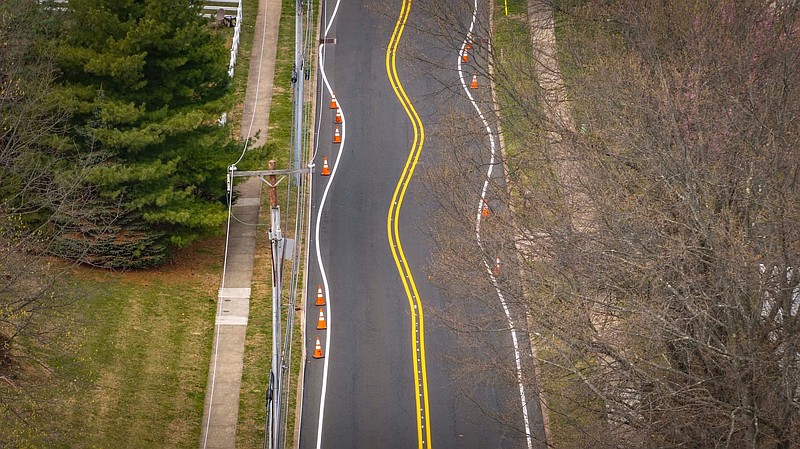
Chicanes on Grays Lane in Montgomery Township Photo by James Short.
Supervisors review framework that would standardize how neighborhoods request speed-reduction measures
Montgomery Township officials are preparing to adopt a formal traffic calming policy that would create a step-by-step process for neighborhoods seeking measures to slow traffic on residential roads.
Police Chief Bill Peoples told the Board of Supervisors Monday night that the draft policy stems from a PennDOT Local Technical Assistance Program (LTAP) study and draws from similar policies used by surrounding municipalities, as well as a PennDOT publication on contextual roadway design.
“At the January 26 meeting, I advised that a new traffic calming policy was recommended as part of a PennDOT traffic study,” Peoples said. “After reviewing these materials, a comprehensive traffic calming policy was developed using best practices identified in comparable policies.”
The proposal was reviewed by the township’s Public Safety Committee on Feb. 4 and endorsed to move forward to the full board for consideration.
A structured process for neighborhood requests
Township Manager Carolyn McCreary said the biggest change is that the township would no longer evaluate traffic calming requests on an informal, case-by-case basis.
“This provides a framework going forward,” McCreary said. “If somebody comes into the board and says, ‘Well, I know in 2026 you approved a traffic calming measure on this road. Why can’t I get one?’ Now there’s metrics in there.”
Those metrics include traffic volume, crash history, roadway type and speed limits, along with input from the township’s Highway Safety Unit. The policy would apply primarily to lower-speed residential roads rather than major thoroughfares.
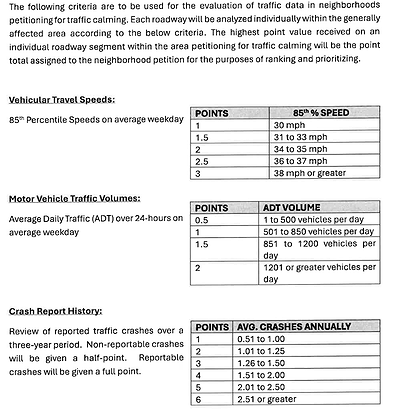
The proposed policy includes a ranking system that scores roads based on measurable traffic conditions, not just complaints. Each roadway segment is graded using three data categories
Only roads where the 85th percentile speed is more than 10 mph over the posted limit are even considered for traffic calming measures. Each category contributes points to a combined score. Neighborhoods must reach at least 3 points from those factors to qualify for the township traffic calming program
If a roadway scores below that threshold, it is not eligible unless traffic conditions significantly change in the future.
A key component is documented neighborhood support. Under the draft policy:
Peoples said the process is designed so residents understand exactly what is being proposed before anything is installed.
“It gives them the whole plan of what’s going to be done for traffic calming so they know what’s going to happen,” he said.
A street may be considered for installation of traffic calming measures if it meets all the following criteria:
Township retains authority if safety concerns persist
One addition highlighted during the meeting clarifies that the township may still move forward with safety measures even if neighborhood support is not unanimous.
Peoples said he realized an earlier draft lacked language covering situations where a proposal might stall despite documented safety concerns.
“If the township deems that it is in the interest of public safety, we would move forward with some type of a measure — we have the option to,” he said.
Supervisor Eric Pelletier, who chairs the Public Safety Committee, said the policy would have helped avoid confusion during last year’s controversial traffic calming rollout.
“I think it’s a really well laid-out plan and would have eliminated some of the confusion we had with the most recent traffic calming implementation we attempted at Grays Lane,” Pelletier said.
Grays Lane will not have to start from scratch
The new policy is closely tied to the township’s ongoing discussions about Grays Lane, where chicanes were installed and later removed after resident backlash.
Chair Tanya Bamford asked how the new policy would apply there.
Peoples said Grays Lane is still within a three-year window from its previous study, allowing the township to skip the data-collection phase.
McCreary added that once the policy is formally adopted, staff can notify residents who have continued requesting action on the street and explain the updated process.
Emphasis on collaboration and transparency
Supervisors said the policy aims to balance professional traffic engineering with community input.
“I just think it’s such a great step to say that we have public involvement and that they can self-govern, come up with solutions themselves, and then bring solutions to us,” Vice Chair Beth Staab said. “But we are going to give advice to them from officials that are experts in the field.”
Bamford described the document as a long-needed guide.
“It’s a playbook,” she said. “And I think that’s what we had hoped for.”
Peoples credited township staff for much of the groundwork.
“I do have to give credit to the Highway Safety officers,” he said. “Officer Mike Jenkins and Peter Burn did a lot of the research for the policy.”
The policy was presented Monday for review only. McCreary said if supervisors have no major changes, it could be placed on an upcoming agenda for formal adoption.
If approved, the traffic calming policy would establish a township-wide system for handling speeding complaints and neighborhood traffic concerns, providing clear criteria, defined public engagement steps, and consistent expectations for residents and officials alike.