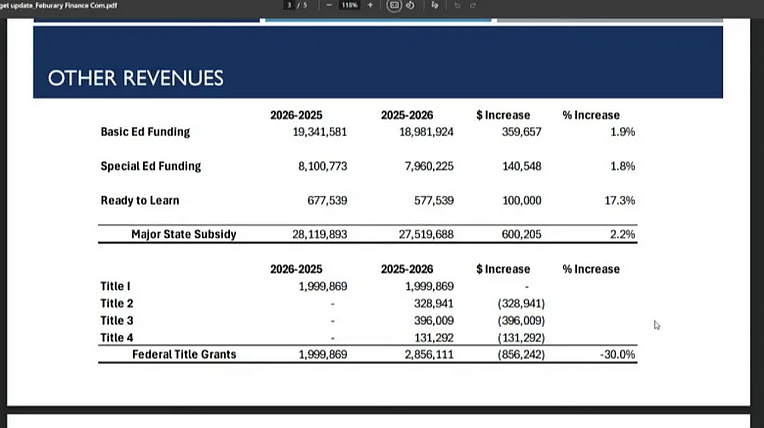
Slide showing projected revenues for the North Penn School District for 2026-27 from state and federal subsidies and grants, as presented to school board finance committee on Tuesday, Feb. 3, 2026. (Screenshot of NPTV video)
Staff detail state, federal funding picture, long-term costs that could impact tax hike
A new school board has some decisions to make for the North Penn School District in the next few months.
Board members heard a preview this week of budget talks they’ll hold over the next few months, as their 2026-27 budget starts to take shape.
“Can we take less than the Act 1 index? This right here tells me, no we can’t take less,” said district CFO Tara Houser.
Each year the school board typically holds a series of in-depth departmental budget presentations through the spring, then votes to advertise a preliminary budget in May and adopt it formally in June before the new fiscal year starts on July 1. Last fall the outgoing board members voted to stay within the state-set Act 1 level of a permissible tax increase without seeking voter approval, and since then three new board members were elected in November and seated in December and two more appointed later that month to fill vacancies caused by resignations.
During the board’s finance committee meeting on Feb. 3, Houser brought the new board up to speed on several new developments since the last round of budget talks. The first major change from prior years will likely be fewer deep dive budget presentations, the CFO told the board, and more focus on the largest line items and categories in the budget.
“Rather than having all of the departments come and present, we’re probably going to focus on a couple, mainly the biggest drivers, which would be
operations and special education, then have a bigger discussion about salaries and benefits, because they’re our biggest drivers,” she said.
Tax increase options
Based on the total assessed value of all properties in the district: roughly $7.4 billion in Montgomery County and another $2.9 million in Bucks County, staff have developed a series of projections to calculate how much new revenue would come in during 2026-27 with no tax increase, an increase of one mill, or increases of 1, 2, 3, or 3.7 percent which is the Act 1 level. Each one percent increase would add another roughly $2.5 million of new revenue, the CFO added, and the 3.5 percent Act 1 level increase would bring in a total of roughly $8.1 million, plus another roughly $213,000 in added real estate tax revenue based on the natural growth in value of those properties.
“Essentially, if we went to the Act 1 index, that would add about $8.3 million to the budget, for the course of the year. About $213,000 of that is just because the value of our properties has increased,” Houser said.

Based on the Tuesday state budget address from Governor Josh Shapiro, Houser added, the district finance office has started to develop a first draft of a 2026-27 budget with estimates of the district’s state subsidies included.
The CFO then showed the 2025-26 figures alongside the projected numbers for 2026-27. Using those figures, district basic education subsidies from the state would increase by roughly $360,000 or 1.9 percent from $18.9 million in 2025-26 to $19.3 million for 2026-27; special ed funding would increase by roughly $141,000 or 1.8 percent from $7.9 million to $8.1 million, and state ‘Ready to learn’ funding would increase by roughly $100,000 from $577,000 to $677,000.
“Overall, we’re looking at about a 2.2 percent pickup, if those numbers hold. I think that’s reasonable, that’s not a huge, pie-in-the-sky kind of increase. I will probably continue to build that into the budget, going forward,” Houser said.
The flip side of those possible increases? A likely drop in federal funding due to national initiatives to roll back Department of Education funding for school districts nationwide, the CFO said, which the board discussed last spring as federal budget stalemates and shutdowns drew headlines.
“The biggest disappointing factor right now: I am not budgeting anything for Titles II, III or IV. There’s just not a lot of good information out there that they’re going to continue it: Title II, maybe, but the other two probably not,” she said.
Superintendent Todd Bauer added that the state special ed subsidy, projected at $8.1 million based on Shapiro’s request, “continues to be woefully insufficient” to meet the district’s special education costs.
“The costs of special education, the programming, the services provided, all necessary for our students,” Bauer said, adding “the underfunding of special education, it just continues to fall further and further behind. We’ve talked about inflation costs, and the costs of special ed far exceed inflation, and that 1.8 (percent) is just not sufficient.”
“We say this every year, and it never seems to get better,” he said.
Salaries and subsidies
Houser then showed a third table, with budget categories for 2026 and projections for ’27 listed by fund number, with educational staff salaries totaling just under $104 million for the current school year and projected to reach roughly $109.6 million for the upcoming year, which combine with smaller categories to total a projected roughly $7.5 million increase before any new hires.

Other pieces of the budget puzzle that will come into focus in the next few months will include any possible year-end surplus from 2025-26, medical and health insurance costs, debt payments from any new borrowing needed to fund renovations to North Penn High School, and changes in interest rates that could impact earnings on savings and/or property sales that yield transfer tax revenue.
Board member Christine Coyne said she had seen projections that the Act 1 index is slated to decrease in coming years, and Houser said those projections are accurate.
“So there’s a challenge with: if we don’t raise it high enough (in 2026-27), we’ll be limited in future years,” Coyne said, and Houser replied: “Correct.”
‘Some significant spending’
Last September the board authorized a district wide assessment of all facilities aside from the high school, and said that study is meant to update the roughly $180 million list of capital and infrastructure needs already identified by staff at the district’s middle and elementary schools, offices, and other facilities.
“We know that number is going to come back pretty high, and we’re going to have some significant spending that we’re going to need to do,” Houser said.
Coyne then asked if finance staff knew how to offset or account for the loss in the federal subsidies, and Houser said “that would have to come from someplace else in the general fund budget,” if the programs such as special needs education, ESL classes and professional development currently funded by those federal grants were to continue. Other business managers across the county have started to discuss ways to seek other grant funds, possibly from private benefactors, that could help offset those costs, and other districts have been hit harder.
“We don’t have a big federal component to our budget, in North Penn. Some of the other districts are in a desperate state, with losing the federal funding that they’re going to lose,” Houser said.
Bauer then reminded the board of one other consideration, made by their predecessors: the long-term borrowing plans discussed in recent years for the estimated $260 million in high school renovations were based on future boards choosing to apply the maximum Act 1 tax increase each year for the near future.
“Our modeling, from years ago, was: us taking Act 1, for the next number of years. You can’t make decisions for future boards, but you also have to understand the commitment that you’re making when you renovate a high school,” he said.
“The projections, at the time, had next year’s Act 1 at 3.7 (percent). It is now at 3.5. So the Act 1 index (tax) increase is less than what was projected at that time. Which is concerning to us: it is trending down,” Bauer said.
Since Act 1 was adopted in 2006, the superintendent added, the average level set by that law has been roughly 2.7 percent, and that average figure was used in the long-term projections prior to the high school renovations being approved — but the index, which is based in part on economic growth across the state, could vary.

Board member Al Roesch said the new board members should also keep in mind the long-term capital list of roughly $180 million, pending the update now underway, and how much funding annual budgets will need to tackle that to-do list.
“That means that we have to have about $18 million a year, just to keep our buildings operating, without investing more money or upgrading our buildings. That’s another good reason why we think we have to raise by Act 1,” he said.
Board member Tim MacBain asked if the board needed to hold any formal vote to say they’re staying at or under the Act 1 index, and Houser said the old board did so last fall for the upcoming 2026-27 budget year, and the new board may be asked to look at seeking exceptions from Act 1 for 2027-28 for the first time since a prior board did so in 2018 for ’18-19.
“You may have to start looking at exceptions in the future. You may not even qualify for any. We’d have to do the math and see: for our district, really the only one that we would probably qualify for is special ed,” Houser said.
North Penn’s school board next meets at 7 p.m. on Feb. 19 and the finance committee next meets at 6 p.m. on March 3, both at the district Educational Services Center, 401 E. Hancock Street. for more information visit www.NPenn.org.
This article appears courtesy of a content share agreement between North Penn Now and The Reporter. To read more stories like this, visit https://www.thereporteronline.com