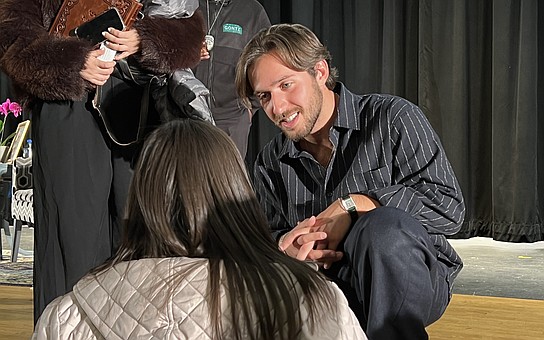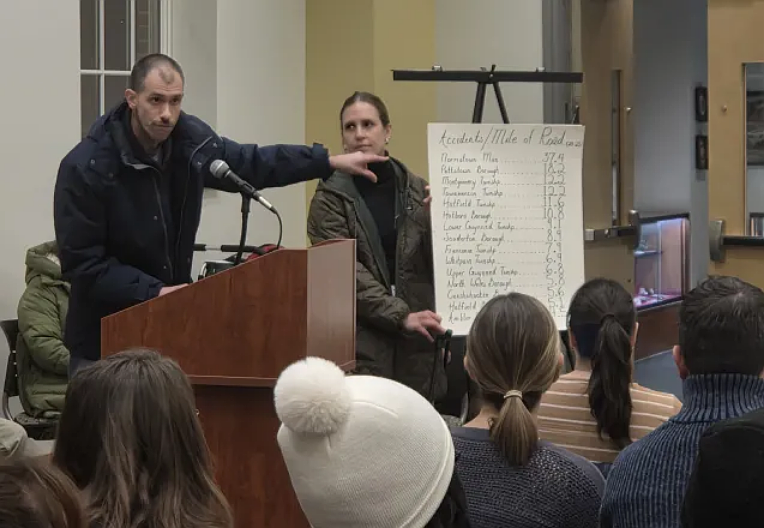
Lansdale residents Rob and Marianna Kirkner of Perkiomen Avenue show a chart of accidents per mile of roadway from 2020 to 2025 in several local towns, during the Lansdale public safety committee meeting on Wednesday, Feb. 4, 2026. Photo by Dan Sokil | The Reporter.
Petition signed by more than 200 presented to council
Residents of Lansdale’s West Ward pleaded for public safety improvements Wednesday night, as town officials vowed once again to address traffic issues.
“Pottstown and Norristown are the only municipalities that are worse than us. Who’s proud to be in the company of Pottstown and Norristown?” said resident Rob Kirkner of Perkiomen Avenue.
For several years, council and its public safety committee have heard complaints about traffic throughout town and drivers speeding and ignoring stop signs on the town’s side streets to avoid congestion on Main and Broad streets. Residents have continued to raise concerns as several accidents have happened along those studied streets in recent years; in fall 2024 the town’s traffic engineer presented a formal study of several targeted areas in town, and in summer 2025 council voted to repaint no-parking zones and ban turns on some of the targeted streets.
The most recent incident in the area happened on Jan. 30, when a ten-year-old girl was reportedly injured after being hit by a car at the corner of Delaware and Cannon Avenues, prompting a petiton and online uproar from residents who packed the public safety committee Wednesday night.
“In just three days, 200 residents have signed that petition — in three days, 72 hours — the vast majority from the West Ward. Public safety is not an abstract issue, is it? This is personal for us,” said Sheldon Good of Pennsylvania Avenue.
“Our petition was born out of tragedy. It was born out of a recent hit-and-run accident that seriously injured a precious ten-year-old child, a classmate of one of my own children. It was born out of the tragic death of our dear neighbor, 71-year-old Diane Kopena, killed just a few blocks from here last spring. It was born out of the countless near misses we all witness every day, moments that don’t make the news, but could easily become the next tragedy,” Good said.
“And, respectfully, it was also born out of what we see as too much inaction by borough leadership.”
Solutions ‘urgently needed’
Good then made two requests to council on behalf of the residents: to meet with neighbors to identify immediate and long-term safety fixes and to commit to funding those fixes and safety upgrades.
“Let me be clear: This crowd here tonight is acting in good faith, because we want to partner with you — the police department, the council, staff — to finally move forward on long-discussed, long-delayed, and urgently needed traffic and safety solutions,” Good said.

“Speed humps, more curb painting, more stop signs, better sightlines, clearer and more effective street striping. One-way streets where appropriate. Adequate enforcement. And above all, pedestrian safety to be treated as a true priority, not an afterthought,” he said, prompting applause from about 50 neighbors.
“We’re here tonight with one message: Enough is enough. No more near misses. No more preventable injuries. No more preventable deaths. No more excuses, it’s time to take action,” said Good.
Close calls
Shannon DeBellis of Delaware Avenue said she has children “nearly the same age” as the one who was injured in the most recent accident, and she’s attended numerous traffic safety meetings hosted by council in recent years and taken her concerns directly to PennDOT with a request for more four-way stop signs, but seen little to show for it.
“This would allow all drivers to pause, look both ways, and assess if it’s safe to cross. Please consider our request as we are deeply concerned that another tragedy will occur. I’m going to continue to follow up with PennDOT, and I’ll relay my correspondence to the committee and my fellow citizens,” she said.
Dr. Karalyn Derstine, who co-authored the petition with Good, and daughter Emilie, of Derstine Avenue, shared their own recent loss.
“Our cat got run over by a car,” Emilie started, and her mother continued, “Because of a lack of stop signs, and a lack of putting speed humps.”
“I feel that you have prioritized our neighborhood as a cut-through, to end the backups on the tributary roads, rather than the safety, health and wellbeing of a walking, pedestrian neighborhood,” Derstine said, adding that “last year, my family experienced a near miss of someone on our road, who truly could’ve ended the lives of myself and my children.”
Derstine noted how a council vote in January to end the search for a new police chief was prompted by a single public comment, comparing it to a room full of residents asking for action.
“Last month, we saw one voice set a precedent — that borough council chose to act when they heard from the community. Well, I stand here today (as) the coauthor of the petition — in 72 hours, with little effort, we received, and I just checked, 213 voices. So if one voice can lead to considerable change in borough tactics, then what can 213 of our residents and fellow community members and parents within the school, do?”
Emilie closed by adding her own plea: “Make my street safe, keep my street safe.”

Maps and data
Rob and Marianna Kirkner came armed with displays, including a chart they said was based on PennDOT accident data for 2020 to 2025, showing accidents per mile of roadway in several local towns, with Norristown topping their chart at 37.4 accidents per mile, then Pottstown at 18.2, Montgomery and Towamencin townships at 12.6, Hatfield Township at 11.6, and others with fewer.
“Do we think we’re in the bottom half, or the top half? Top half? Do we think we’re towards the bottom, or the top? 12.4, 12.4 is Lansdale, the entire borough,” he said.
The couple then showed a hand-drawn map of a neighborhood in Ambler they said was comparable to their ward, with a calculated rate of 4.5 accidents per mile, and safe crossings highlighted in green and accidents in blue — before showing a similar map of their own Lansdale ward, with numerous accidents highlighted.
“That’s your neighborhood. That’s Lansdale. Multiple intersections with multiple accidents. Multiple injuries here: Columbia and Cannon. Multiple injuries here, Perkiomen and Cannon, including the one we just experienced. Richardson and Delaware, York and Towamencin, Richardson and Columbia, look at this bloodbath over here on Vine, this is where they got rid of a four-way stop,” Rob said, pointing out each intersection on the map as he spoke.
“Multiple accidents there, Hancock and Green — and all of these accidents are happening in a neighborhood with a school,” he said.
Marianna added that their children walk to school every day, and that means concerns for parents both ways, every day. She offered to walk the town’s traffic engineer along the same route to show those obstacles firsthand. “We can take a look together at what it’s like, because it’s a challenge.”
Dominic Frascella asked council to consider what each dot denoting an accident meant to those involved.
“What that blue dot meant for us was learning to walk again, delaying life events, so many unspoken things that just sit behind a PennDOT statement of ‘minor injuries suspected.’ Each of those are individual families, and multiple families sometimes, that are affected,” he said.

Citizen solutions
Frascella gave his own three-part plan for the committee and council to consider, including creating a citizen pedestrian safety and accessibility task force to field feedback and vet any safety upgrades.
“This is not a focus group, it’s not a study committee. This is a boots on the ground team of residents, of people who have already stood at this podium and said, ‘We’ll paint the curbs, we’ll clear the corners, just tell us where to go’,” he said.
That group could do walk audits documenting hazards or needed upgrades, could clear or trim vegetation, report safety issues to borough staff, and could tie into his second recommendation, creating a snow management standard for downtown businesses and residents to meet.
“After every snowfall, sidewalks, curb ramps and crosswalks should be fully cleared within 48 hours and continually maintained as plows continue to clear the roads,” he said.
His third recommendation? “I’m calling for immediate action on Hancock Street and Whites Road, two of the most prolific speeding corridors in the borough.” Frascella then cited data from the 2025 study clocking some drivers as high as 55 miles per hour on Hancock, and over 2,000 exceeding the speed limit on Whites by more than 10 miles per hour.
“Speed humps were discussed at a previous meeting, but no implementation date has been committed. In the meantime, I’m asking for designation of Hancock and Whites as speed enforcement priority zones,” with increased police patrols and posted speed display signs there.
Not a new concern
Kacey D’Amico of Richardson Avenue said she has emails with borough officials from as far back as 2010 raising concerns about some of the streets in question and asking for action.
“This is not a new issue. It has come up, time and time again,” she said: “So when we stand here, with all of this passion, it is because this is what we see every day, and what we’ve seen every day for the last few decades. And we want a plan.”
Derstine added that she’s seen similar complaints on certain streets and noted that “with the developments happening in Towamencin, these problems are only going to get bigger and bigger.”
Geoff Hynes of Columbia Avenue said borough statements that they don’t control the placement of stop signs, “sounded almost like an excuse,” and asked for specifics of what must be done to get stop signs installed, before Michelle Hynes said her students walk to and from bus stops and “almost daily, he’s avoiding being hit by a car.”

“I have to almost pull out into the middle of the intersection, to see if anybody’s coming. People are out walking early in the morning, people are walking their dogs, I don’t want to hit somebody. I can’t see, because the cars are all the way up, and they’re not being ticketed, and the curbs are not painted,” she said.
Jake Wallace of Mt. Vernon Street asked if the engineer and police could also examine the syncing of the double traffic signals at Valley Forge and Whites and Allentown Roads, saying backups there often cause drivers to speed through neighborhoods instead: “I’m right there, and I see cars just fly by…that causes a major concern, with cars coming right through, because of those two lights.”
Tom Sherwood of Delaware Avenue said he worked on a safety improvement plan for his job several years ago after repeated accidents and incidents, and said the town should do something similar: “I think the borough has a culture problem – you’ve gotta change your culture.” And Wayne Kalbach of Whites Road said recent speeding signs that showed drivers how fast they were going were a good start.
“We were blown away at how effective that was. It was something that worked really well,” he said; “If something like that could be put in permanently, it’s right in front of my house. I’ll charge the batteries.”
Traffic engineer answers
Traffic engineer Mark Bickerton answered the comments by noting he had “pages of notes” of resident feedback, and detailed how the warrants used by PennDOT to determine whether a stop sign is needed at an intersection, are set by state law and not the town.
“Borough council and PennDOT can’t authorize a stop sign that’s in violation of PA code. Part of the reason for this is, the over-signing of stop signs. Anybody here go to south Philly or Mt. Airy? Lot of unwarranted stop signs there,” he said.
“If a stop sign’s not warranted, most drivers that are accustomed to driving that, will roll (through) the stop sign. That, to me, is a more dangerous situation than pedestrians having to look both ways,” Bickerton said.
Stop signs in the middle of long corridors like Hancock or Whites could also lead to more speeding, the engineer said: “They actually have higher speeds, because people, in order to make up the time lost from slowing down, will push the accelerator to increase their speed in between.”
Council vows more talks
Public safety committee chair Mary Fuller said she and the rest of council were open to more meetings and feedback and to finding funding for fixes where possible.
“I know those are just words. We can do more than conversation. We can make things happen, to make all the streets: not just in this ward, but there’s two other wards in the borough, that have children and schools and people to keep safe,” Fuller said.
Councilman Andrew Carroll asked that another meeting be held in the next 90 days with updates from staff on fixes and safety features that have been done by then, and councilwoman Rafia Razzak suggested residents contact state Representative Steve Malagari for help contacting PennDOT.
Police Chief Ryan Devlin added that he had been in contact with Pennsylvania State Police earlier that day and that agency is willing to run radar speed detection systems in town where needed.
“I have two family members in the West Ward, so I understand: every Sunday dinner, I hear it from my sister-in-law, how the West Ward is with traffic,” Devlin said.
“You have a 100 percent commitment from the police department. We are working on safety, we have our parking enforcement guy out there working on stop signs. The officers are on directed patrols, night and daytime, doing enforcement. We’re working on speed, we’re going to work in the springtime on (painting) curbs. There’s stuff in the works, so give us some time, but we are committed to the safety of not just the West Ward, but the entire borough,” he said.
Lansdale’s borough council next meets at 7 p.m. on Feb. 18 and the public safety committee next meets at 6:30 p.m. on March 4, both at the borough municipal building, 1 Vine Street. For more information visit www.Lansdale.org.
This article appears courtesy of a content share agreement between North Penn Now and The Reporter. To read more stories like this, visit https://www.thereporteronline.com