Manufacturing at a massive scale often forces a compromise between structural integrity and capital efficiency. In the conventional landscape of plastic production, the move from a desktop-sized part to a meter-wide industrial housing represents a financial "death valley." If you choose high-pressure injection molding for a medical MRI enclosure or a heavy-duty agricultural cover, you are immediately tethered to a staggering tooling debt. Large steel molds can cost hundreds of thousands of dollars and take months to refine. For startups and mid-market OEMs, this is an innovation killer. However, there is a technical sanctuary that operates at the intersection of low pressure and high molecular performance. This is the strategic domain of Reaction Injection Molding (RIM). It is a process that fundamentally rewrites the laws of large-format plastic forming. Instead of fighting against thousands of tons of clamping pressure, RIM harnesses the power of chemical thermodynamics to create massive, complex, and structurally superior components within a fraction of the traditional capital cycle.
At Jucheng Precision, we recognize that true engineering freedom only exists when the manufacturing process supports, rather than restricts, the design. We have centered our large-scale production facility around the specialized requirements of the medical, automotive, and heavy machinery sectors. RIM is not a simple subtractive or additive process; it is a molecular event engineered into a physical geometry. By utilizing low-viscosity liquid resins and low-pressure aluminum tooling, we provide a pathway for components that must survive in hospitals, laboratories, and the most aggressive outdoor environments. This guide is a comprehensive 2000-word manifesto on the physics of thermoset chemistry, the economic paradigm shift of aluminum molds, and the material science that allows JUCHENG to deliver parts that feel like solid metal but offer the lightweight versatility of advanced polymers.
Efficiency in the modern supply chain is found in the removal of brute force. When you eliminate the need for astronomical clamping pressures, you open a floodgate of design possibilities—variable wall thicknesses, integrated metal inserts, and complex internal ribbing. Whether you are building a ruggedized housing for an autonomous robot or a sophisticated diagnostic suite, the logic of the reaction is your greatest competitive asset. Let us examine the technical pillars of RIM and see how they redefine the ROI of your most ambitious large-format plastic designs.
The decision to adopt Reaction Injection Molding is rarely just a technical one; it is a move of financial defiance. In the standard world of injection molding, the cost of the mold is the ultimate barrier to market entry. If you want to mold a component with a surface area larger than one square meter, you are no longer talking about a machine—you are talking about a massive civil engineering project. A steel mold of that size must withstand internal pressures of 15,000 to 20,000 PSI. This requires thousands of pounds of P20 or NAK80 tool steel, months of heavy-duty CNC milling, and a specialized crane just to move the tool. For production runs of 500 to 2,000 units per year, the amortized cost per part becomes astronomical. Many brilliant medical and industrial designs die on the drawing board because the "entry fee" of high-pressure molding is too steep.
RIM fundamentally disrupts this cost-to-scale ratio. Because the liquid resins enter the mold at pressures typically under 100 PSI, the physical demands on the tool are negligible. Jucheng Precision utilizes high-grade aluminum tooling for the vast majority of our RIM projects. Aluminum is 300% faster to machine than steel, offers superior thermal conductivity for cooling, and is significantly lighter. This translates into a tooling investment that is often 70% to 80% lower than its high-pressure equivalent. But the economic logic goes deeper than the mold. Because we aren't fighting the massive internal pressures of molten plastic, we can produce "Net Shape" parts with complex details and integrated mounting features that would require expensive side-actions and hydraulic cams in a high-pressure tool. For the OEM, this means a faster path to market and a significantly lower risk profile. You can launch your product, iterate on the design, and scale to thousands of units without the fear of a million-dollar tooling loss. We act as your fiscal partner, helping you identify the exact moment where RIM offers the highest ROI for your large-scale designs.
To understand why a RIM part survives where other plastics fail, you must understand the molecular handshake. Standard injection molding is a thermal process. You take thermoplastic pellets (ABS, PP, Nylon), heat them until they turn into a thick, viscous liquid, shove them into a cold mold, and wait for them to freeze back into a solid. This is a reversible process, and it is fraught with internal stress. As the plastic cools, it shrinks aggressively. In large parts, this leads to warping, "potato-chipping," and ugly sink marks behind every internal rib. You are essentially fighting the material's desire to return to its original shape.
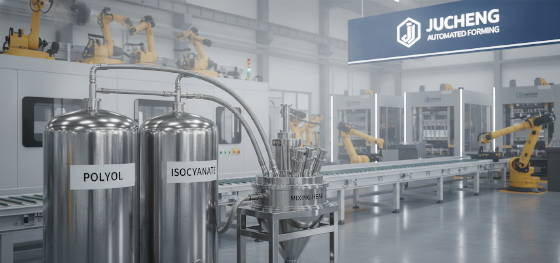
Reaction Injection Molding operates on the superior logic of thermoset chemistry. Instead of melting plastic, we mix two low-viscosity liquid components—Polyol and Isocyanate—inside a high-speed impingement mixing head. This mixture is injected into the mold as a liquid with the consistency of warm motor oil. Once inside, these two liquids undergo a rapid chemical reaction that builds the material and the part simultaneously. This is an exothermic reaction that creates a 3D cross-linked molecular network. Unlike thermoplastics, which are held together by weak physical bonds, RIM parts are held together by strong, covalent chemical bonds. This cross-linked structure is permanent; it will not melt, and it will not creep under load. Because the material is born at low pressure, there is virtually zero residual internal stress. A RIM part that is one meter long will stay perfectly flat and dimensionally stable for its entire service life. At Jucheng Precision, we calibrate the mixing ratios and the mold temperatures to control the "Gel Time" and "Cure Time" down to the second, ensuring that the crystalline structure of your part is optimized for the brutal mechanical realities of the automotive and medical sectors.
One of the most powerful aspects of RIM is its ability to act as a "material chameleon." Because we are working with liquid resins, we can adjust the internal chemistry to mimic the properties of nearly any production-grade polymer. Many engineers worry that by moving away from traditional injection molding, they are sacrificing the familiarity of ABS or Polypropylene. The reality is that JUCHENG’s palette of Reaction Injection Molding materials offers performance profiles that often exceed standard resins.
We utilize high-fidelity polyurethane systems from industry leaders like Hei-Cast and Axson to deliver specific mechanical results. For medical device enclosures that must be cleaned with aggressive alcohols hundreds of times, we provide a Simulation ABS that offers exceptional chemical resistance and high-gloss aesthetics. For automotive bumpers or industrial fenders that must absorb massive impacts without shattering, we utilize Simulation PP/PE grades that offer incredible elongation and toughness. We even offer "Structural Foam" variants, where a chemical blowing agent creates a part with a hard, dense outer skin and a lightweight, cellular core. This provides an extraordinary stiffness-to-weight ratio, allowing us to produce massive panels that are rigid enough for heavy machinery but light enough for a single technician to install. By tuning the "B-Side" chemistry of the polyol, we can adjust everything from the Shore hardness to the UV stability of the part. You aren't just choosing a plastic; you are engineering a material that is tailor-made for your product's survival.
The geometry of a mold is the ultimate governor of part quality. In the high-pressure world, mold design is an exercise in defensive engineering. You are building a steel fortress to contain a violent explosion of molten resin. In Reaction Injection Molding, the philosophy is different. We are engineering a vessel for a chemical flow. Because the internal pressures remain low, the primary requirement for the tool is not raw mass, but precision of thermal management and surface integrity. At Jucheng Precision, we utilize high-grade aluminum alloys for the majority of our RIM projects. Aluminum offers a thermal conductivity that is nearly four times higher than tool steel. This allows us to maintain a perfectly uniform temperature across a massive mold face, which is essential for ensuring the polyurethane reaction occurs at the same rate in every corner of the cavity.
The use of aluminum also accelerates the cnc machining process. We can mill complex geometries, deep cooling channels, and intricate textures into an aluminum billet much faster than we could with hardened steel. This translates to a massive reduction in lead time. While a high-pressure steel mold might take three months to deliver, a precision aluminum RIM mold can be ready for the first shot in as little as three or four weeks. This speed is vital for the medical and EV sectors, where being first to market is the primary driver of success. Furthermore, aluminum molds are far easier to modify. If a design revision occurs after the first prototype run, we can often weld and re-machine the aluminum tool to accommodate the change. This flexibility is impossible with hardened steel. By choosing low-pressure tooling, you aren't just saving money; you are buying the ability to iterate at the speed of modern innovation. We treat the mold as a precision instrument, ensuring that the parting lines are tight and the ejector pins are seamless, delivering parts that require minimal secondary cleanup.
A raw part is rarely the final part. In the medical and consumer product sectors, the "touch" and "look" of an enclosure are what communicate the brand's quality to the end user. RIM parts have a natural skin that is dense and smooth, but to achieve a true Class-A finish, professional post-processing is mandatory. At Jucheng Precision, we don't consider the job finished until the surface meets your exact aesthetic and functional requirements. Polyurethane is an exceptionally receptive substrate for secondary finishes. Unlike many thermoplastics that require aggressive chemical priming, RIM parts bond naturally with high-performance urethanes and epoxies.
We offer a comprehensive suite of finishing options in-house. This includes professional painting with custom color matching to any RAL or Pantone specification. We can achieve everything from a soft-touch matte finish that feels like leather to a high-gloss metallic finish that mimics cast aluminum. For medical enclosures, we apply antimicrobial coatings that stand up to the rigors of hospital sterilization. For electronic systems, we provide internal EMI/RFI shielding by spraying the interior of the housing with conductive copper or silver-based coatings. We also handle the fine details, including silk-screening, pad printing, and laser marking for permanent logos and safety warnings. This integrated approach ensures that when you receive a RIM enclosure from JUCHENG, it is ready for final assembly. You eliminate the risk of a third-party paint shop ruining your precision parts with uneven thickness or poor adhesion. We manage the entire visual lifecycle, ensuring that the "first impression" of your product reflects the engineering excellence within.
In the aerospace and healthcare worlds, a part is only as good as the data behind it. Manufacturing a massive RIM housing is a technical feat, but validating its integrity is a regulatory mandate. At Jucheng Precision, we have centered our quality ecosystem around the most demanding global standards. Our facility is ISO 9001 and IATF 16949 certified, which means our process control is not an opinion—it is a documented system. For our medical and automotive clients, this certification is the primary reason they trust us with their high-value assemblies. It means every chemical batch is verified, every mix ratio is logged, and every part is traceable.
We utilize large-format Coordinate Measuring Machines (CMM) to verify the dimensional integrity of our RIM components. On a part that measures over one meter, managing thermal expansion and warpage is critical. We measure our parts in a climate-controlled environment to ensure the data is objective and unassailable. We also perform destructive and non-destructive testing, including cross-section density checks and adhesion tests for coatings. If your part is destined for a mission-critical application, we provide full PPAP (Production Part Approval Process) documentation and FMEA (Failure Mode and Effects Analysis) reports. We don't just "hit go" on a machine; we validate a process that ensures the 1,000th part is a perfect clone of the first. This technical transparency is what separates a world-class RIM provider from a simple prototype shop. We provide the paper trail that allows your engineers to sleep at night, knowing that their structural plastic components are as resilient as the designs intended.
Ultimately, the decision to utilize Reaction Injection Molding is a move toward industrial pragmatism. It is the acknowledgement that in the middle-market of manufacturing—where volumes are too high for 3D printing but too low for 100,000-dollar steel molds—there is a superior way to build. RIM offers the structural toughness of fiberglass without the labor-intensive hand-layup. It offers the precision of injection molding without the high-pressure price tag. It offers the complexity of metal casting but at a fraction of the weight. It is the "Swiss Army Knife" of large-format plastic forming.
At Jucheng Precision, we act as the bridge between your digital CAD vision and a physical, market-ready product. Our expertise in cnc machining process optimization ensures that your RIM tooling is efficient, and our mastery of polyurethane chemistry ensures your parts are invincible. We invite you to challenge our engineering team. If you have a massive enclosure that you've been told is "too expensive to mold," let us perform a technical DFM review. We often find that by converting a heavy metal fabrication or an expensive assembly of smaller plastic parts into a single, structural RIM housing, we can reduce your total project cost by 30% to 50%.
Success in the modern market requires the ability to scale without the anchor of excessive capital risk. RIM provides that agility. It allows you to launch with confidence, knowing that your parts carry the IATF 16949 pedigree of quality. Don't let the high cost of traditional molding stifle your engineering ambition. Experience the clarity and the capability that specialized reaction injection molding can bring to your next mission-critical project. Contact Jucheng Precision today and let our engineers help you build a bigger, better, and more profitable physical reality.