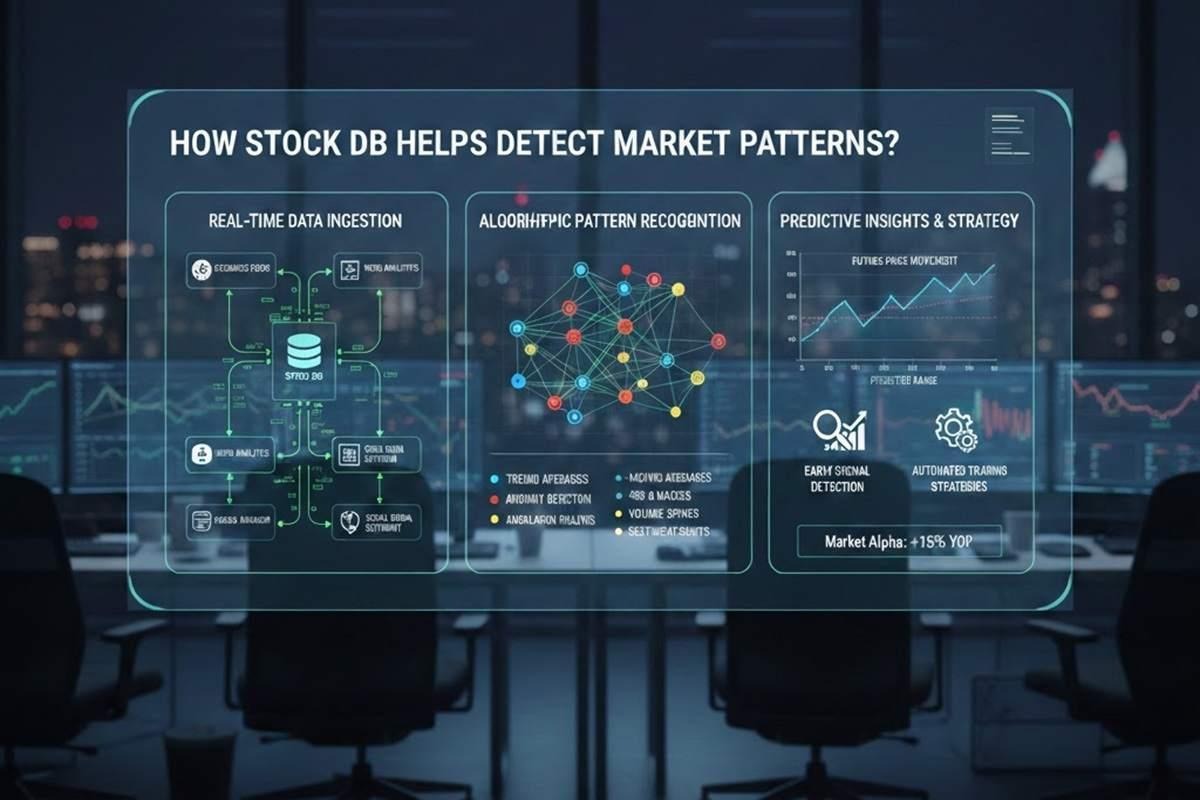
In modern financial markets, recognizing trends is essential for investors seeking profits. Stock databases, or Stock DB, organize vast amounts of market data efficiently. These platforms combine structured and unstructured information to reveal patterns that are otherwise difficult to detect. By using advanced analytical tools, Stock DB provides traders with insights that help them make smarter decisions.
Stock DB is more than just storage for stock prices and volumes. It integrates real-time feeds, historical records, and analytical algorithms. These features enable it to predict trends, spot anomalies, and generate alerts when market behavior changes. Investors can gain a competitive advantage by leveraging these capabilities effectively.
Stock DB identifies market patterns by collecting, organizing, and analyzing large datasets systematically. By examining historical trends, technical indicators, and correlations, it uncovers recurring behaviors. Algorithms within the system can detect formations invisible to manual analysis. This structured approach provides reliable insights that support informed trading strategies.
The database uses predictive techniques and visualization tools to clarify complex patterns. By combining past trends with real-time monitoring, it anticipates market movements efficiently. Traders gain actionable information to respond quickly to volatility. Stock DB therefore becomes both an analytical and strategic asset for market participants.
Organized data is the foundation for effective pattern detection. Stock DB gathers information from exchanges, financial reports, and news sources consistently, and platforms like https://dbclick24.com/ provide tools to classify data by stock, sector, price history, and trading volume to ensure structured analysis. Accurate organization reduces complexity when analyzing market trends across multiple assets.
By maintaining structured datasets, Stock DB allows quick retrieval and comparisons across timeframes. Investors can focus on trend identification rather than data cleaning. This organization also supports automated algorithms that rely on consistent input formats. Ultimately, precise data organization enables more reliable pattern recognition.
Historical market data is essential for recognizing recurring trends. Stock DB stores years of trading information, including price movements, volumes, and sector performance. Analysts can study past reactions to global events and policy changes to anticipate future behaviors. These insights form the basis for trend prediction and strategic planning.
By examining historical cycles, traders detect resistance and support levels, trend reversals, and seasonal fluctuations. Historical analysis highlights patterns invisible in short-term data. It allows investors to forecast market movements with greater confidence. Stock DB makes this analysis faster and more accurate through automation.
Technical indicators are vital tools integrated within Stock DB. Moving averages, RSI, MACD, and Bollinger Bands reveal momentum, overbought or oversold conditions, and potential trend reversals. These metrics provide measurable insights into stock performance. Traders can combine indicators to improve pattern detection accuracy.
Stock DB continuously calculates indicators across multiple stocks and timeframes. It helps visualize trends and identify trading opportunities. Using technical indicators with historical data enhances predictive modeling. Investors benefit from structured signals to inform decisions efficiently.
Pattern recognition algorithms analyze price and volume movements to detect recurring formations. Examples include head-and-shoulders, double tops, and triangles. Machine learning improves their accuracy by learning from historical successes and errors. These algorithms identify subtle patterns undetectable to manual analysis.
Advanced recognition methods also adapt to changing market conditions. They detect anomalies, reversals, and trend confirmations automatically. By integrating algorithmic results with visualization, Stock DB presents actionable insights. Traders can act promptly, relying on both historical data and real-time signals.
Market dynamics change constantly, making real-time monitoring essential. Stock DB tracks live prices, news feeds, and trades continuously. Alerts are triggered when patterns emerge or thresholds are crossed. This ensures traders respond to opportunities without delay.
Combining historical patterns with live updates allows proactive decision-making. Investors can act on short-term movements confidently. Real-time monitoring reduces the risk of missing critical market events. Stock DB keeps traders informed with accurate and timely data.
Visual tools in Stock DB help interpret complex market patterns. Candlestick charts, line graphs, and heatmaps illustrate trends clearly. Visualization transforms raw numbers into digestible insights for investors. It highlights anomalies, correlations, and trend directions effectively.
Charts allow traders to compare multiple assets and timeframes quickly. Scenario simulations show potential market outcomes. By presenting patterns visually, investors make faster, more confident decisions. Stock DB turns data analysis into an intuitive, actionable process.
Correlation analysis identifies relationships between stocks, sectors, and indices. Stock DB measures positive and negative correlations to reveal dependencies. This analysis helps diversify portfolios, anticipate market ripple effects, and manage risk efficiently.
Understanding correlations allows traders to adjust positions strategically. Stocks influenced by similar factors can be tracked together. Pattern detection improves when relationships between assets are considered. Stock DB uses this insight to guide both investment and hedging strategies.
Predictive modeling forecasts potential market movements based on historical data. Stock DB applies machine learning to identify trends and probabilities of outcomes. Traders can simulate scenarios to test strategies before committing capital. These forecasts enhance decision-making under uncertainty.
While predictions are never certain, modeling provides a systematic framework for planning trades. It supports risk management by highlighting potential pitfalls. Predictive insights complement real-time monitoring and technical indicators. Stock DB thus combines data, analysis, and foresight effectively.
Custom alerts notify traders when specific patterns or conditions appear. Users can set thresholds based on price, volume, or technical indicators. Alerts reduce the need for constant monitoring and ensure timely responses to market changes.
These notifications allow investors to execute strategies promptly. They are customizable for risk tolerance, trading style, and asset focus. Custom alerts enhance efficiency and improve opportunity capture. Stock DB ensures traders stay informed without manual tracking.
Pattern detection in Stock DB supports risk management by identifying potential threats. By tracking correlations and anomalies, traders can adjust portfolio exposure. Stop-loss levels and asset diversification reduce vulnerability to volatility.
Effective risk management ensures long-term sustainability in trading. By combining alerts, predictive models, and historical insights, investors minimize losses. Stock DB empowers traders to balance profit potential with protection. It integrates analytics into strategic, risk-conscious decision-making.
DB Click offers databases that specialize in detecting market trends with remarkable accuracy. Their systems integrate real-time data, historical records, and advanced analytics to identify patterns reliably. Traders can trust these databases to highlight potential opportunities and risks quickly. Accuracy is enhanced by machine learning models that adapt to changing market conditions automatically. You can explore their offerings in detail at https://dbclick24.com/.
With DB Click, investors receive actionable insights without spending hours analyzing raw data. The combination of technical indicators, pattern recognition algorithms, and predictive modeling ensures dependable trend detection. Real-time alerts and visual dashboards simplify decision-making. Using their databases makes market analysis faster, precise, and highly reliable for strategic trading.
Stock DB transforms raw market data into actionable insights for pattern detection. It combines organized data, historical analysis, technical indicators, and algorithms to reveal trends. Traders gain a structured approach to identify opportunities and reduce uncertainty in decision-making.
From real-time monitoring to predictive modeling and custom alerts, Stock DB equips investors with essential tools. Its integrated features enhance efficiency, accuracy, and risk awareness. By leveraging these capabilities, traders can make informed choices in dynamic financial markets.