(Submitted photo)
Neighbors cite cut-through driving, inconsistent stop signs, and unimplemented study recommendations ahead of Wednesday public safety meeting
A serious crash on the Friday morning school run has reignited long-simmering anger in Lansdale’s West Ward neighborhood, where residents say speeding, cut-through traffic and a confusing patchwork of stop signs have made everyday walking and driving feel like a gamble.
Neighbors plan to pack Wednesday night’s Lansdale Borough Public Safety Committee meeting at 6:30 in council chambers to press the borough’s newly appointed police chief, Ryan Devlin, and committee members for answers and immediate enforcement and engineering changes.
Neighbors Dr. Karalyn Derstine and Sheldon C. Good drafted a petition to Devlin and disseminated it to the neighborhood. Read and sign the petition here.
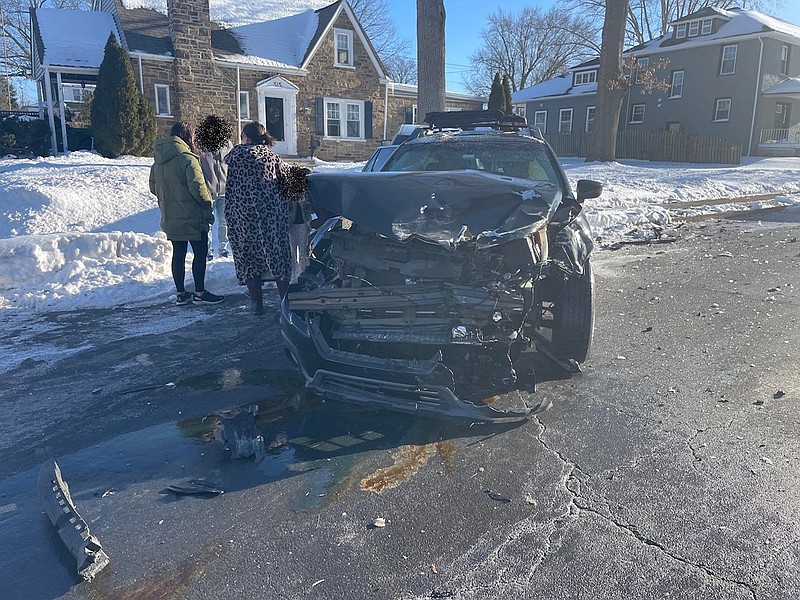
The push comes days after a collision at Delaware and Cannon avenues left a 10-year-old girl with a broken jaw in three places, requiring surgery, according to her mother’s account in a private Facebook neighborhood watch group.
Police had not filed charges against the driver in the Pennsylvania court system as of Monday morning, according to the Pennsylvania Judiciary Web Portal. The driver was arrested at the scene after allegedly fleeing after the collision.
Resident Shannon DeBellis, speaking for West Ward neighbors, said the community wants to come to the table ready to work with borough leaders, not against them.
“Because we are located between several main arterials that get congested with traffic, many folks driving in Lansdale cut through our neighborhood to save time,” DeBellis said in a statement, adding that inconsistent stop signage “does not follow a pattern,” which she believes contributes to crashes.
She told North Penn Now on Monday that residents hope to be “partners, not antagonists” as council and the new chief weigh next steps.
The neighborhood petition itself begins with congratulations to Devlin’s appointment to the new role of chief after 30 years with the department.
“As residents of Lansdale’s West Ward neighborhood, we are particularly concerned with what we perceive as a lack of sufficient action to address the urgent, ongoing traffic and safety issues within our neighborhood,” wrote Good and Derstine in the petition. “We have repeatedly asked for more predictable four-way intersections, more stop signs, better sightlines, a fundamental shift toward truly prioritizing the safety of pedestrians and cyclists, not just vehicles, and more. We received a Traffic Study whose only recommendation for the West Ward was to install six speed humps.”
The petition went on to suggest that while speed is indeed an issue in the neighborhood, the traffic study did not address and otherwise minimized most of the other safety issues experienced by neighbors daily.
“As the residents who live here, we feel that our concerns have often been dismissed – before, during, and after the study. PennDOT’s data shows that not only have accidents become increasingly common in recent years, there has been a disproportionate increase in major accidents involving injury, death and/or towed vehicles,” said the petition. “Meanwhile, solutions from the Borough have been lacking: Curbs have been left unpainted, speed humps not installed, and enforcement has seemingly dwindled since public outcry waned. This inaction leaves residents to believe our safety and wellbeing is not a priority.”
Unfortunately, any traffic data fails to show another major issue – near-misses.
“We entrust you with the health, safety, and wellbeing of all residents of our community. We wish to collaborate with you to ensure our streets are safe for all, including the hundreds of children and families that walk or ride bikes to school every day in the West Ward, and those who don’t because they, understandably, do not feel safe to do so,” stated the petition. “We want to work with you to not only think about the wants of individuals using our neighborhood to save time and avoid traffic but also the needs of neighborhood residents who desire consistent and enduring public safety.”
A neighborhood built for walking, residents say, but designed around cut-through traffic
The West Ward includes York Avenue Elementary School, residential blocks dense with street parking, and well-used neighborhood routes, such as Cannon and Delaware avenues, that residents say should be predictable for children, families and pedestrians. Instead, neighbors argue that drivers trying to bypass congestion on major roads treat local streets like shortcuts.
In her statement, DeBellis said residents have been raising concerns with borough council and police for years, and that a borough-approved traffic study in 2024, with findings shared publicly in 2025, has not yet led to changes residents can feel on their blocks.
“This is not just an issue of car accidents. It is also a problem for pedestrians,” DeBellis said, referencing the death of 71-year-old Diane Kopena struck last spring in the West Ward.
Crash that injured child becomes a breaking point
In the private West Ward Neighborhood Watch group, mother Kristen Ortiz identified herself as the driver in Friday’s crash and said she was traveling the speed limit when another vehicle “blew through the stop sign on Delaware and Cannon” at a high rate of speed. She said her fifth-grade daughter suffered three jaw fractures and underwent surgery.
“I do not want any parents or children to go through what we have,” Ortiz wrote, adding that neighbors helped her family immediately after the collision.
Residents are circulating a call to action urging neighbors to attend Wednesday’s meeting and request steps such as four-way stop signs, speed bumps, speed limit enforcement and curb painting.
What the traffic study actually found in the West Ward
The borough’s traffic calming study, completed by Pennoni Associates and submitted in February 2025, focused on three study areas, including the West Ward. The study’s executive summary notes the West Ward was identified by the Public Safety Committee as an area with major perceived speeding or cut-through concerns, and that a public meeting on Oct. 30, 2024 drew feedback from more than 100 residents.
Cut-through traffic signals on key West Ward streets
One of the study’s more telling data points is its comparison of estimated “local trip generation” versus actual weekday traffic counts, producing an “estimated excess (surplus) traffic” figure that can indicate cut-through volume.
In the West Ward, the study estimated:
Those numbers match what residents describe an internal neighborhood grid being used as a pressure-release valve when surrounding arterials back up.
Speeds: not always “wild,” but still dangerous at intersections
The study’s speed tables show West Ward side-street averages generally near the posted 25 mph limit, with 85th percentile speeds (a common traffic engineering benchmark) pushing into the upper 20s on some streets.
The report also includes “speed enforceability” data, reflecting Pennsylvania’s limitations on certain local speed enforcement tools and the reality that, for an enforceable speeding offense, a driver often must be at least 10 mph over the limit.
On several West Ward streets, the share of vehicles traveling more than 10 mph over the speed limit was relatively low:
Residents say that does not tell the whole story. Even “near-the-limit” speeds can be catastrophic at a stop-controlled intersection when sightlines are blocked by parked cars, drivers misread which direction stops, or someone simply runs a sign.
What the study recommended for the West Ward
Pennoni’s recommended approach for the West Ward was straightforward: install one speed hump on each of several key roadways, placed roughly midway between Valley Forge Road and Cannon Avenue, to reduce speeds and make cut-through routes less appealing.
The executive summary specifies the target corridor more broadly, recommending one speed hump between Salford Avenue and Mitchell Avenue on each of these streets:
That list overlaps heavily with the streets West Ward neighbors say are most impacted: Cannon, Delaware, Perkiomen, West Mount Vernon, Derstine, Columbia, Towamencin, Richardson, Mitchell, Salford and York.
How much would it cost?
A preliminary cost slide in the study materials lists speed hump/speed cushion costs at $3,000 to $5,000 per location, with other tools like curb extensions/bulb-outs priced higher depending on design and drainage needs.
Residents want four-way stops, and say the current pattern is a trap
While the study emphasizes speed humps, many West Ward residents are also pushing hard for additional four-way stops, saying the borough’s current two-way stop layout is inconsistent and “dangerously non-intuitive,” forcing drivers to alternate between stopping and going block to block.
In a June 2023 letter to the editor, Perkiomen Avenue resident Robert Kirkner wrote that the arrangement of two-way stops is inconsistent, and that heavy street parking can block sightlines near intersections, making crossings risky for drivers and pedestrians.
Kirkner’s family is also referenced in the neighbors’ latest statement. His spouse, Marianna Kirkner, believes, “This is a walkable neighborhood but their priority is the cars that are cutting through the neighborhood. They need to shift their focus on us as pedestrians and residents.”
What neighbors are asking for now
In addition to showing up Wednesday, residents say they want a clear, public plan with deadlines. Their requests include:
Residents also want borough leaders to explain, publicly, how decisions get made when a crash leads to citations, charges, or neither, especially after last year’s fatal pedestrian collision in the same neighborhood.
The Lansdale Borough Public Safety Committee meeting is at 6:30 p.m. Wednesday in council chambers at Lansdale Borough Hall, 1 Vine St. The full council work session begins at 8:30 p.m. in the main meeting room.