A grease trap that is working properly is invisible to everyone in a commercial kitchen. Nobody thinks about it. Drainage flows freely, there are no smells, and service continues without interruption.
The moment it stops working properly, however, it becomes very hard to ignore.
Understanding how grease trap cleaning actually works — what happens during a proper service and why each step matters — helps business owners make better decisions about maintenance before problems develop.
Before getting into the cleaning process, it helps to understand what the trap is actually doing.
Wastewater leaving a commercial kitchen carries fats, oils and grease, collectively referred to as FOG, along with food solids.
The grease trap intercepts this wastewater and uses the difference in density between grease and water to separate them.
Grease floats to the top, food solids sink to the bottom, and relatively clean water passes through to the sewer.
Over time, the accumulated FOG and solids reduce the trap's capacity to separate effectively.
When the trap reaches roughly a quarter of its capacity with grease, the separation process deteriorates and FOG begins passing through into the sewer system.
That is the point at which cleaning becomes necessary, though in practice a regular schedule is far preferable to waiting for performance to drop.
Before any cleaning begins, the water supply to the trap is shut off. Dishwashers and sinks connected to the unit need to be turned off to prevent the trap from refilling mid-service.
Professional technicians will also set up appropriate containment around the work area, as the process generates waste that needs to be managed carefully from the outset.
Grease trap waste produces hydrogen sulphide gas as organic material decomposes, which means ventilation and appropriate protective equipment are not optional considerations.
Anyone working on or near an open trap should be properly equipped before the lid comes off.
The lid is removed carefully, often requiring a pry bar or wrench depending on the trap type and how long it has been since the last service.
Before any material is removed, a professional will measure the depth of the FOG layer and the solids layer at the bottom.
This measurement is important for two reasons.
It gives a clear picture of how the trap has been performing since its last clean, and it provides documentation that some water authorities require as part of ongoing compliance.
The condition of internal components is also assessed at this stage. Baffles, screens and inlet and outlet pipes are checked for damage, corrosion or blockage before the removal process begins.
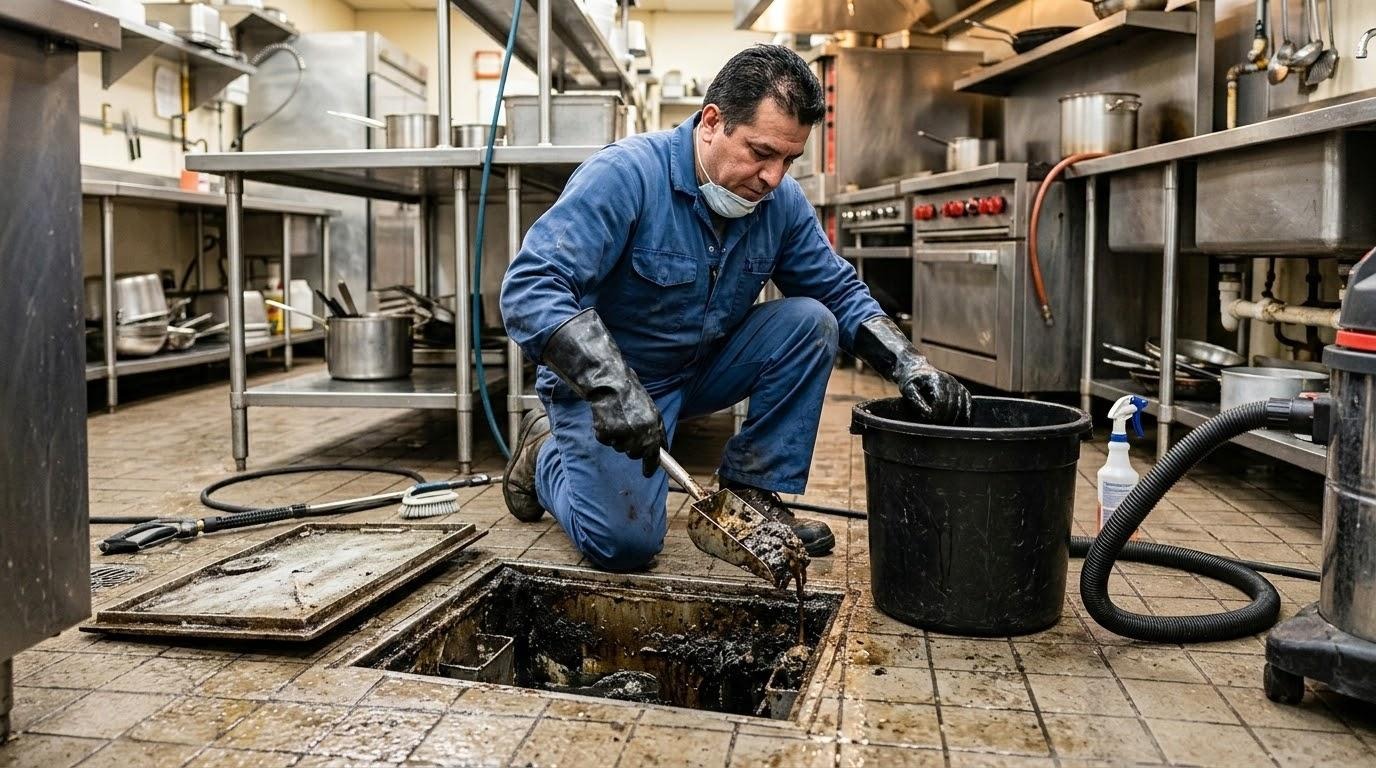
The floating grease layer is removed first, typically using vacuum equipment on larger commercial traps or by manual scooping for smaller units.
This material goes directly into sealed containers for compliant disposal and is never returned to any drain or waste stream that connects to the sewer.
Once the grease layer is cleared, the remaining water and food solids are pumped out. Attempting to dispose of this liquid down a drain is a common and costly mistake.
Untreated grease trap waste must be transported to a licensed facility — it cannot simply be discharged into the wastewater system it was designed to protect.
Once the trap's been emptied, it's time to get to the inside surfaces.
Baffles, walls and the lid all get a good scrape to get rid of any stuck on grease residue, then are given a good scrub with warm water and some tough detergent. It's a bit of a litmus test, really - does the service provider actually do a thorough job or just slap the trap back together.
If the trap's been pumped but hasn't been properly scrubbed, it's only a matter of time before you start getting issues with odour and performance. Conversely, one that's been good and properly cleaned will keep on trucking long after others have started to struggle.
Any components that got yanked out during inspection also get scrubbed down before being put back in service.
Parts that get damaged during this process really should be junked, rather than being put back in the mix - a compromised baffle or cracked screen will make the whole trap underperform, no matter how well everything else is looked after.
Once the trap's all reassembled, give it a good blast of clean water to get rid of any remaining detergent and to check that the flow's working alright.
That water should move through the trap without any trouble. If you do find that it's sluggish after a good clean, the issue's probably with the drain lines rather than the trap itself, and is worth taking a closer look at.
The waste collected during the clean - FOG, solids, and the contaminated water - gets hauled off to a registered waste receiving facility by the service provider.
For people using a professional service, this bit's handled as part of the deal.
You'll usually get documentation from your service provider confirming how much waste was removed and what happened to it, which is useful for keeping an eye on compliance records.
Depends on how busy the kitchen is, and what sort of cooking's going on. If you're a high-volume operation with a deep fryer, you might need to get your trap serviced every two to four weeks.
Smaller places with lighter grease loads can sometimes get by on a monthly or quarterly schedule.
A pretty good benchmark used across the industry is to clean the trap before the FOG content gets to 25% of the trap's total liquid capacity.
Booking in with a professional service and getting them to come out on a regular basis takes the guesswork out of when to have it done, and ensures the trap gets properly serviced regardless of what's going on in the kitchen.