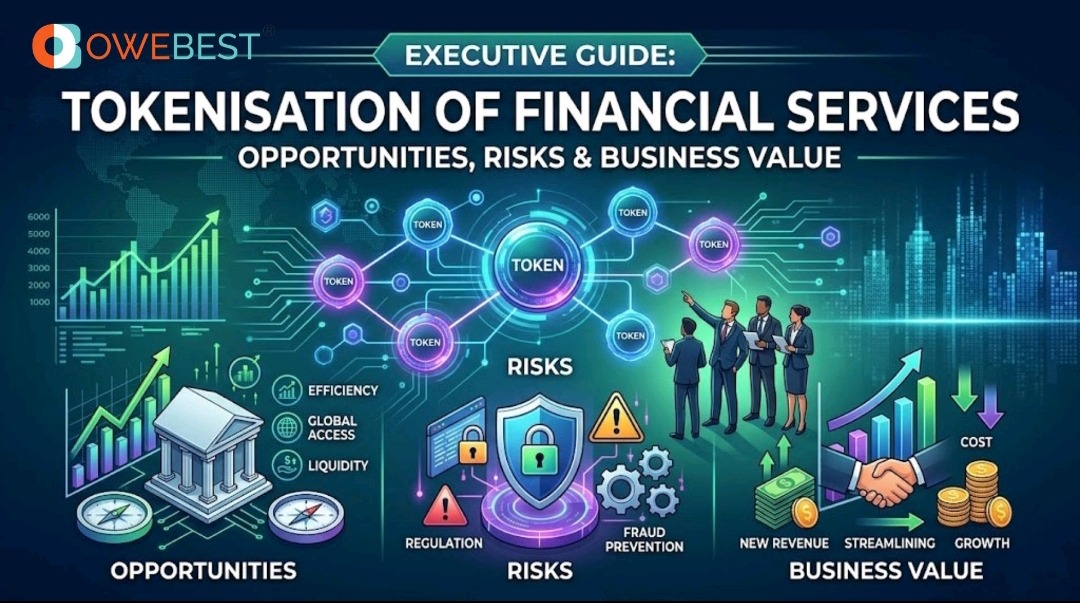
The concept of Tokenisation is significantly transforming financial services from static digitisation to modern blockchain-based infrastructure. In 2026, the global asset tokenisation market is already estimated to surpass $3 trillion, growing at over 40% CAGR, mainly driven by institutional adoption and regulatory clarity.
However, for financial companies, tokenization is not about experiments, but rather a strategic method to improve liquidity and reduce operational friction. Working as a cryptocurrency development company, Owebest Technologies works with both startup and enterprise-level fintech companies as well as financial institutions to build tokenised asset platforms. The team work on smart contract systems and develops scalable blockchain infrastructure that can be easily integrated with existing financial systems.
But, how does this shift actually look in reality, and how does it work? Let’s reveal.
Tokenization successfully converts both financial and real-world assets into digital tokens. It enables the best programmability, fractional ownership, and faster transactions while reducing the chances of overall reliance on intermediaries.
Key aspects of tokenisation include:
In 2026, tokenization has strongly evolved beyond the concept of cryptocurrencies and is now increasingly embedded into financial ecosystems. With this aim, it is helping financial institutions build faster, transparent, and future-ready financial infrastructures.
Beyond the concept of theory, tokenization has already been implemented in multiple ways. Currently, financial institutions, including global banks, government asset managers, and infrastructure players, are already experimenting with this concept, or some are actively adopting the latest tokenized models.
However, for organisations evaluating tokenisation strategies, understanding the cost to build cryptocurrency infrastructure also becomes an important part of early planning.
Financial institutions are strongly developing digital representations of cash. These allow them to move seamlessly on multiple distributed networks. Such on-chain money can streamline:
By reducing the chances of friction and enabling near instant transfers, tokenized cash has the strong potential to enhance payment and settlement efficiency.
Several government bodies and corporate issuers have already begun experimenting with blockchain-based issuance of proper bonds and debt securities. Furthermore, some key advantages include:
Integrating these strategies helps your business to reduce the chances of overall administrative complexity.
Real estate tokenization also involves dividing ownership of large physical assets into smart digital tokens. These models also assist by offering:
It enables wider investor participation without requiring full ownership of a property.
While tokenisation is already discussed in the context of innovation, its real value lies in the primary and practical efficiencies. A cryptocurrency development company helps to bring the concept of tokenisation to different financial markets and asset management processes:
Tokenisation enables high-value or traditionally exclusive assets that are divided into smaller and more affordable units. This can expand participation among retail investors.
Digital tokens can be easily structured, and they are also accessible across borders. These allow a wider investor base to participate in proper compliant offerings.
Tokenisation can successfully streamline different processes by minimising the need for paperwork. This also reduces the chances of dependency. This also lowers the chances of reconciliation-related workloads.
Tokens can also be incorporated in some predefined rules using smart contracts. This also enables some automated functions such as -
These programmable controls can also successfully help strengthen risk oversight. This reduces the chances of manual intervention while still functioning within the applicable regulatory framework.
Despite its significant benefits, tokenization has introduced different regulatory, technological, and certain operational risks. Even after knowing the cost to build cryptocurrency, financial institutions need to carefully manage these aspects. Also, they need to ensure proper compliance adoption.
Global regulations for multiple digital assets remain fragmented, creating certain compliance challenges. It also slows down adoption across different jurisdictions.
Digital assets are considered more vulnerable to hacking. This also increases the chances of smart contract vulnerabilities and cyber threats.
Existing banking infrastructure is often considered much outdated. Hence, it makes safe integration with different blockchain systems. A cryptocurrency development company can help in this case.
Digital asset markets are volatile. This also affects investors' confidence while slowing down the mainstream adoption.
Lack of certain standardised protocols across different blockchain networks limits seamless asset transfer. This also affects better scalability.
Defining ownership rights and ensuring proper secure custody of tokenized assets. This is considered a key legal challenge.
A well-structured and proper implementation approach helps financial institutions successfully adopt tokenisation by aligning different strategies, technologies, compliance, and partnerships. At this stage, many enterprises also assess the cost to build cryptocurrency solutions to align technology investment with long-term business goals.
Start by identifying the most high-impact areas like payments, lending, or even proper asset tokenisation.
Start working closely with different regulators and adopt the best compliant frameworks.
Adopt many scalable, API-driven, and blockchain-compatible smart systems.
Implement advanced cybersecurity with the best risk management practices.
Once you get the idea of the cost to build cryptocurrency, you can move from pilot programs to proper enterprise-wide adoption.
Over the next few years, tokenization will likely become a vital part of financial markets. It is also expected to see -
Tokenization could fundamentally change the concept of how wealth is created, managed, and also transferred.
Tokenisation is significantly transforming financial services into transparent and programmable financial systems. As adoption is accelerating, tokenization has become a strategic necessity rather than an option. It offers significant business value through efficiency, innovation, and global reach.
Hence, if you are exploring tokenization, working with a team experienced in fintech-grade blockchain systems like Owebest Technologies can help you move from concept to a secure, scalable implementation faster than you think.
Understanding the secure architecture, greater compliance, and real-world integration, the team can help you achieve the best outcome with crypto and blockchain.