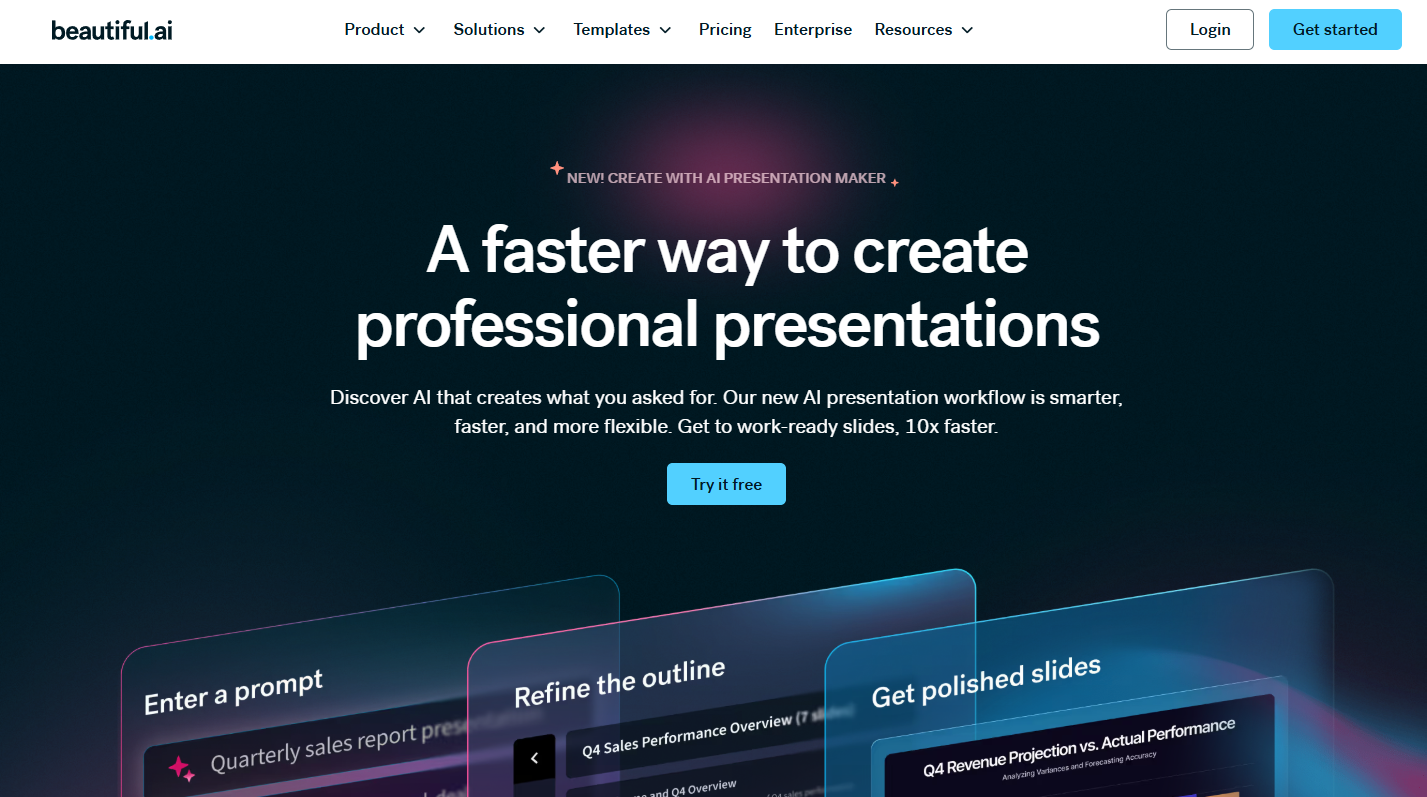
Beautiful.ai still does some things well.
It helps users make clean slides quickly. Its Smart Slides system keeps layouts tidy, and it can generate a decent first draft without much setup. That is why many teams still use it.
But in 2026, more people are asking a different question:
Is Beautiful.ai still worth the price?
For many users, the answer is getting harder to justify.
The issue is not only cost. It is cost plus limitations. Beautiful.ai can feel expensive when users also run into fixed templates, limited layout freedom, and a workflow that becomes less satisfying after the first draft. Alai’s current Beautiful.ai comparison makes the same point: Beautiful.ai still works, but its pricing and template system make it harder to recommend when better-fitting options exist.
That is why more users are now looking for alternatives.
They are not only trying to find the cheapest tool. In many cases, they want something that gives them:
This matters even more for client decks, strategy decks, pitch decks, and other presentations where final quality really counts.
Beautiful.ai’s main strength is also its biggest weakness.
Its Smart Slides system keeps everything structured. That helps when you want consistency and less manual work. But it also means the tool often decides too much for you. Each layout has fixed content slots, so users work inside the system instead of shaping the slide more freely. Over time, that can make different decks feel too similar.
Pricing makes the problem bigger.
Beautiful.ai offers a 14-day free trial, but not a permanent free plan. Its Pro plan starts at $12 per month billed annually or $45 per month billed monthly, and Team pricing goes higher. That becomes harder to justify when users compare it with tools that offer more flexibility, a free plan, or stronger editing for similar money.
So the switching decision usually comes from two things together:
That is why this is not only a pricing issue. It is a value issue.
You should seriously look at other options if any of these sound familiar:
If your main priority is strict structure and predictable formatting, Beautiful.ai can still make sense.
But if you want more freedom without losing speed, the shortlist changes quickly.
This comparison reflects the main reason users switch: they want a better mix of flexibility, workflow fit, and value.
Most people who switch are looking for one or more of these:
They want the slide to adapt to the message, not the other way around.
A lot of tools feel fine at the beginning. The real test is how easy they are to improve later.
Cleaning is not always enough. Many users want slides that feel more modern and less repetitive.
Users do not mind paying when the tool feels worth it. The problem starts when the workflow still feels limiting at a higher price point.
That is where the Beautiful AI alternatives conversation becomes stronger. People are not only asking, “What is cheaper?” They are asking, “What is better for the way I actually work?”
Alai is the strongest option here if your biggest problem with Beautiful AI is that it feels too rigid.
That is where the difference becomes clear.
Beautiful AI's Smart Slides use fixed content slots: one title position, one image spot, one text block per slide. You cannot put a process diagram next to a metrics panel. You cannot add a second content block without switching to a different template. Alai uses a responsive canvas instead. Add a new element and everything else shifts to accommodate it. Delete one and the remaining content rebalances. You build the layout around the message, not the other way around.
Why Alai stands out
The first reason is design quality.
Beautiful.ai renders flat: solid colors, no depth, no layering. The output looks clean but dated against tools built more recently. Alai applies gradients, shadows, and overlays that give slides visual weight. When I put the same content through both tools, Beautiful.ai produced a deck that looked like a filled-in template. Alai produced one that looked like something a designer had made a considered set of choices about.
The second reason is visual depth.
Beautiful.ai has no equivalent to Nano Banana Pro. Its slide generation is limited to standard text and image blocks: flat colors, no gradients, no layering.
Alai's Nano Banana Pro integration generates image-forward slides with real visual depth. Apply it during first draft generation as one of the four layout options, or convert existing slides using presets trained on 1,000+ presentations. The slides are theme-aware, fully editable, and mix cleanly with regular slides in the same deck.
The third reason is ongoing AI assistance.
Beautiful.ai's AI generates your first draft and then stops. Alai's AI stays active throughout editing. Convert a bullet list to a timeline, rewrite a section in a sharper tone, try a completely different layout for one slide without touching the rest. It also generates four layout options per slide rather than one, so if the first draft misses the mark, you are not starting over.
What to know before switching
If you are comparing Beautiful.ai alternatives, Alai is the clearest upgrade when you need design that holds up in client-facing work, layouts that flex around complex content, diagram support, and AI that keeps helping after the first draft.
Gamma is a strong option if your main goal is async sharing.
It is built for decks that get sent rather than presented live. Gamma's scrollable card format works naturally in a browser, loads cleanly on any device, and lets viewers move through content at their own pace. It also supports trackable sharing links so you know who opened what.
Its biggest strength is how well the format suits async consumption. That is why it works well for internal updates, client leave-behinds, and decks where the presenter will not be in the room.
The tradeoff is that Gamma's scrollable format is not traditional slides. If your audience expects a standard deck or you present live frequently, the format can feel like the wrong tool. For async-first workflows though, it is purpose-built for exactly that.
Canva makes sense when presentations are only one part of your work.
It is useful because many teams already use it for graphics, documents, branded content, and other design tasks. Canva has a free plan and paid Pro, Business, and Enterprise options.
Its biggest advantage is flexibility. If you want one platform for many kinds of content, Canva is easy to justify. It is especially practical for startup teams and marketers who want one tool for many design jobs, not just slides.
The tradeoff is that Canva is broad, but less presentation-specific. If you want a more presentation-first workflow with stronger control over how the deck evolves, other tools may feel sharper.
Plus AI is one of the best options if you already work in Google Slides or PowerPoint and do not want to leave them.
That is its biggest advantage. Plus AI is built directly for those workflows, and its pricing starts with a 7-day free trial. Basic starts at $10 per user per month billed annually.
Its biggest strength is workflow fit. A lot of teams do not want a completely new system. They want help inside the tools they already know.
The tradeoff is that Plus AI is better for improving an existing workflow than for replacing it with a more design-led standalone experience.
Pitch is a better fit for teams that build decks together.
It includes a free plan for individuals and small teams, plus paid plans for broader team use. That makes it useful when deck creation is shared across a startup team rather than handled by one person alone.
Its biggest strength is collaboration. If several people need to review, update, and reuse the same deck, Pitch can feel more natural than a tool built mainly around solo drafting.
The tradeoff is that Pitch is stronger for teamwork than for solving the exact Beautiful.ai problem of rigid design logic.
The best option depends on why you want to leave Beautiful.ai.
If your main problem is rigidity and you want stronger design quality with better editing control, Alai is the clearest option. If you want async deck creation, Gamma is a good fit. If you want one tool for slides and other visual work, Canva is practical. If you want to stay inside Google Slides or PowerPoint, Plus AI makes more sense. If collaboration matters most, Pitch is worth a closer look.
Ask yourself:
Those answers usually make the right choice much clearer.
Beautiful.ai can still work for some users.
But once the price feels harder to justify and the template system starts to feel too limiting, switching becomes easier to understand. Users are not only looking for something cheaper. They are looking for something that fits the way they actually want to build presentations.
Why are people looking for Beautiful.ai alternatives?
Usually for two reasons: pricing and rigidity. Many users like the clean output, but they want more layout freedom, easier editing, or better value for the price.
What is the best Beautiful.ai alternative for better design quality?
Alai is one of the strongest options if you want more flexible, modern presentation design and stronger editing control after the first draft.
Which Beautiful.ai alternative is best for Google Slides or PowerPoint users?
Plus AI is a strong fit for users who want AI help directly inside Google Slides or PowerPoint.
Is Gamma a good alternative to Beautiful.ai?
Yes, if your priority is async deck creation. If your priority is deeper presentation polish and more design control, Alai is a better fit.