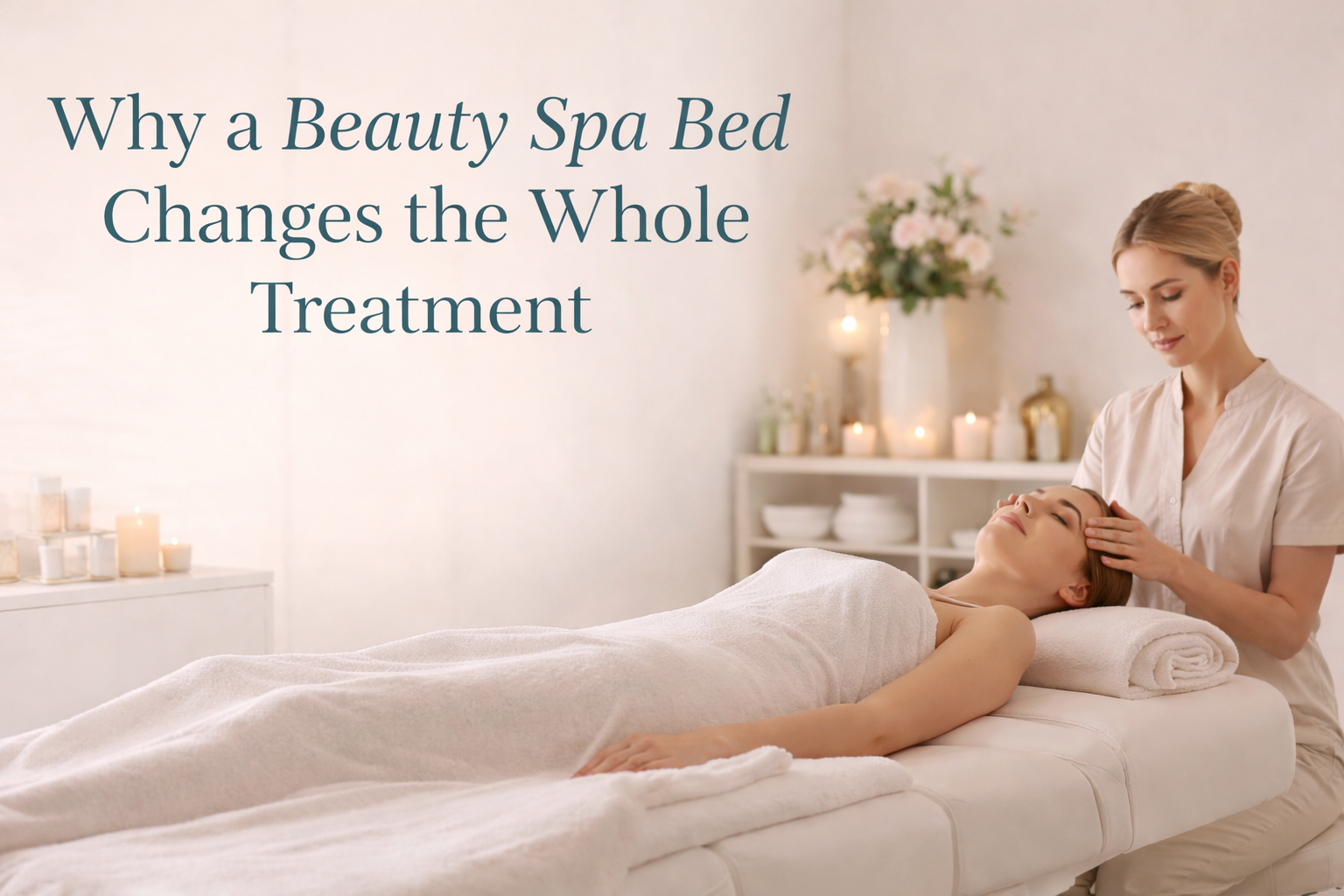
A beauty spa bed does more than give someone a place to lie down. It shapes how a treatment feels from beginning to end.
Most people do not think about that when they book an appointment. They think about the facial, the massage, the room, the products, maybe even the price. But once the treatment starts, the body notices things fast. If the bed feels wrong, the whole experience can feel less relaxing than it should.
That is one reason some treatments stay with people in a good way, while others do not. They are not bad, just not as good as they should have been.
Most clients do not leave a treatment room saying the bed lacked support or the angle felt wrong. They say something simpler.
They say they could not fully relax.
They say the treatment felt a little awkward.
They say something felt off, even though the service itself seemed fine.
That usually starts in the body before it turns into words.
A neck that never fully settles. A lower back that starts to feel tense halfway through. Arms that do not rest naturally. Small position changes that break the mood. None of these things sounds dramatic on its own, but together they can change the whole treatment.
This is where many people get misled.
A bed can feel soft at first and still become uncomfortable later. Real comfort is not just about softness. It is about support.
A good beauty spa bed helps the body stay in a natural position without asking for constant small adjustments. It supports the head, neck, back, and legs in a way that makes it easier to let go. That matters even more during longer treatments, when the body needs to stay still without slowly building tension.
This is why two treatments that seem similar on paper can feel very different in real life. One allows the body to settle. The other keeps asking it to work a little.
Two salons can offer the same kind of facial. The treatment menu may look almost identical. The room may even look just as polished in photos.
But once the appointment starts, the difference can become obvious.
One treatment feels calm, stable, and quietly well put together. The other feels slightly restless in ways that are hard to explain. Not terrible, just not as relaxing as expected.
That difference often comes down to a few details:
These are not flashy details, but they often decide whether a treatment feels polished or only looks polished.
A treatment is not only shaped by how the client feels. It is also shaped by how easily the therapist can work.
If the bed height is awkward, if the backrest does not adjust well, or if the setup does not match the service, the therapist has to work around those limits the whole time. That can affect the rhythm of the treatment, the quality of the movements, and the overall sense of calm in the room.
When the setup works well, the therapist can focus on the person instead of the furniture. And that usually shows.
Most clients never think about who supplied the bed in the room, and that is completely normal. What they do notice is whether the treatment feels calm, supportive, and easy to relax into. If one facial feels smooth while another feels awkward the whole way through, the difference often comes down to details people do not notice right away, like stability, support, adjustment, and whether the bed actually suits the treatment.
That is usually the point where the focus moves beyond the room itself and toward the equipment behind it. A beauty spa equipment supplier starts to matter because materials, consistency, support, and long-term performance all shape what the client eventually feels. In that deeper comparison, UniRelax is not just a brand label, but as part of a closer look at what actually improves the treatment experience.
People usually do not care about bed names at the beginning. What they notice first is the result. One treatment feels easy to enjoy. Another feels harder to relax into, even when the room looks just as nice.
The name only becomes useful when people start asking why that difference exists. That is when something like UniRelax beauty spa bed starts to mean more, because the question is no longer about appearance alone. It becomes a question of support, comfort, adjustment, and whether the bed actually helps the treatment feel better from start to finish.
Most clients will not remember the model of the bed. They may not remember the exact wall color either.
What they will remember is whether the treatment felt easy to enjoy.
They will remember whether their body settled in or kept resisting. Whether the whole experience felt smooth or slightly distracting. Whether the room looked good and felt good, or only did one of those things.
That is why a beauty spa bed changes the whole treatment. Not because it is the star of the room, but because it shapes the part people carry away with them: the feeling of how the treatment actually was.